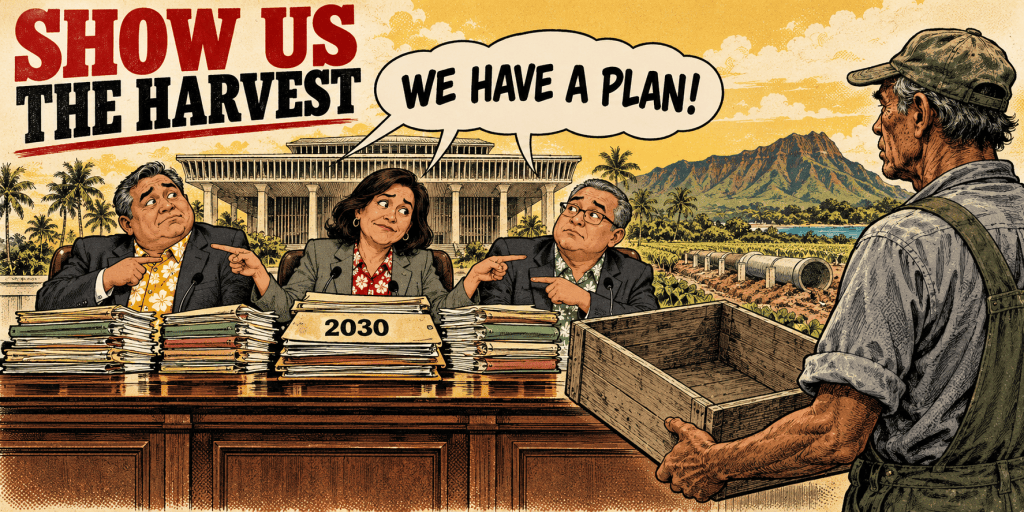
The state keeps promising to grow more food.
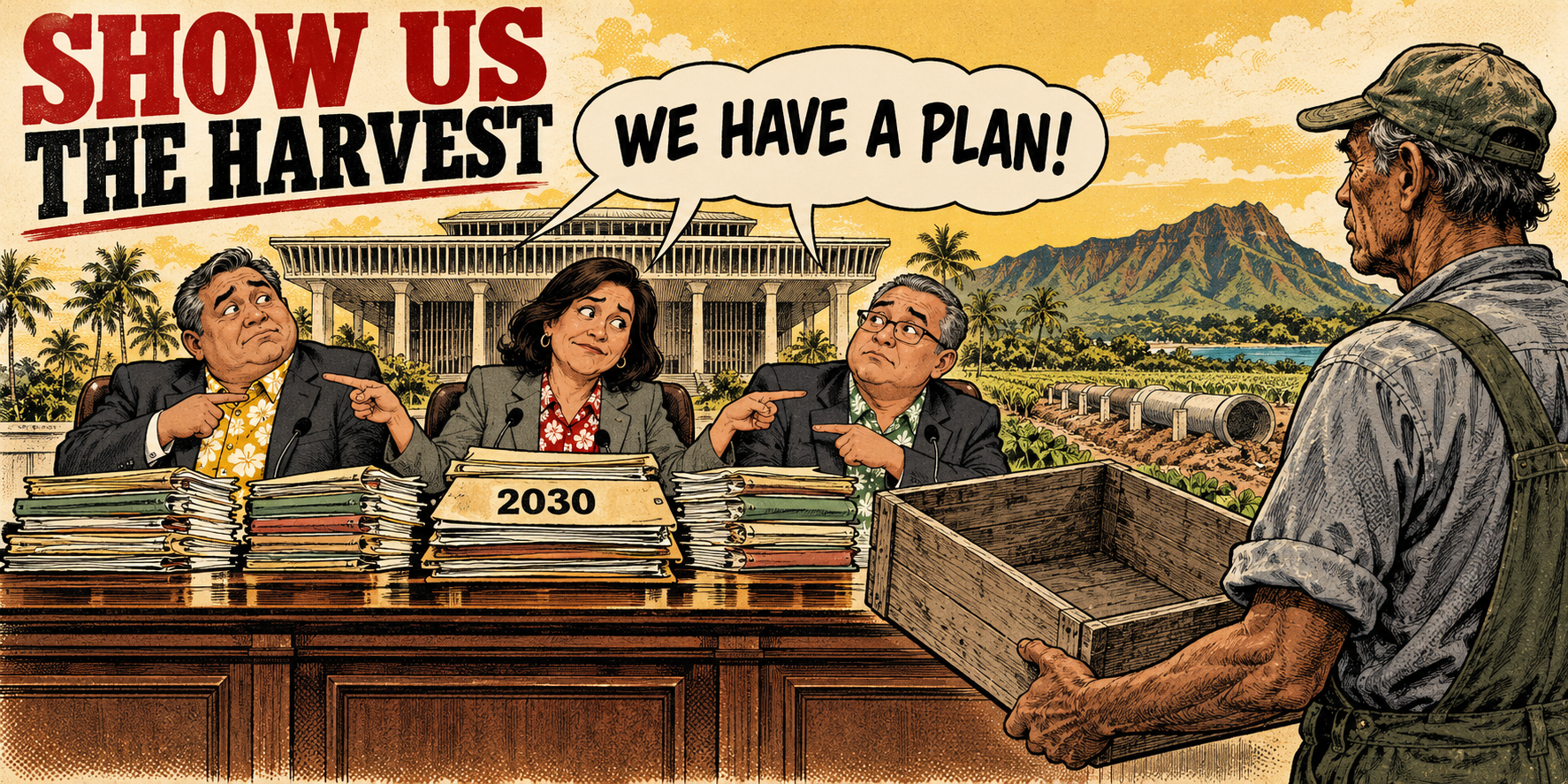
Its own auditors cannot report whether it is or not.
Hawaiʻi has become very good at announcing an agricultural future.
- We will grow more of our own food
- Support farmers
- Feed schoolchildren local produce
- Restore agricultural lands
- Build a diversified economy
And it will be regenerative, sustainable, even free of fossil fuels.
[Insert rainbow here.]
Every new administration gets another occasion to describe the future in which these things happen.
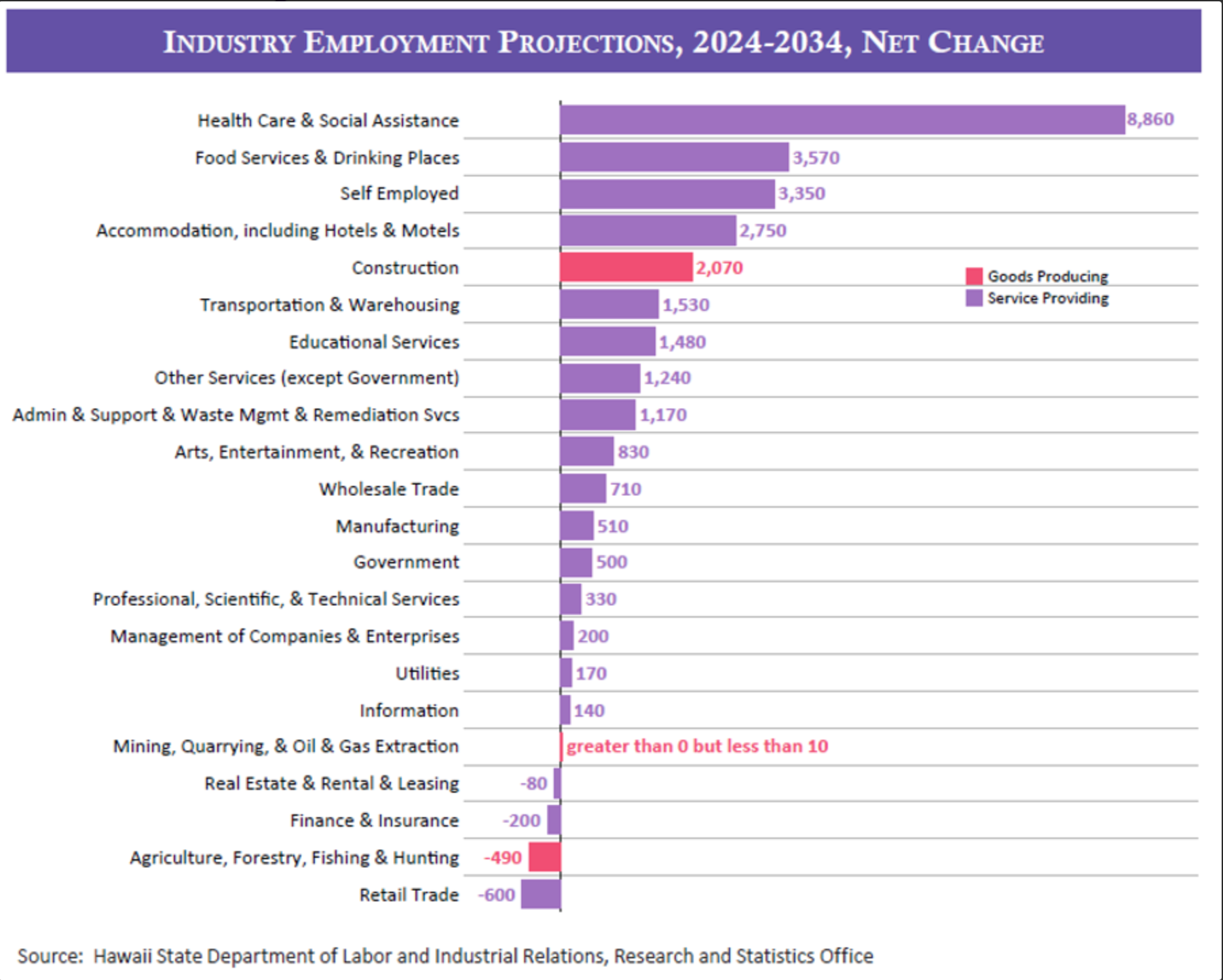
Meanwhile, the state’s labor department projects an 8.8 percent contraction in agriculture, forestry, fishing, and hunting employment through 2034 — about 490 jobs.
The latest agricultural census recorded fewer farms and fewer acres. And in March 2026, the state auditor reported that the Department of Education’s effort to put local food in school meals had proceeded “without structure, direction, or consequential actions.”¹
The promise to double local food production is older than any of these. It appears in the Hawaiʻi 2050 Sustainability Plan of 2008. David Ige campaigned on it in 2014 with a 2020 deadline, then moved that deadline to 2030 in September 2016 — four years before the first one would have come due. In July 2023, presenting Hawaiʻi’s Voluntary Local Review to the United Nations, Governor Josh Green’s office reported that the 2030 goal was not on track. Production of most crops was not rising fast enough.²
The deadline had already been moved once. The replacement was seven years out. The transformation remained undemonstrated.
That review contained an admission worth more than another sustainability speech: progress was difficult to measure because there was not enough funding for agricultural statisticians.
Consider what that means. The state committed itself to doubling production without paying for the work that would tell the public whether production was doubling. As with disaster recovery, no one is required to report the result against the promise.
A measurable promise needs a baseline, consistent annual reporting, and someone answerable for the distance between target and result. Without those, a deadline is just an appointment for another announcement.
The 2023 review made its own point for it. The most recent evidence it could cite was a 4 percent rise in farm numbers between 2012 and 2017. When the 2022 agricultural census arrived seven months later, it showed the opposite.
Between 2017 and 2022, Hawaiʻi’s farm count fell 10 percent, to 6,569. Land in farms declined from approximately 1.135 million acres to 1.053 million. The average producer was 60.7 years old.³
These figures need careful interpretation. A reduction in land reported by farms does not establish that every missing acre became a subdivision. Fewer agricultural jobs do not necessarily mean less production; equipment and improved methods can reduce labor requirements.
Sales rose 20 percent over the same period, reaching $673.8 million. That is real economic activity. But sales measured in dollars do not tell us how much food was grown, how much stayed in Hawaiʻi, or what farmers kept after expenses. Prices and product mix matter. Export crops and nonfood agricultural products can lift sales without adding a single meal to a local table.³
Agricultural revenue, food security, farm livelihoods, and environmental stewardship are not interchangeable accomplishments. Each requires its own evidence.
School meals are the clearest test, because the government is the customer.
Act 175 (2021) set two statutory targets: 10 percent of school food costs sourced locally by January 1, 2025, and 30 percent by 2030. The first was missed. Local purchasing measured 6.1 percent in 2022–23, fell to 5.4 percent in 2023–24, and reached roughly $5.03 million out of $77.36 million — 6.5 percent — in 2024–25. Three years, no trend.⁴
At that same budget, a 30 percent share would represent about $23.21 million in annual local purchases. The difference is roughly $18.18 million.
That is not a claim that local farms could supply it tomorrow. It is the size of the market the state has promised to create.
The March 2026 audit found no plan to create it. Auditors reported that neither the farm-to-school program nor the mandate was a departmental priority, and they questioned DOE’s own figures: schools had no centralized method for tracking local spending, and some cafeteria managers were recording food costs on index cards.¹
This is the missing-statistician problem one level down. The state sets a numeric target, then declines to build the counting apparatus that would make the number mean anything.
Farmers need orders they can plan around — what schools will buy, in what quantities, at what prices, and when. Kitchens need appropriate equipment and staff. Producers need processing, distribution, and help meeting food-safety requirements. A purchasing target becomes agricultural policy only when those arrangements move together.
There has been movement. In March 2026, DOE announced its first completed purchase under a new process connecting a small farm directly with a school: Kahaluʻu Elementary buying from Kupu Place under an arrangement permitting purchases below $5,000 across the school year.⁵ That is real progress. It also shows how much elementary institutional work remains undone in year five of a nine-year mandate.
Public land is another test. In 2021, the state auditor found that the Agribusiness Development Corporation had spent more than $76 million acquiring 3,542 acres while producing no meaningful agribusiness plan — its executive director told auditors such a plan was unnecessary, indicating that he carried it in his head.⁶
Land acquisition can protect future farming opportunities. But acquired land still needs water, access, infrastructure, workable leases, and viable producers. A purchase price cannot tell us whether those conditions exist. ADC has since documented efforts to improve its planning and administration; those efforts should be judged by completed infrastructure, acreage in production, and farms that survive.⁶
Nor is it accurate to say government spends nothing on agriculture. In July 2024, the administration announced that general funds for biosecurity and invasive-species mitigation had more than tripled, to $19.2 million. Protecting crops from destructive pests matters. But in the same month, the governor line-item vetoed $9.8 million from one of the two bills being celebrated.⁷ An announced figure is a ceiling, and an appropriation is permission to spend. The public still needs to know what was paid, what work was completed, and whether it worked.
Hawaiʻi needs an agricultural accounting that follows public money into the field: land made productive, irrigation restored, farmers paid, food harvested, local orders filled, and soil and water protected.
Until then, sustainability will remain easier to celebrate than to demonstrate.
Our farmers deserve dependable institutions. The public deserves verifiable results. Eighteen years is ample time to explain what we intend to grow.
Show us the harvest.
- Hawaiʻi Office of the Auditor, Audit of the Department of Education’s Efforts to Meet Its Mandate to Increase Locally Sourced Foods in School Meals, Report No. 26-08, March 2026.
- State of Hawaiʻi, Hawaiʻi 2050 Sustainability Plan (2008); “Ige sets new target date of 2030 for doubling food production,” Honolulu Star-Advertiser, September 11, 2016; Office of the Governor, “Recap of Governor Green at the U.N. Presenting Hawaiʻi Sustainability Update,” July 12, 2023.
- USDA National Agricultural Statistics Service, “2022 Census Profiles Hawaii Farmers and Agriculture,” February 13, 2024.
- Act 175, Session Laws of Hawaiʻi 2021; Hawaiʻi Department of Education, Annual Report on Local Meals and Farm to School Meals, November 2025, 1–3. Calculations hold total food expenditures constant.
- Hawaiʻi Department of Education, “Hawaiʻi Public Schools Advancing Farm-to-School Efforts with New Small Farm Partnerships,” March 4, 2026.
- Hawaiʻi Office of the Auditor, Audit of the Agribusiness Development Corporation, Report No. 21-01, January 2021; Report on the Implementation of State Auditor’s Recommendations 2019–2022, November 2024, 32–47; Agribusiness Development Corporation, board submittal package, May 21, 2026, 9–10.
- Hawaiʻi Department of Agriculture, “Hawaiʻi Department of Agriculture Announces Record Funding for Biosecurity Measures and Invasive Species Programs,” July 15, 2024; Act 230 and Act 231, Session Laws of Hawaiʻi 2024.
- Hawaiʻi Department of Labor and Industrial Relations, “State Releases Forecast for Jobs and Industries Through 2034,” July 28, 2026.
Please subscribe and share.
This is a no-profit enterprise. If you care to support this effort I accept payments at http://www.hawicenter.com/payments, via Zelle, and at CashApp $richardbodien.

Leave a Reply