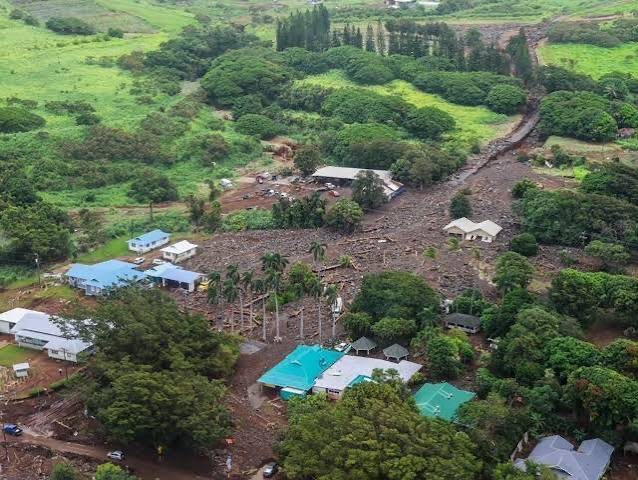
As of September 10, 2026, Kaʻū has made substantial progress restoring basic services after Lala, but permanent recovery remains unfinished. Water infrastructure, Nāʻālehu Elementary, damaged homes, and Nāʻālehu Cemetery remain major concerns. I found documented funding approvals and relief awards, but no consolidated accounting showing how much has actually been spent in Kaʻū or what proportion of rebuilding is complete.
Where operations stand
| Area | Latest verified status |
|---|---|
| Water | DWS reported September 4 that service had returned to 95% of Nā‘ālehu–Waiʻōhinu system customers. Approximately 60 accounts remained without household service in Waiʻōhinu Homestead and portions of South Point Road. The precautionary boil-water notice remains in effect. Mountain House Spring restoration requires access-road repairs, replacement pipelines, and structures carrying pipes over washed-out drainageways. No completion date was given. |
| Electricity | Hawaiian Electric reported August 31 that major system repairs were complete and customers who could safely receive service had been restored, with exceptions including Wood Valley and properties with access or electrical damage. Wood Valley requires rerouting lines because portions of the road washed away. |
| Roads | Main access to Kaʻū was restored by late August. Mālama Kaʻū’s September 5 update still reported damaged sections and alternating traffic on Highway 11. Restored access does not establish that permanent road repairs are complete. |
| Schools | Kaʻū High & Pāhala Elementary reopened August 31. Nāʻālehu Elementary students began returning to temporary classrooms at Kaʻū District Gym, on a staggered schedule. Repairs to their campus are expected to continue into October. Combined damage to the two schools is estimated at $2.3 million. |
| Nāʻālehu Cemetery | Recovery involves collecting displaced remains and personal objects, identification, and reunification with families. Federal mortuary specialists were requested. I found no verified completion date or final restoration budget. |
| Household relief | Community organizations continue supporting cleanup and basic needs. Nāʻālehu Hongwanji’s hub supplied up to 170 meals daily during the first two weeks; by early September, demand was shifting toward cleaning supplies and tools. |
What funding is documented
| Funding source | Amount and purpose | What the record establishes |
|---|---|---|
| Federal transportation emergency relief | $6 million, approved August 19 for storm-damaged transportation infrastructure. | Initial funding approval for Hawaiʻi; the announcement does not identify Kaʻū’s share, contractors, or payments to date. |
| FEMA emergency declaration | August 25 authorization for Hawaiʻi, Maui, and Honolulu counties: emergency protective measures, limited to direct federal assistance at a 75% federal share. | Access to federal personnel, equipment, and emergency support. This announcement does not authorize a general household rebuilding program or publish a dollar allocation. |
| Office of Hawaiian Affairs | $338,468.43 in existing funds and gift-card resources, prioritizing affected Native Hawaiian beneficiaries in Kaʻū. | Resources authorized and made available; the announcement does not establish the total delivered to beneficiaries. |
| Hawaiʻi Community Foundation | Published awards include $249,000 to Community First Hawaiʻi, $100,000 for ranching water assistance through Hawaiian Council, $100,000 to The Food Basket, and $27,800 for Kaʻū-area radio communications. | Named awards as of September 4, with stated purposes; these are not expenditure or project-completion reports. |
| USDA farmland recovery | Emergency Conservation Program applications opened September 1 and close October 30. Eligible work includes debris removal, fencing, land restoration, and erosion measures. | An available assistance program; I found no published Kaʻū total approved or paid. Hawaiʻi County FSA: 808-933-8334. |
| Maui County | $10 million for emergency repairs and operations passed first reading, according to September 8 reporting; estimated costs were exceeding $15 million. | Preliminary legislative approval, not verified final appropriation or cash disbursement. |
One potentially confusing point: the September announcement of FEMA Individual Assistance for Hawaiʻi County concerns the May 22 Kona earthquake. The governor explicitly distinguishes that declaration from Lala recovery. It should not be counted as Lala household assistance.
The principal accountability gap is now the connection between funding and results: amounts paid, recipients and contractors, homes made habitable, permanent infrastructure completed, and completion dates. The sources above document real work and relief, but they do not yet support a defensible total for “Lala recovery money spent in Kaʻū.”

Leave a comment