
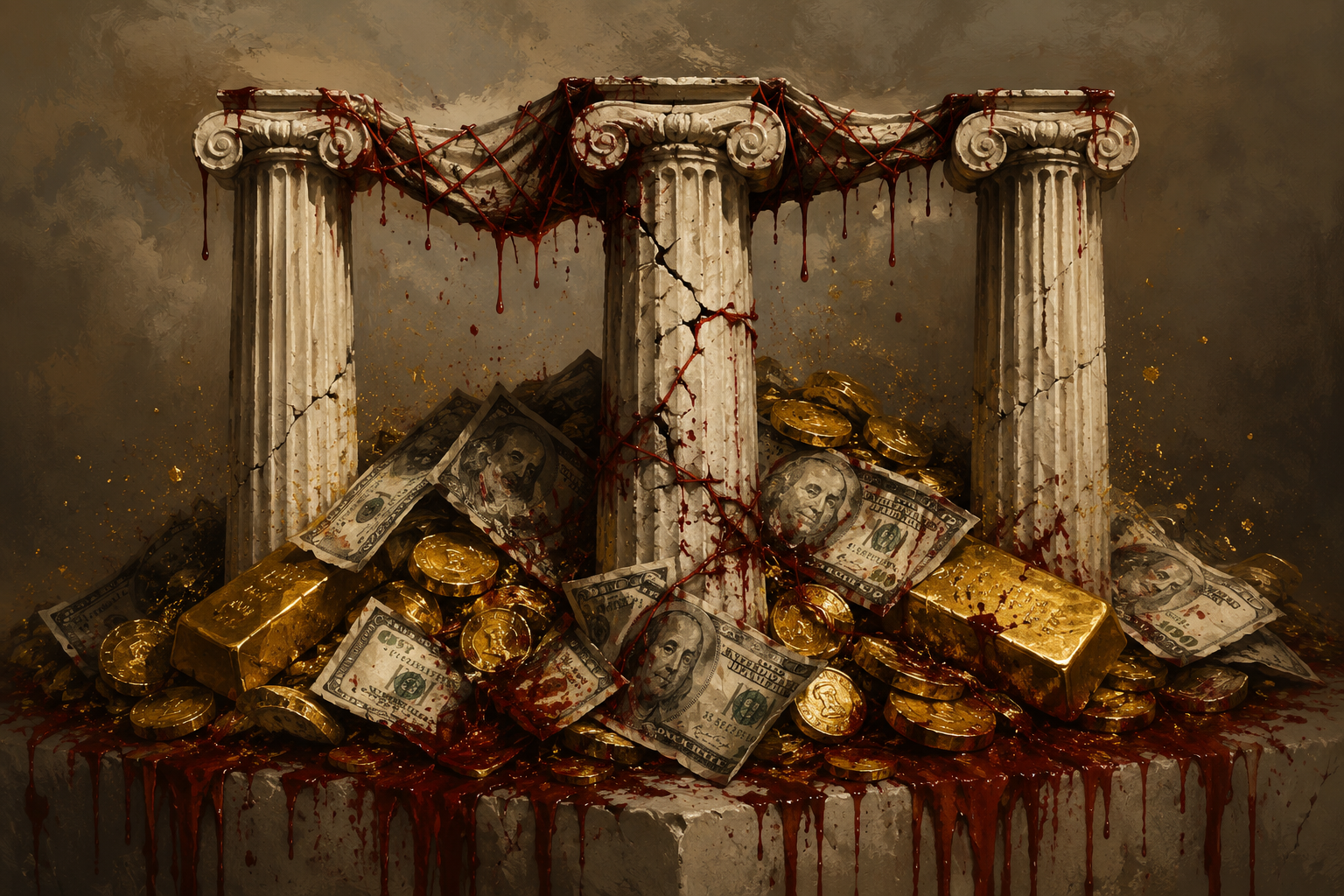
In 1776, a group of colonists said something genuinely new: that governments get their power from the people they govern, and that a government which stops serving those people loses its right to exist. That was the promise. Two and a half centuries later, it is fair to ask whether the government we have still runs on the consent of the governed…or something else.
What “grotesque” means
Grotesque is not the same as the ugly. Something is grotesque when two things that should never be joined get stitched together, and you can still see the stitches. A stone church with a demon carved into the roof. A doll with a human eye. A clown who is not funny.
The grotesque disturbs you because it does not hide the seam. It shows you the place where the wrong pieces were joined.
That is a useful word for American government right now. All the parts still look correct from a distance. Flags. Seals. Oaths of office. Speeches about freedom.
But something has been stitched into the middle of it, and if you look closely, you can see the seam. That something is money. Very bloody money.
What happened in 2010?
On January 21, 2010, the Supreme Court decided a case called Citizens United. The Court ruled 5 to 4 that the government cannot stop corporations, unions, and other groups from spending unlimited money on political messages, as long as the spending is “independent.” This is intended to mean not coordinated with a campaign. Justice Kennedy wrote that this kind of spending does not cause corruption, or even the appearance of it. The ruling did not legalize corporate donations straight to candidates. Those are still illegal.
What it did, along with a lower court ruling a few months later, was create the super PAC. A group that can take in unlimited money, from almost anyone, in any amount, forever.
The money concentrated
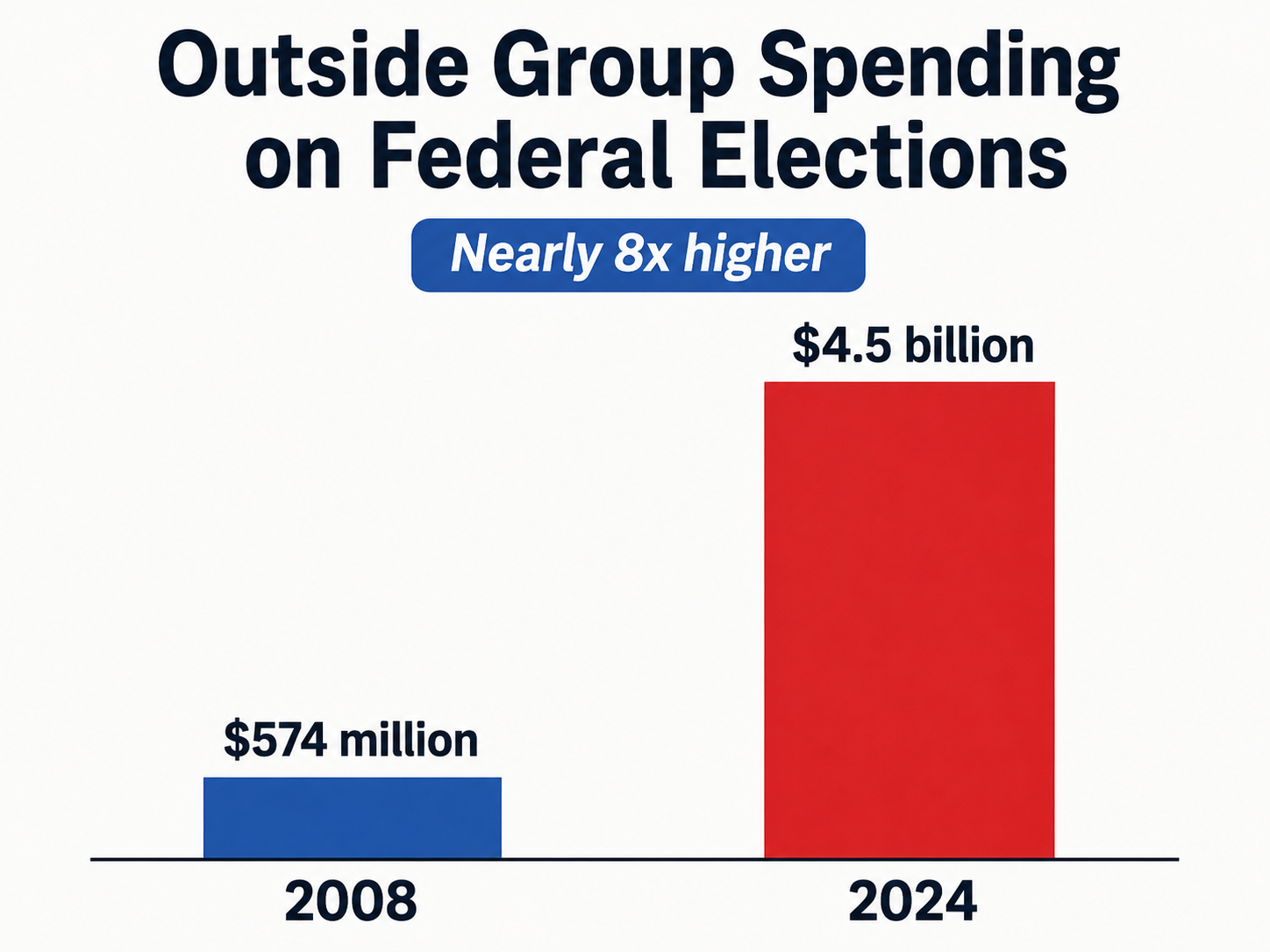
In 2008, before the ruling, outside groups spent about $574 million on federal elections. In 2024 they spent close to $4.5 billion.
But the totals are the boring half. The real question is not how much money was raised. It is how few contributed.
In 2010 the biggest political donors in America were a Texas homebuilder and his wife. They gave $7.6 million. That made them the largest givers in the country.
In 2024, $7.6 million would have ranked them seventieth.
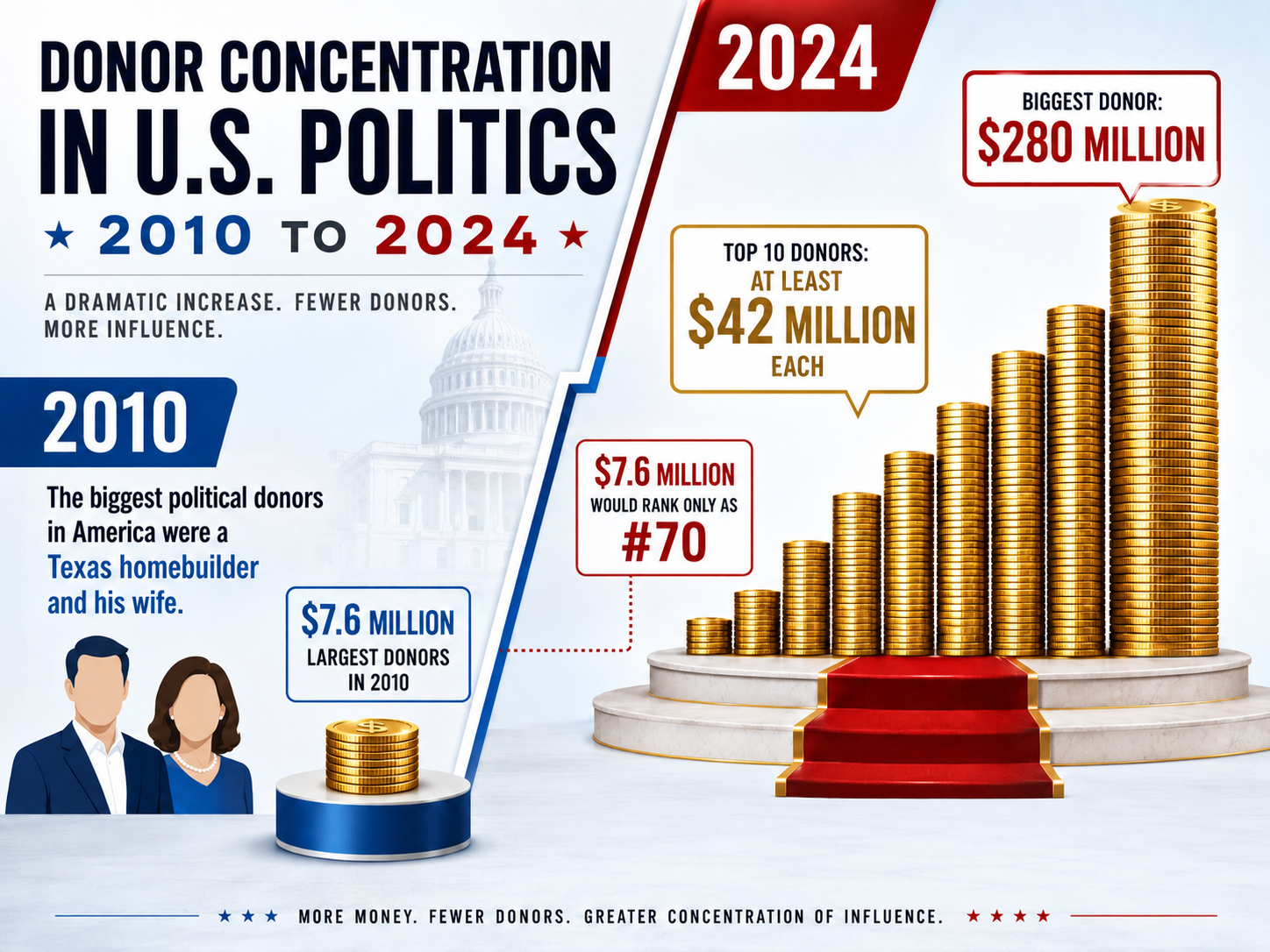
Everyone in the top ten that year gave at least $42 million. The biggest gave $280 million. Of the ten largest donors in 2010, exactly one was still in the top ten fourteen years later. The rest had not quit. They had been passed.
Now put that next to what the law lets you give. If you want to donate straight to a candidate for Congress, the most you can legally give is a little over $3,000 per election. That limit is still there. Nobody struck it down.
So one man gave about eighty-five thousand times what you are allowed to give a candidate. Legally. Without handing a dollar to any campaign.
That gap is the whole thing in one comparison. The rules on ordinary people are still in place. The road around those rules has no limit at all.
Thatʻs because a campaign has to collect money the slow way. It has to find thousands of people, ask each of them more than once, process every check, and report all of it. That work is hard, and it leaves a candidate depending on a lot of people.
A super PAC does not collect. It just holds. One person can fill it in an afternoon.
Those two things grow in completely different ways. If the only legal way to fund politics is to gather small amounts from many people, then power follows the number of people willing to give. If unlimited checks are legal, power follows the size of the biggest available check. And nobody uses the slow road when the fast lane is open.
The money piling up at the top was not an accident. It is by design.
You can see it in the shares:
- In 2008, the hundred biggest donors in the country accounted for about 1.5 percent of all federal election money.
- In 2024, the ten biggest accounted for about 7 percent.
Ten people now carry several times the weight a hundred people carried sixteen years ago.
At the other end, donations under $200, the kind most regular people give, if they giv, made up 16 percent of all contributions in 2024, down from 22 percent in 2020.
Small donors did not vanish. Millions gave. They were greatly outweighed.
And all of these numbers are floors, not ceilings. More than half of that $4.5 billion came from groups that do not have to say where their money came from. Over a billion dollars moved into political committees from shell companies and secret-donor nonprofits, up from under $72 million in 2016.
So the concentration is worse than the numbers show. Nobody is required to write the rest of it down.
All three branches
The usual complaint is that Congress is bought. That is true, but all three branches have been reshaped, each in the way its own structure allows.
Congress is the obvious one. Members of the House run for reelection every two years, which means they are almost always raising money. New members are told how many hours a week to spend on the phone asking for it. And a member who votes the wrong way does not get punished by a bribe, he gets punished by a super PAC funding a primary challenger. He does not have to be paid off. He only has to be able to imagine what would happen.
Then there is the exit. A staffer writes rules for an industry, then goes to work for that industry at five times the salary. A regulator leaves the agency and joins the companies she regulated. Nobody breaks a law. The job market does the work a bribe used to do.
The executive branch does not have to raise money at all, which is exactly why the pressure moves elsewhere. It moves into who gets appointed, which rules get written, which get quietly stopped being enforced, and which contracts get signed. Enforcement is the quiet one. A rule that is still technically on the books, and that no one is investigating, is a rule that does not exist.
The courts were supposed to be immune. Federal judges are appointed for life specifically so that no one can buy them.
But federal judges are chosen by people who do run for office, from lists assembled by organizations that donors fund, and that pipeline was built deliberately, over decades, by people who understood that changing the courts changes everything else more permanently than winning an election does.
And most American judges are not federal. Thirty-eight states elect the judges on their highest court, and those elections now run on the same money as everything else. In 2023, Wisconsin held what was then the most expensive judicial race in American history — roughly $42 million, two-thirds of it from outside groups, much of it from people who did not live in Wisconsin. Two years later, a Wisconsin Supreme Court race cost about $100 million.
Those are the judges who decide whether your family’s landlord can evict you, whether the factory upriver can keep discharging, and how the votes in your state get counted.
Why this is not just “politicians are corrupt”
Ordinary corruption is a person taking a bribe. Ordinary corruption is illegal, and when caught, can be prosecuted.
What is being described here is different, and worse, because almost none of it is illegal. The money is disclosed, or legally exempt from disclosure. The lobbying is registered. The job offers are ordinary job offers. The judicial campaign contributions are reported.
The system has not been broken. It has been built this way.
And once it works this way, nobody involved has to be a villain. A lawmaker who takes the industry’s position does not have to have been bought. She has to have concluded, correctly, that the alternative is losing her seat. An executive raising the price of a medicine does not have to hate sick people. He has to hit a number. A company running a detention facility does not have to hate the people inside it. It needs people inside it, because that is what it is paid for.
This is the real danger. The machinery works. Everyone in it is doing their job. Moral questions go in one end, and administrative decisions come out the other, and nowhere in the process does anyone have to question the consequences. That is not anyone’s assigned task.
What the other side says
You should know the strongest arguments against everything above, because they are not stupid. Citizens United began with the government trying to stop the distribution of a political film. That should make anyone uncomfortable, whatever they think of the film. Once you accept that the government can limit political spending, you have accepted that the government can limit political speech, and governments are run by the people that speech is criticizing.
There is also a factual argument: money does not reliably buy elections. Candidates get massively outspent and win all the time. Small-dollar donations have grown enormously too. Political scientists genuinely disagree about how much independent spending changes outcomes.
The honest response is that outcomes are not the only thing that matters. Money shapes which candidates run at all, which bills get written, which get scheduled for a vote, and which quietly die without anyone taking a position. By the time you are looking at an election result, most of the deciding has already happened.
***
The people in 1776 were not describing a country that existed. They were describing one they wanted. They fell short of their aspirations immediately and enormously. The gap between what they wrote and what they built was obvious to everyone, including them.
But their experiment has survived and every generation since has had to decide whether to maintain their ideals or let them become decoration.
That is the actual question on the 250th anniversary. Does the promise still have force, or has it become something read for entertainment at the fireworks shows?
Our response should not be despair. Despair is what the system wants. A citizen who has given up is cheaper and easier to govern than one who has not.
The better response is to change the way we conduct and fund elections.
Political parties, too, are part of the problem, but thatʻs another essay.
Please pass this on…
Share. Subscribe. Comment.

Leave a Reply