
Hawaiʻi’s existing system is often praised because our Prepaid Health Care Act rHawaiʻi’s Prepaid Health Care Act requires employers to provide coverage to eligible workers and limits the employee share for single coverage to no more than 1.5% of gross wages.1 This proves that public rules can improve coverage.
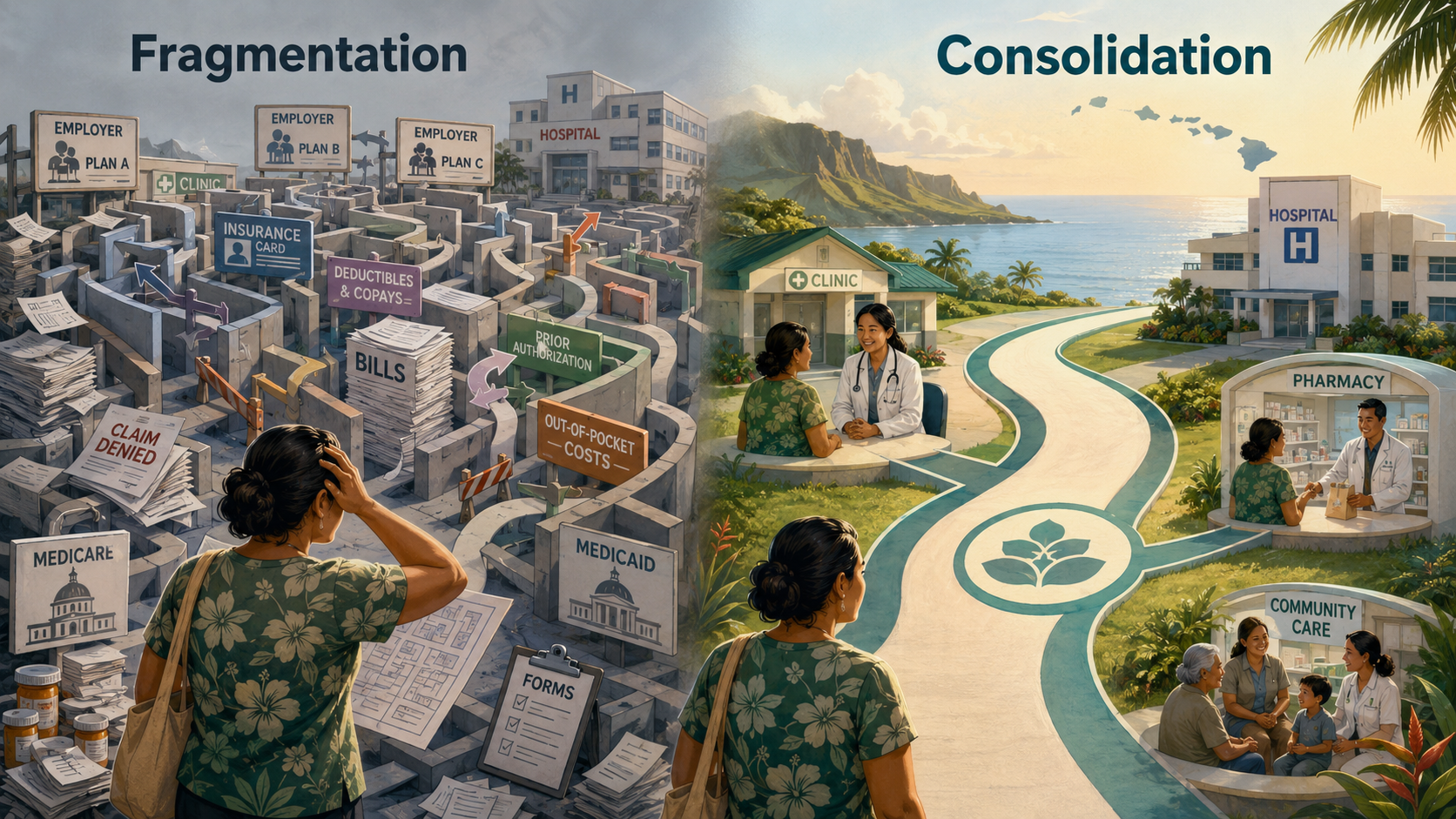
But Hawaiʻi’s fragmented, premium-based, employer-dependent system still leaves too many people uninsured, underinsured, underserved, undermedicated, in medical debt, and administratively burdened. And the healthcare community must negotiate a constantly changing payment system that is fragmented among employer plans, Medicaid, Medicare, military coverage, individual insurance, and the uninsured.
Hawaiʻi already pays, heavily, for health care. We pay through high premiums, employer contributions, deductibles, copays, taxes, medical debt, delayed care, and administrative waste.
A single-payer system would not increase the cost of health care: it would reorganize that cost into one public system designed for coverage, bargaining power, continuity, and accountability.
We also suffer provider shortages and pharmacy deserts. Single payer can provide the structural response required to hire and retain more medical professionals who also are unhappy with what can only be termed a preposterous mess.
The Core Statistics
| Issue | Key statistic | Why it matters |
| Coverage fragmentation | In 2024, Hawaiʻi’s coverage was fragmented. KFF estimates: 50.8% employer, 19.7% Medicaid, 17.0% Medicare, 4.9% nongroup, 4.3% military, and 3.3% uninsured.2 | Single payer’s strongest case is simplification: one public financing system instead of multiple eligibility rules, provider networks, billing systems, deductibles, formularies, denials, and administrative layers. |
| Uninsured residents remain | Even with Hawaiʻi’s strong employer mandate, KFF estimates about 45,500 uninsured residents in 2024.2 Census QuickFacts reports 4.3% of people under 65 without health insurance.3 | Hawaiʻi is close to universal coverage, but not there. A single-payer system would make coverage residency-based rather than employment-based. |
| Employer premiums are already high | In 2024, the average annual family employer-sponsored premium in Hawaiʻi was $22,709: employers paid $16,225 and workers paid $6,484. For single coverage, the average premium was $7,504.4 | A single-payer financing argument should say: Hawaiʻi is already paying. The question is whether we keep paying through private premiums or convert much of that money into a public financing stream. |
| Deductibles still exist | In 2024, Hawaiʻi’s average deductible was $1,275 for single coverage and $3,281 for family coverage.5 | Insurance is not the same as access. Deductibles and cost-sharing still deter care, especially for lower-income households. |
| Aging population | Hawaiʻi’s population is about 22.6% age 65 or older.3 | An older state needs stable, continuous care financing. Aging increases demand for primary care, prescriptions, specialists, home care, long-term care, and chronic disease management. |
| Poverty and disability | Census QuickFacts reports 10.0% poverty and 7.7% disability among people under 65 in Hawaiʻi.3 | These are populations most likely to be harmed by premiums, deductibles, eligibility churn, transportation barriers, and delayed care. |
| Medical debt persists | KFF/Peterson estimates Hawaiʻi has the lowest adult medical-debt rate in the country, but still 2.3% of adults have medical debt.6 A 2026 Hawaiʻi report described about $91 million in medical debt and said 19% of families owed more than $500.7 | Even Hawaiʻi’s comparatively better system still produces medical debt. That is the indictment: the “best” version of U.S. employer-based coverage still fails some families. |
| National health spending is enormous | U.S. health spending reached $5.3 trillion in 2024, or $15,474 per person, equal to 18.0% of GDP. CMS projects health spending will reach 20.6% of GDP by 2034.8 | The macroeconomic case is cost control. Single payer is not just a coverage reform; it is a financing and cost-discipline reform. |
| Hawaiʻi health spending is already substantial | Hawaiʻi personal health care spending was $10,291 per capita in 2020, slightly above the U.S. state average of $10,191.9 | Hawaiʻi is not a low-cost paradise in health care. The state already spends enough to demand a more coherent system. |
| Administrative waste is central | A 2020 Annals of Internal Medicine study estimated U.S. health administration costs at $812 billion in 2017, or $2,497 per person, equal to 34.2% of national health expenditures, compared with $551 per person and 17.0% in Canada.10 | This is one of the strongest single-payer arguments: multi-payer insurance creates billing, coding, claims, authorization, network, and denial machinery that does not directly care for patients. |
| Private insurance cost growth is worse | KFF/Peterson reports that from 2008 to 2023, per-enrollee spending grew 80.4% for private insurance, compared with 50.3% for Medicare and 30.3% for Medicaid.11 | Public programs have generally restrained per-enrollee spending better than private insurance. That supports public rate-setting and unified purchasing power. |
| Prices, not overuse, drive U.S. cost | KFF/Peterson states that U.S. spending is higher largely because of prices, not because Americans use dramatically more care than peer countries.11 | Single payer gives the public payer leverage to negotiate or set hospital, physician, drug, and administrative payment rules. |
The Numbers That Matter Most
- 45,500 uninsured Hawaiʻi residents.2
Even in a high-coverage state, tens of thousands remain outside the system. - $22,709 average annual family premium in Hawaiʻi.4
That is the hidden health-care tax already paid by workers and employers. - $6,484 average worker contribution for family coverage.4
That is before deductibles, copays, prescriptions, dental, vision, travel, and uncovered care. - $3,281 average family deductible.5
Coverage still leaves families exposed. - 22.6% of Hawaiʻi residents are 65 or older.3
An aging population needs continuity, not eligibility churn. - $91 million in reported Hawaiʻi medical debt.7
Even a comparatively well-covered state produces unpayable bills. - $812 billion in U.S. administrative health spending.10
That is the bureaucracy tax of multi-payer health care.
Unfortunately, a Hawaiʻi single-payer plan would need federal cooperation. Medicare, Medicaid, TRICARE, ERISA-regulated employer plans, union plans, and federal funding streams cannot simply be absorbed by the State of Hawaiʻi without waivers or federal legislation. The 2026 “Hawaii Care” proposal recognized this by requiring federal Medicaid/Medicare-related waivers and a state implementation plan.12
The 2026 Hawaii Care Proposal (HB2143)
The 2026 “Hawaii Care” proposal was a state single-payer health-care bill introduced as HB2143 in the Hawaiʻi House, with a Senate companion, SB3305. It did not pass; both versions died in committee in the 2026 session.13
In substance, Hawaii Care would have created a universal, publicly administered single-payer health-care system for Hawaiʻi residents. The bill said the system would provide “comprehensive health care benefits to all residents of the State” and eventually replace existing health-care plans in Hawaiʻi, subject to federal approvals and waivers.14
The bill assigned responsibility to the Hawaii Health Authority, which would plan, implement, and administer Hawaii Care. It required the Authority to prepare a full implementation plan covering eligibility, sequencing, financing, projected costs, five-year revenue and expense projections, hospital budgets, benefit design, and possible funding mechanisms, including an income tax or surcharge.15
The bill’s own findings were unusually blunt. It described Hawaiʻi’s existing health-care insurance system as “disjointed, costly, inefficient, and unnecessarily complicated,” and criticized the multi-payer model as profit-driven, adversarial, bureaucratic, and irrational. It identified three major cost drivers: administrative costs, lack of access to primary care, and high prescription drug prices.16
The proposed benefits were broad. Hawaii Care would have covered hospital care, surgery, primary care, preventive care, chronic disease care, diagnostics, prenatal and neonatal care, substance-abuse treatment, mental health care, emergency services and ambulance coverage, durable medical equipment, dental, vision, hearing, physical therapy, prescription drugs, standard screenings, and CDC-recommended vaccines.17
The proposal also included several structural reforms:
- Hospital global budgets rather than ordinary fee-for-service hospital billing.18
- Standardized provider payment schedules for independent providers.19
- A Hawaii Care special fund to receive state appropriations, federal funds, grants, and donations.20
- An Office of the Patient Advocate to investigate adverse decisions by Hawaii Care, hospitals, providers, or facilities.21
- Community-based program budgets for mental health, substance abuse, home care, and specialized care support.22
- Federal waiver applications, including Medicaid amendments or waivers and an Affordable Care Act section 1332 innovation waiver.12
The most important legal caveat is that the bill could not simply absorb Medicare, Medicaid, employer plans, and ACA structures by state command alone. It was written to take effect only after approval of the necessary federal Medicaid plan changes, federal waivers, and ACA innovation waiver authority.23
So, in plain language: Hawaii Care was a proposed single-payer transition plan for Hawaiʻi. It was not enacted. It was a serious legislative template for replacing fragmented private and public insurance with one state-administered public health-care financing system.
1. Hawaiʻi Department of Labor and Industrial Relations, “Frequently Asked Questions About Prepaid Health Care.”
2. KFF, “Health Insurance Coverage of the Total Population,” State Health Facts, 2024.
3. U.S. Census Bureau, “QuickFacts: Hawaii,” 2025 population estimate and 2020–2024 demographic and economic estimates.
4. KFF, “Average Annual Single Premium per Enrolled Employee for Employer-Based Health Insurance” and “Average Annual Family Premium per Enrolled Employee for Employer-Based Health Insurance,” State Health Facts, 2024.
5. KFF, “Average Annual Deductible per Enrolled Employee in Employer-Based Health Insurance,” State Health Facts, 2024.
6. KFF/Peterson Health System Tracker, “The Burden of Medical Debt in the United States,” February 12, 2024.
7. Hawaii News Now, “Plan to Erase $91M in Medical Debt for Hawaii Families Heads to Governor,” May 15, 2026; Honolulu Civil Beat, “Hawaiʻi Residents With Unpaid Medical Bills Could Soon Get Help,” May 18, 2026.
8. Centers for Medicare & Medicaid Services, “National Health Expenditure Fact Sheet,” 2024 data and 2025–2034 projections.
9. KFF, “Health Care Expenditures per Capita by State of Residence,” based on CMS State Health Expenditure Accounts, 2020.
10. David U. Himmelstein, Terry Campbell, and Steffie Woolhandler, “Health Care Administrative Costs in the United States and Canada, 2017,” Annals of Internal Medicine 172, no. 2 (2020): 134–142.
11. KFF/Peterson Health System Tracker, “How Has U.S. Health Care Spending Changed Over Time?”
12. HB2143, Hawaiʻi Legislature, 2026 Regular Session, waiver provisions (Medicaid amendments or waivers and an Affordable Care Act section 1332 innovation waiver) and state implementation-plan requirements.
13. Civil Beat Digital Democracy lists HB2143’s 2026 status as “Failed” after referral to House committees; LegiScan lists HB2143 and its Senate companion, SB3305, as introduced and died in committee, 2026 Regular Session.
14. HB2143, provisions stating that Hawaii Care would provide comprehensive health-care benefits to all residents of the State and eventually replace existing health-care plans, subject to federal approvals and waivers.
15. HB2143, requirements that the Hawaii Health Authority prepare an implementation and administration plan covering eligibility, sequencing, financing, projected costs, five-year revenue and expense projections, hospital budgets, benefit design, and possible funding mechanisms.
16. HB2143, legislative findings on Hawaiʻi’s health-care crisis and cost drivers.
17. HB2143, mandatory health-care benefits section.
18. HB2143, hospital global budget provisions.
19. HB2143, standardized fee-for-service payment schedule for independent providers.
20. HB2143, Hawaii Care special fund provisions.
21. HB2143, Office of the Patient Advocate provisions.
22. HB2143, community-based program provisions.
23. HB2143, effective-date language requiring federal approvals before implementation of Part III.

Leave a Reply