
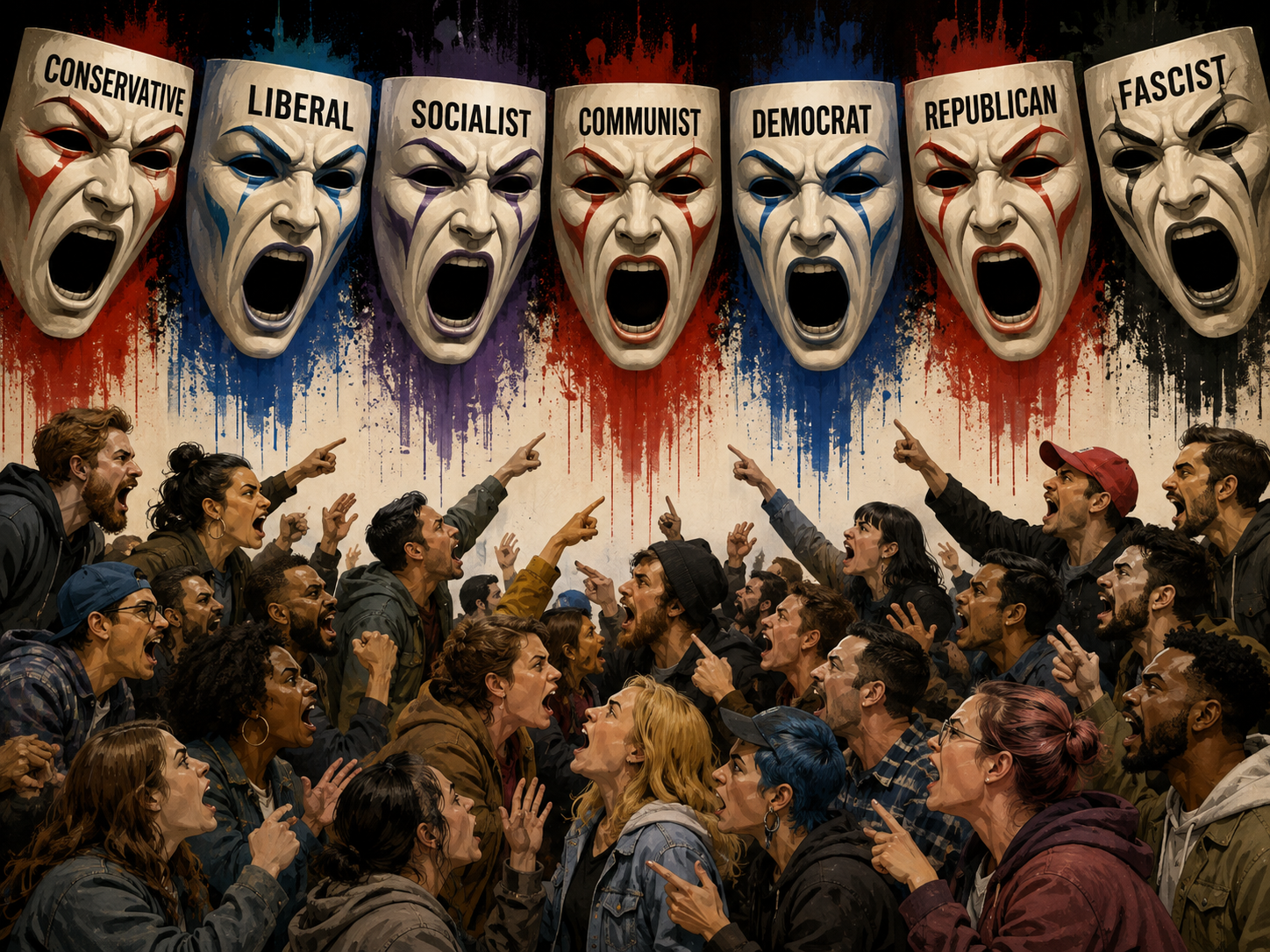
Conservative. Liberal. Socialist. Communist. Democrat. Republican. These terms once referred, however imperfectly, to recognizable traditions, institutions, and theories of government. Today they function mostly as tribal markers. They may tell us which group a person belongs to, which media they watch, which enemies they fear, and which slogans they repeat. They tell us far less about what that person actually believes.
“Conservative” may describe someone who wants limited government, balanced budgets, traditional religion, unrestricted corporate power, aggressive policing, military expansion, or near-total presidential authority. These positions are not naturally compatible. A government cannot be both small and equipped with unlimited powers of surveillance, imprisonment, deportation, and war.
“Liberal” is no clearer. It may refer to civil liberties, social tolerance, labor rights, environmental protection, regulated capitalism, or the professional class that administers the institutions of the status quo. A multinational corporation can call itself liberal because it celebrates diversity while opposing unions, avoiding taxes, exploiting workers, and concentrating wealth.
“Socialist” now means almost anything involving public expenditure. Public schools, libraries, Medicare, disaster relief, farm subsidies, and fire departments have all been denounced as socialism.
“Communist” is often not used as an economic description at all. It has become a general accusation against anything considered foreign, collective, radical, or inconvenient.
Democrat and Republican still have concrete meaning as party affiliations, but less meaning as political philosophies. Both parties contain contradictory factions. Both depend heavily on wealthy donors, consultants, corporations, financial institutions, and professional political organizations. Their policies change according to electoral necessity. Their most consistent purpose is not philosophical coherence but the acquisition and preservation of power.
The labels survive because they are useful to the institutions that organize political conflict. They divide the public into manageable camps. They reduce difficult questions to brand loyalty. They enable politicians to avoid explaining what their policies will actually do.
A more useful political vocabulary would begin with power.
Who owns the land?
Who controls housing, medicine, energy, food, transportation, information, and finance?
Who profits from a policy?
Who pays for it?
Who bears the risk?
Who receives protection?
Who is permitted to make decisions?
Which decisions can be reversed, and which will permanently alter the lives of future generations?
These questions reveal more than party labels ever could.
We might describe governments and policies as democratic or authoritarian, centralized or local, extractive or regenerative, egalitarian or oligarchic, public-serving or profit-serving. We could ask whether wealth is broadly distributed or concentrated, whether institutions are accountable or insulated, and whether citizens are treated as participants in public life or merely as consumers, workers, data points, and voters.
This does not mean that history no longer matters. Liberalism, conservatism, socialism, communism, and other political traditions have real histories. They shaped revolutions, governments, labor movements, wars, constitutions, and economies. But historical meaning is not the same as present usefulness. A word may retain emotional power long after it has lost descriptive precision.
The old labels increasingly conceal the central conflict of our time.
That conflict is not simply left against right. It is the public against institutions that claim the right to govern without meaningful consent. It is communities against corporations that can extract wealth and leave the costs behind. It is citizens against monopolies, financial systems, military bureaucracies, technology platforms, and executive governments that have grown too powerful to be held accountable.
This conflict cuts through both major parties. It also cuts through the old ideological categories.
A politician may call himself conservative while expanding federal government power. Another may call herself progressive while protecting corporate monopolies. A corporation may project liberal values while practicing economic exploitation. A government may hold elections while ensuring that the most important decisions remain beyond public control.
Political labels may not quickly disappear. They are too deeply embedded. But we can stop treating them as meaningful. It is high time to drop the masks, ditch the labels of division, and develop useful conversations that address real issues.
Please subscribe and share.


Leave a Reply