It Is Far Worse
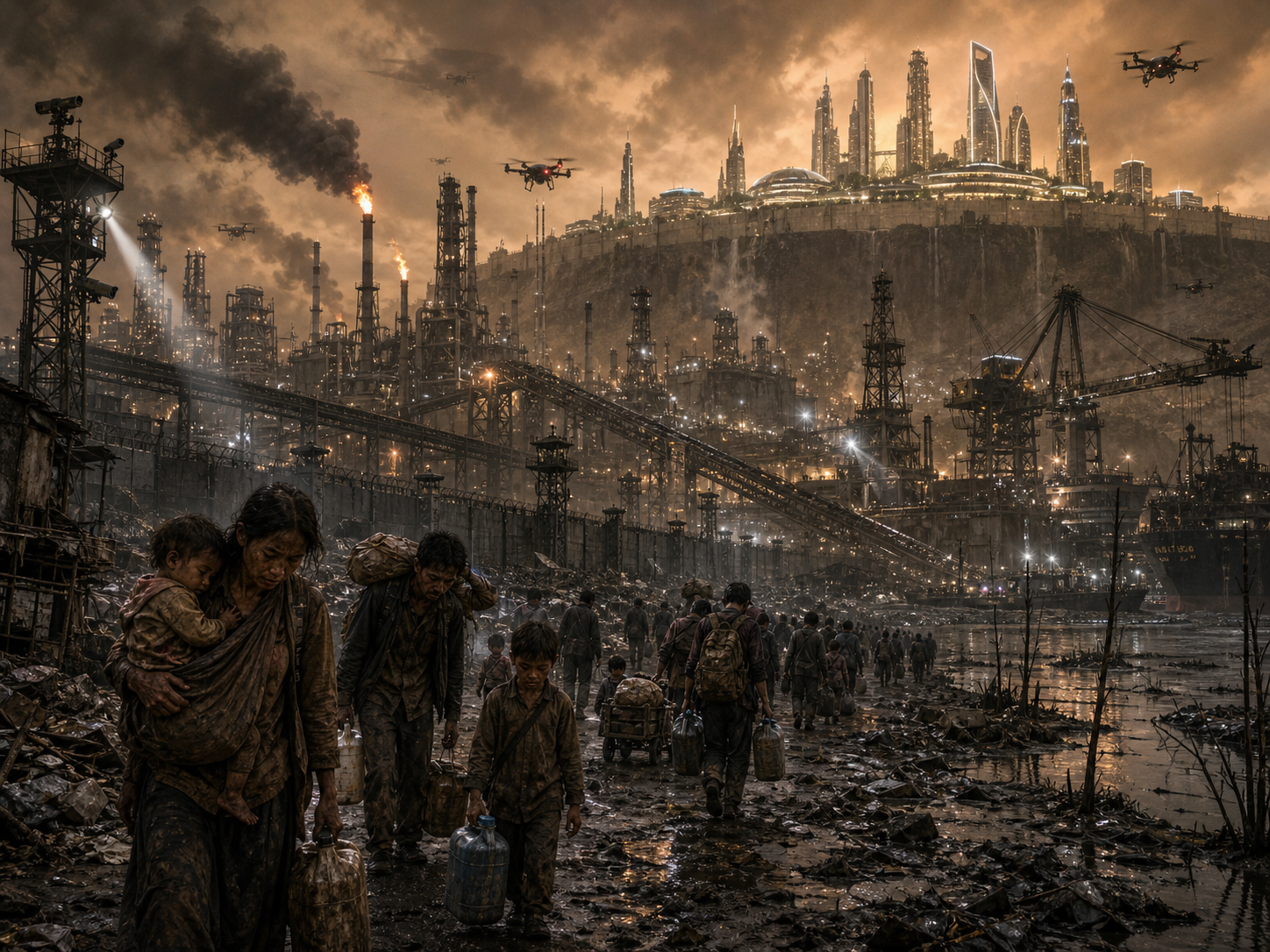
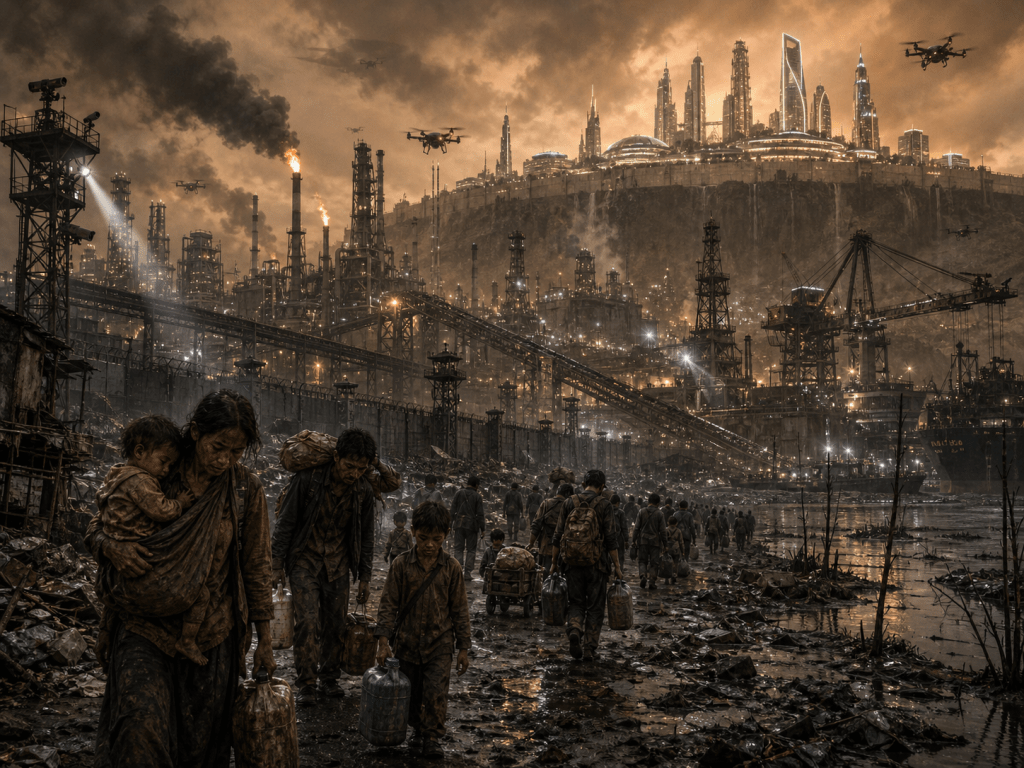
If the masses of humanity are miserable now – and by most standards that includes at least three billion people (50% of the total population) the real risk is not that humanity disappears in one grand final event. The real risk is that humanity survives in a world made meaner, hotter, poorer, lonelier, surveilled, militarized, and much less alive. That is not extinction. It is suffering.
Unfortunately, the public debate about civilizational collapse tends to split into two opposing forms of evasion.
The first is denial: nothing fundamental is broken, the market will innovate its way through, human ingenuity has always found a solution, and those who say otherwise are alarmists with an ideological agenda.
The second is apocalypse: extinction is imminent, the end is already written, the game is over, and action is therefore sentimental theater.
Both positions are wrong in ways that only serve the status quo, those people, corporations, governments, investors, institutions, and political systems that already (and will most likely continue to) profit from the way things are and they hope will continue to be.
Denial says there is no problem urgent enough to demand structural change. Apocalypse says there is no point in structural change because the outcome is already determined.
One protects the existing order by refusing reality; the other protects it by surrendering to despair. The result is the same: paralysis.
The more accurate picture is harder to hold in mind because it requires genuine uncertainty without moral retreat. It asks us to act without guarantees. It asks us to admit that the future may become much worse than the present, while also refusing the lazy comfort of inevitability.
That distinction matters. It matters enormously. Precision is not a luxury here. It is the first condition of responsibility, what is known as kuleana in ʻOlelo Hawaiʻi.
The Human Species Will Likely Survive. Civilization? Maybe Not So Much.
Human extinction is not the most likely outcome of the crises now converging on the planet. Barring nuclear war, engineered pandemic, runaway technological catastrophe, or some other compound disaster, humans are genuinely hard to eliminate. We are incredibly adaptable, widely distributed, technologically capable, and biologically opportunistic. We survived the last Ice Age with stone tools. We survived plague, famine, empire, conquest, and ecological disruption. We are, for better and worse, a very durable species.
But complex civilization is far more fragile than the species that produced it.
What we now call civilization depends on an astonishingly delicate web of assumptions: stable climate patterns, predictable growing seasons, functioning fertilizer supply chains, international shipping, electricity grids, digital networks, financial systems, freshwater availability, public health capacity, political legitimacy, and trust.
Trust may be the most underestimated of these. Trust that institutions are not merely instruments of extraction. Trust that agreements will be honored. Trust that tomorrow will resemble today enough to plan for it. Trust that a society will not sacrifice its poorest people first and call the result efficiency.
Damage enough of these dependencies at once and the system doesnʻt “end” in any cinematic sense. It degrades. It fractures. It becomes cruel for most living things while remaining entirely functional for a tiny, insulated minority.
This is not a distant fantasy. It is already visible in societies where climate disaster, housing unaffordability, food insecurity, political corruption, surveillance, and private security expand together while public life contracts.
The question is not whether human beings will continue to exist a century from now. They almost certainly will.
The question is what kind of life will be available to them, under what conditions of freedom, dignity, ecological sufficiency, and political agency. The real danger is not instant extinction. It is a long descent into managed collapse in a world of suffering.
The Compound Problem
What makes the present moment different from previous civilizational crises is not any single threat. It is the intersection of threats and the degree to which they amplify one another.
Climate shocks destabilize food production. Food insecurity generates political instability. Political instability weakens the institutions needed to coordinate climate response. Debt crises force governments to cut the public investments required for ecological transition. Disinformation corrodes the shared ground without which democratic decision-making becomes almost impossible. Authoritarian movements exploit fear to consolidate power. Ecological collapse removes the natural buffers that previous societies could fall back on when political and economic systems failed.
These are not isolated emergencies. They are interacting failure modes in a system never designed to manage any of them individually, let alone together.
The biological evidence is already severe. The Intergovernmental Science-Policy Platform on Biodiversity and Ecosystem Services concluded in 2019 that around one million animal and plant species are threatened with extinction, many within decades.¹ The Intergovernmental Panel on Climate Change has stated that human activities have unequivocally caused global warming, with global surface temperature reaching about 1.1°C above 1850–1900 levels in 2011–2020.² The planetary boundaries framework, updated in 2023, found that six of nine boundaries had been transgressed, placing Earth outside the safe operating space within which Holocene civilization developed.³
These findings do not mean the Earth is ending. The Earth will continue, indifferent as stone. They mean the conditions that enabled agriculture, cities, states, trade, and modern economies to flourish are being destabilized by the same civilization that depends on them. This is the sort of achievement only a very clever species could manage: to become powerful enough to damage its own operating system, then hire consultants to describe the damage as an opportunity.
The risk is compounded further by weapons and technology. The Stockholm International Peace Research Institute warned in 2025 that nuclear risks were growing as arms control weakened and nuclear-armed states modernized their arsenals.⁴ The World Economic Forum’s 2026 risk assessment placed misinformation, cyber insecurity, adverse outcomes of AI, geopolitical conflict, and environmental breakdown among the central risks shaping the next decade.⁵
These are not separate files in separate cabinets. They interact. AI accelerates propaganda, surveillance, financial speculation, labor disruption, weapons systems, and energy demand. Geopolitical conflict slows climate cooperation. Climate stress increases migration and instability. Instability strengthens authoritarian politics. Authoritarian politics weakens truth, accountability, and ecological restraint.
The word for this is cascading failure. Engineers know that complex systems are often most vulnerable not when a single component fails, but when one failure places stress on adjacent systems, which then fail faster than repair capacity can respond. [If you have maintained an old automobile, you know. You fix one failure, and the next appears, and on and on until there are no more parts available.] Global civilization is now complex enough, and stressed enough, that cascading failure is no longer a remote scenario. [You canʻt even work on the new and infinitely more complex automobile-it requires specialized machines to repair it.] Cascading figure is already an active process in several regions of the world at once.
Whatʻs New Is the Scale
Of course, many great civilizations have collapsed before. This is sometimes offered as reassurance: humanity has always survived. But this is also a grave warning.
Forests have been stripped before. Soils have been exhausted before. States have overreached militarily, widened inequality until it became explosive, and mistaken domination for permanence. Complex societies have repeatedly destroyed the conditions of their own flourishing while elites mistook temporary command for permanent law.
The difference now is scale.
Past societies could destroy watersheds. We can destabilize the carbon cycle. Past elites could ruin regions. Ours can damage planetary systems while issuing sustainability reports and congratulating themselves at conference centers. Past collapses were tragedies, but most were local or regional. Their ecosystems could often recover over centuries or millennia. The carbon cycle continued beyond them. The oceans remained beyond their reach. Biodiversity persisted outside their borders.
Those protections no longer hold. Extraction is global. Emissions are global. Finance is global. Shipping is global. Surveillance is global. Propaganda is global. Weapons systems are global. Supply chains tie the fate of forests, mines, oceans, workers, investors, governments, consumers, and militaries into one feverish machine optimized for short-term return.
The obscene novelty of this moment is not greed. Greed is old, dull, and reliable, like mildew with a bank account. The novelty is greed amplified by planetary technology and protected by economic ideology. The novelty is the ability to externalize costs onto the atmosphere, the ocean, the poor, the young, the unborn, and the nonhuman world, then describe the result as growth.
What Kind of Thinking Produced This?
At some point, an honest account of this crisis must move beyond systems analysis and ask not only what went wrong, but what kind of worldview made it possible.
Modern industrial society, in both capitalist and Soviet-socialist forms, trained itself to see nature as raw material, time as money, labor as a cost to be minimized, land as an asset to be leveraged, and the future as a discount rate. Within this framework, a forest has value insofar as it can become timber, a river insofar as it can power a turbine or receive waste, a human being insofar as they can produce or consume. That which cannot be priced tends to disappear, not always from conscious malice, but from institutional blindness. The system cannot see what it has not been taught to count.
This worldview is not merely unsustainable, it is disconnected from reality. It severs humans from obligation to the systems that produced and sustain them. It makes gratitude look childish and restraint look economically illiterate. It treats a thousand-year-old forest as inventory and a three-generation aquifer as a quarterly resource. It discounts the future, literally, by treating the welfare of future people as worth less than the preferences of present investors.
Against this, many of the communities most damaged by industrial expansion have preserved relational understandings of the world that industrial civilization tried to erase. These traditions are not perfect. No culture gets to float above power, conflict, error, or contradiction. But they often begin from sounder premises.
Aloha ʻāina (love and duty toward land) does not treat land as inert resource but as ancestor, provider, law, and obligation. The Andean concept of Pachamama carries a cosmology in which Earth is not backdrop but living presence. Ubuntu philosophy in southern Africa grounds human identity in relationship rather than isolated accumulation. These are not romantic relics. They are better ecological premises than the operating system currently running the global economy.
A civilization that understood the living world as ancestor and provider, rather than resource and externality, would make different decisions. It would measure success by different standards: not the volume of matter extracted, processed, sold, and discarded, but the health of watersheds, soils, reefs, forests, families, languages, cultures, and future generations. It would ask not only what can be taken, but what must be returned. Astonishing concept. Someone alert the economists.
The Narrowing Corridor
We are not watching the end of the world in any guaranteed or predetermined sense. The outcome is not fixed. History does not move on rails. People who said transformation was impossible have been wrong before: about slavery, apartheid, women’s suffrage, colonial empires, and the permanence of political orders that looked immovable until they moved.
But we are watching a narrowing corridor.
The window in which the most catastrophic outcomes can still be avoided is measurably closing. The speed at which it closes depends on choices being made now: in boardrooms, legislatures, courts, laboratories, farms, classrooms, households, movements, and communities. The future will be shaped by what societies prioritize, what they refuse, what they protect, what they build, and what they finally stop pretending not to know.
The work ahead is not mysterious. Fossil fuel combustion must fall dramatically. Ecosystems must be protected and restored at a scale large enough to preserve the biological systems that regulate climate, water, food, and disease. Food production must be redesigned to feed people without destroying the land and water that make food possible across generations. Dangerous technologies must be governed before they outrun institutional capacity. Economies must stop treating throughput as success and begin measuring health, repair, resilience, sufficiency, and justice.
None of this is technically impossible. The knowledge exists. Much of the technology exists. The capacity for collective action exists. What remains fragile is political will, institutional imagination, and the cultural shift away from the worldview that produced the crisis.
No single tradition holds the full answer. Not American liberalism. Not European social democracy. Not Chinese state capitalism. Not any singular revolutionary doctrine polished into certainty by people who enjoy meetings too much. Any livable answer will be plural. It will be assembled from Indigenous knowledge and scientific rigor, communal economics and democratic governance, ecological restoration and legal transformation, local sovereignty and international coordination, technological restraint and cultural renewal.
The old story is a dead end: endless growth, endless extraction, endless technological escape from the consequences of endless growth and extraction. The geological and biological evidence has already rendered its verdict. What remains is the question of how much of the living world that dead story will take with it before enough people, in enough places, with enough institutional power, decide to stop calling the suicide machine progress.
That decision is not made only at climate summits or in policy reports, though both matter. It is made in the accumulation of smaller decisions: what institutions to build, which ones to withdraw support from, what stories to tell, what values to defend, what land and water to protect, what forms of wealth to delegitimize, and whether the world we inherited is the only world that can exist.
The real risk is not that humanity disappears. The real risk is mass suffering. And it is something worse in moral terms: a meager survival after the surrender of responsibility.
None of this is inevitable.
It remains ours to fix.
Notes
¹ Intergovernmental Science-Policy Platform on Biodiversity and Ecosystem Services, “Species Extinction Rates ‘Accelerating,’” May 6, 2019; IPBES, Global Assessment Report on Biodiversity and Ecosystem Services (Bonn: IPBES, 2019).
² Intergovernmental Panel on Climate Change, Climate Change 2023: Synthesis Report, Summary for Policymakers (Geneva: IPCC, 2023).
³ Katherine Richardson et al., “Earth beyond Six of Nine Planetary Boundaries,” Science Advances 9, no. 37 (2023); Stockholm Resilience Centre, “All Planetary Boundaries Mapped Out for the First Time, Six of Nine Crossed,” September 13, 2023.
⁴ Stockholm International Peace Research Institute, “Nuclear Risks Grow as New Arms Race Looms,” June 16, 2025; SIPRI, SIPRI Yearbook 2025: Armaments, Disarmament and International Security (Oxford: Oxford University Press, 2025).
⁵ World Economic Forum, The Global Risks Report 2026, 21st ed. (Geneva: World Economic Forum, 2026); World Economic Forum, “The Global Risks Report 2026,” January 14, 2026.
⁶ Robert J. DiNapoli et al., “A Model-Based Approach to the Tempo of ‘Collapse’: The Case of Rapa Nui,” Journal of Archaeological Science 121 (2020); Binghamton University, “What the Easter Island Myth Gets Wrong,” 2021.
⁷ Diana K. Davis, Resurrecting the Granary of Rome: Environmental History and French Colonial Expansion in North Africa (Athens: Ohio University Press, 2007).

Leave a Reply