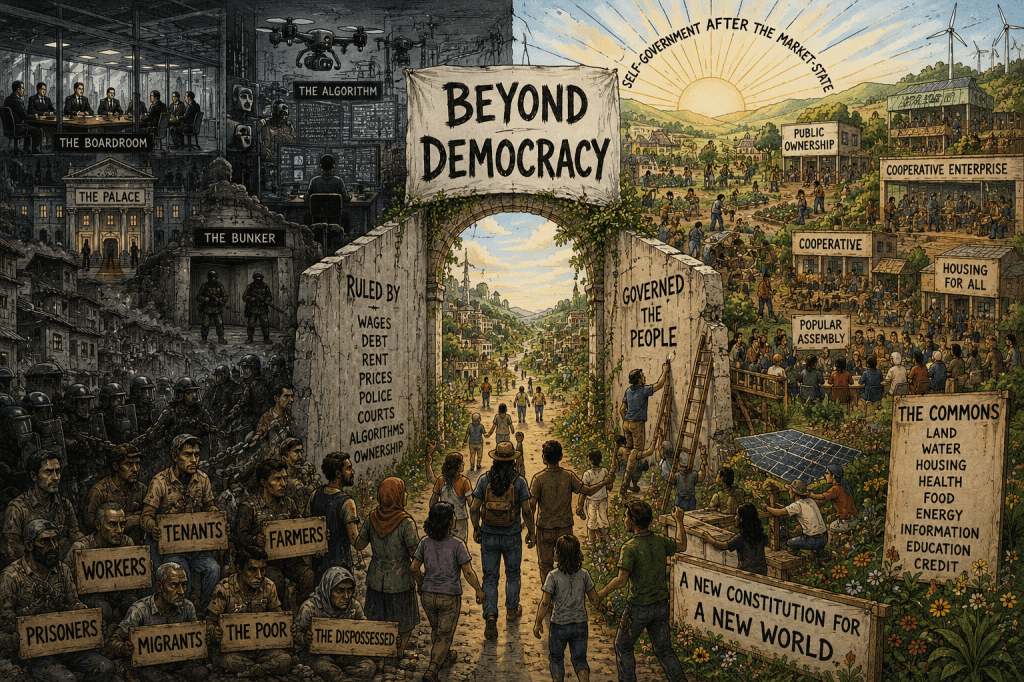
Self-Government After the Market-State
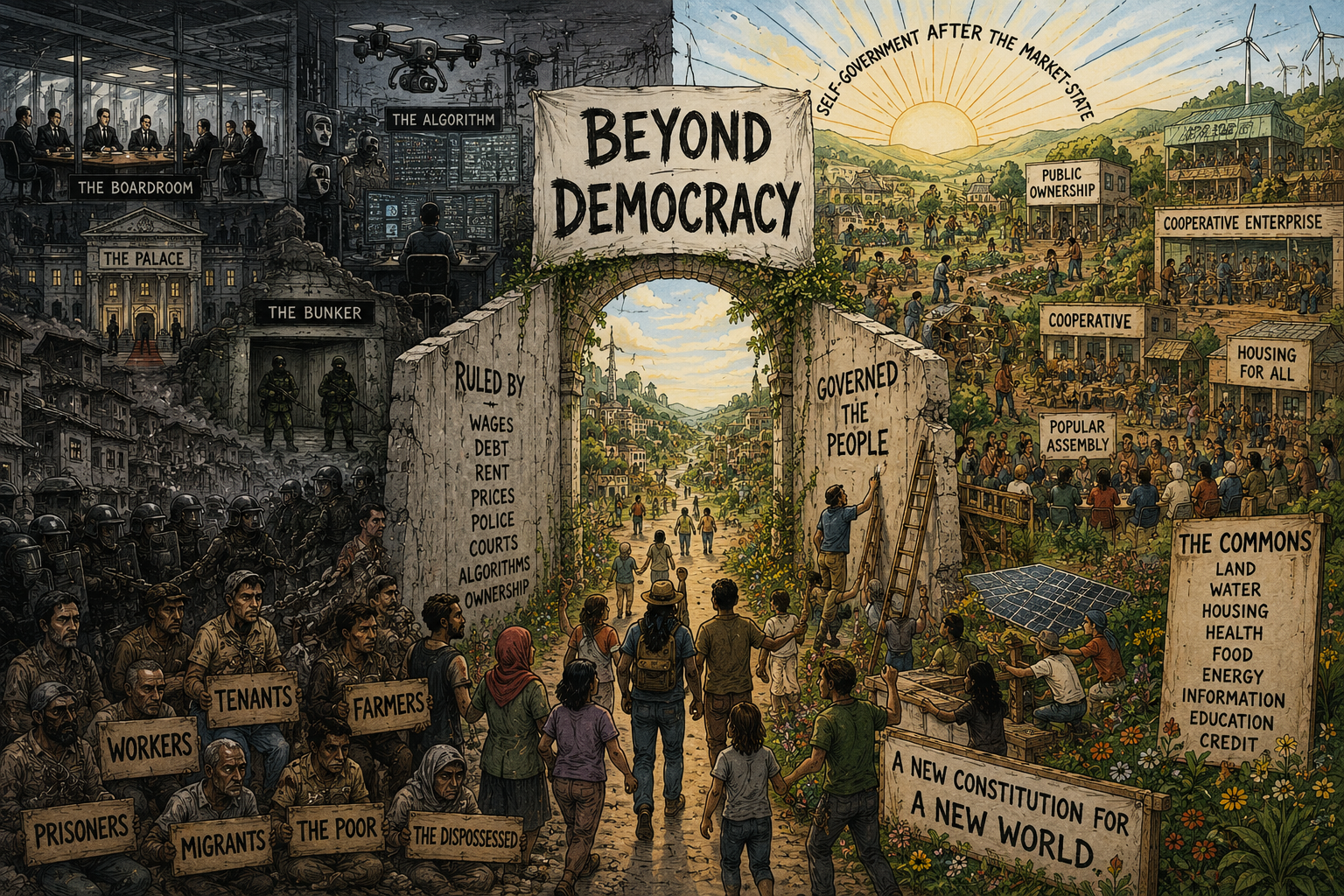
Beyond democracy, beyond capitalism, another form of life waits to be born. It will not come from the boardroom, the palace, the bunker, or the algorithm. It will rise from the long injury of the many, from the blood price already paid by workers, tenants, farmers, prisoners, migrants, the poor, and the dispossessed. The question is not whether history demands a new order. The question is whether that order will be built by the people, or once again built over their bodies.
The French Revolution ended when democratic aspiration exhausted itself inside war, hunger, faction, corruption, and institutional weakness, clearing the road for Napoleon. Its failure was not that people demanded too much freedom. Its failure was that political freedom was never secured by a durable social and economic order. The people were declared sovereign, but sovereignty did not feed them, protect them, house them, or prevent power from reorganizing itself through military force, wealth, and administrative control.
That remains the central failure of modern democracy.
The deeper lesson is not “democracy failed.” It is worse than that. Formal democracy without economic justice, civic trust, food security, institutional legitimacy, and protection from oligarchy becomes a theater of consent. People vote; capital governs. People deliberate; markets decide. People protest; police manage the overflow. Eventually, a figure arrives promising order, and the public, battered by chaos, accepts command in place of freedom.
A vote without material power is not self-government. A citizen without secure housing, land, food, health care, education, meaningful work, and protection from corporate domination is not free in any serious sense. He is merely permitted to participate in the ceremonial maintenance of a system that rules him through wages, debt, rent, prices, police, courts, algorithms, and the ownership of everything necessary to survive.
Modern democracy has narrowed freedom into procedure. It has confused representation with power, elections with consent, and consumer choice with liberty. The result is a political order in which people vote for governments, while capital governs the conditions under which governments operate. The ballot remains, but the economy has become the real constitution.
What is required now is not dictatorship, technocracy, or nostalgia for monarchy dressed up in digital robes. It is not the replacement of democracy with command. It is the completion of democracy beyond the limits imposed by capitalism, empire, militarism, and corporate law.
A new constitutional order must be built around the commons: ecological limits, economic rights, public ownership where necessary, cooperative enterprise where possible, democratic control over essential systems, strict limits on concentrated wealth, and institutions capable of governing beyond the shallow ritual of elections. Land, water, housing, health, food, energy, credit, and information cannot remain private instruments of domination while society pretends to be free.
The people must not only govern the state.
They must govern the economy that governs the state.

Leave a comment