On Coerced Labor and Plantation Power in Hawaiʻi
June 14, 1900, became a turning point in plantation labor history. On that day, the Hawaiian Organic Act took effect, formally organizing Hawaiʻi as a U.S. territory and ending the legal machinery of penal contract labor. Workers could still be trapped by poverty, plantation housing, company stores, debt, and economic dependence, because naturally power does not surrender just because Congress discovers morality. But after June 14, planters could no longer use criminal punishment to force workers back into the fields.The history of forced and controlled labor in Hawaiʻi is not only a story about workers. It is also a story about land, law, money, and power. It is about how Hawaiian ʻāina was turned into plantation property, how Hawaiian law was pressured by foreign business interests, and how thousands of workers from many countries were brought here to serve an economy they did not control.
Before sugar plantations took over large swaths of ʻāina, Native Hawaiians lived in a land system based on the ahupuaʻa. Land was not treated as private property. It was tied to family, food, water, work, chiefs, gods, burial places, and responsibility. People belonged to the land, and the land sustained the people.
That world was deeply damaged after Western contact in 1778. Foreign diseases killed huge numbers of Native Hawaiians. The population may have been between 300,000 and 800,000 before contact, but by the middle of the 1800s fewer than 80,000 Kānaka Maoli remained.¹ This was not just a population decline. It was a national disaster. Hawaiian communities lost parents, children, farmers, fishers, chiefs, priests, and knowledge keepers.
At the same time, foreign businessmen saw Hawaiʻi as a place to profit. Sugar grew well in the islands. But sugar plantations needed large numbers of workers who could be controlled. Many Hawaiians were dead, sick, grieving, or still connected to their own lands and ways of life. Plantation discipline did not fit easily into Hawaiian life. So the planters created a new system through law.
In 1850, the Hawaiian Kingdom passed the Masters and Servants Act. This law enabled employers to bind workers through labor contracts. If a worker left before the contract ended, the employer could have him arrested and forced back to work. Workers could be punished with extra labor time, imprisonment, and hard labor.²
On paper, these were contracts. In real life, they were bondage. A poor worker might sign a contract without fully understanding what it meant. Once signed, he could not freely leave. His labor, and even his body, became controlled by the employer.
This law was passed under the Hawaiian Kingdom, but it was shaped by foreign influence. One important figure was William Little Lee, an American lawyer who became Chief Justice in Hawaiʻi and was also invested in sugar.³ This shows the problem clearly. The Kingdom was still sovereign, but foreign lawyers, investors, and planters were gaining more power inside its legal system. Hawaiian authority was being used to support a plantation economy that served foreign profit.
The planters were honest about what they wanted. In 1883, a planter labor committee said sugar required “cheap labor,” which meant “servile labor.”⁴ In plain language, they wanted workers who were low cost, dependent and easy to control as documented in committee minutes.
Since there were not enough Hawaiian workers for the plantations, laborers were brought from other places. In 1852, 195 Chinese workers arrived on the ship Thetis. They were contracted for five years at very low wages.⁵ Later came workers primarily from Japan, Portugal, Korea, Puerto Rico, the Philippines.
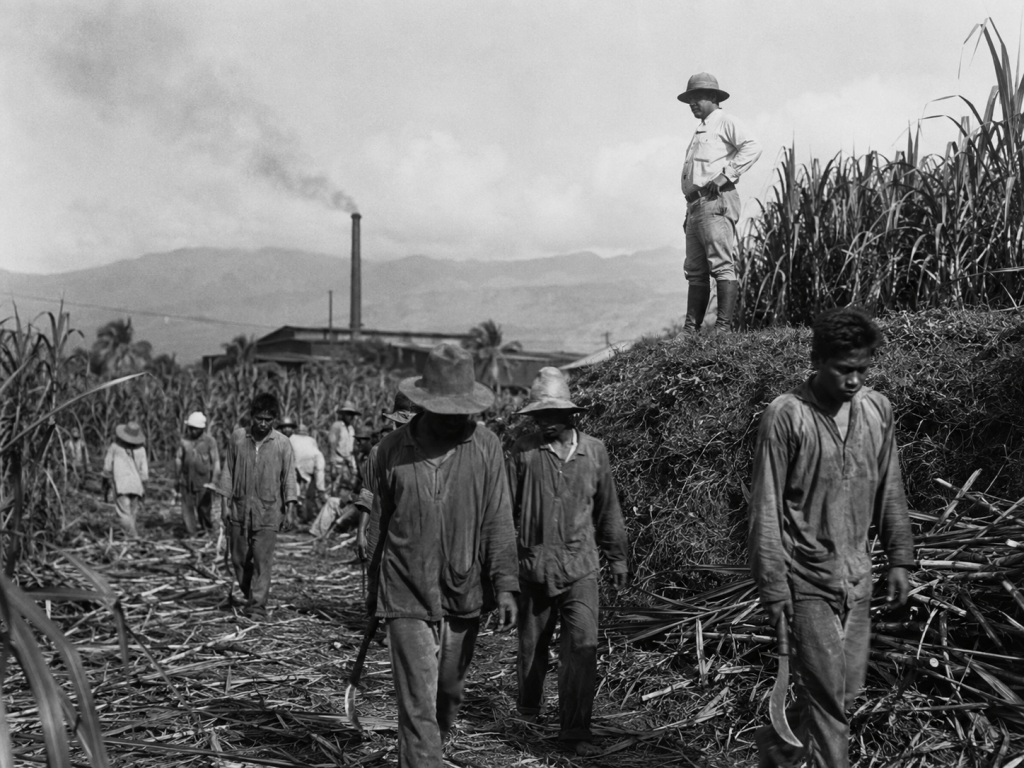
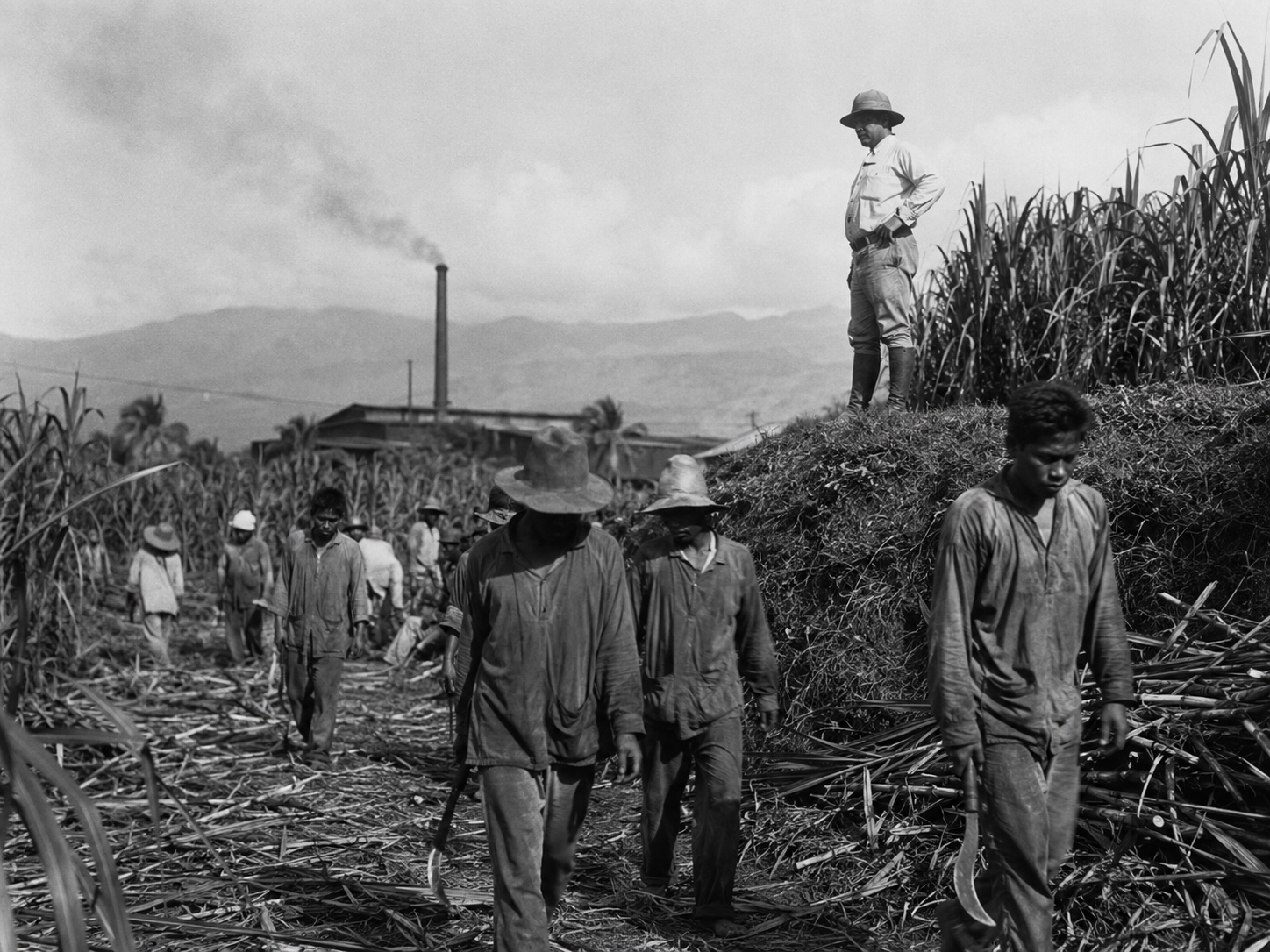
These workers were promised opportunity. They found harsh conditions instead. They worked long hours, earned low wages, lived in poor housing, and could be punished for resisting. They did not own the land they worked. They did not control the crop. They did not get to share in the wealth they created.
The plantation system purposely divided workers by race and nationality. This strategy housed in separate ethnic camps, and they were paid different wages for similar work. Portuguese workers were often used as lunas, or overseers, placed between white bosses and Asian workers.⁶
The bango system showed how cold this system was. Workers wore metal tags with numbers on them. The shape of the tag showed the worker’s race or nationality. Instead of being called by name, a worker could be known by a number.⁷ This made workers easier to manage and easier to divide.
By keeping workers separated, planters hoped to stop them from uniting. They knew that if Chinese, Japanese, Filipino, Portuguese, Puerto Rican, Korean, and Hawaiian workers stood together, plantation power would be in danger.
The overthrow of the Hawaiian Kingdom in 1893 and U.S. annexation in 1898 further helped protect the plantation system. After annexation, the planters rushed to bring in more Japanese contract laborers before American law ended contract labor in Hawaiʻi. In 1899, more than 26,000 Japanese contract workers were brought in. This was the largest single-year arrival of plantation workers in Hawaiʻi’s history.
In 1900, the Organic Act made Hawaiʻi a U.S. territory and ended penal contract labor. Existing labor contracts were declared void.⁸ Legally, workers could no longer be jailed just for leaving a plantation contract.
But legal freedom did not mean real freedom. The plantation still controlled housing, stores, medical care, jobs, and credit. If workers left, where could they go? The same companies controlled much of the economy. Workers were no longer legally bound by contract, but they remained trapped by poverty and dependence.
Workers resisted again and again.
In 1909, Japanese workers on Oʻahu organized the first major island-wide plantation strike. They demanded fair wages and protested racial pay differences. About 7,000 workers joined. Plantation owners and the territorial government responded by arresting leaders and evicting workers from plantation housing. The strike did not win everything, but wages rose afterward.⁹
In 1920, Japanese and Filipino workers struck together, joined by workers from other groups. This was a major step because it broke through the ethnic divisions planters had created. The strike was crushed, but it proved that workers from different backgrounds could unite.
In 1924, Filipino workers led by Pablo Manlapit struck across the islands, demanding two dollars a day and an eight-hour workday. On September 9, 1924, police arrived at the Hanapēpē strike camp on Kauaʻi. In the violence that followed, sixteen Filipino workers and four police officers were killed. One hundred and one workers were arrested, and sixty received four-year prison sentences. Manlapit, who was not even present at Hanapēpē that day, was convicted of conspiracy, imprisoned, and later forced to leave Hawaiʻi.¹⁰ The Hanapēpē Massacre showed how far the plantation government would go to defend plantation power.
The biggest victory came in 1946. Jack Hall and the International Longshoremen’s and Warehousemen’s Union, or ILWU, spent years organizing sugar workers across ethnic lines. On September 1, 1946, about 26,000 sugar workers walked out, shutting down thirty-three of Hawaiʻi’s thirty-four sugar plantations. Including families and supporters, nearly 76,000 people were involved. Workers organized food, communication, transportation, and community support across the islands. When planters tried to bring in thousands of workers from the Philippines to break the strike, the ILWU met them at the docks and persuaded many to join the union instead.¹¹
After seventy-nine days, the plantations settled. Wages rose, but the victory was larger than money. Workers from Japanese, Filipino, Chinese, Portuguese, Puerto Rican, Korean, Hawaiian, and other backgrounds had acted together against the racial divisions the plantation system had spent generations building.
The same coalition carried its power into politics. In 1954, labor-backed candidates helped break the old Republican and Big Five business control of Hawaiʻi politics. This became known as the Democratic Revolution.¹²
But from a Hawaiian perspective, even this victory did not solve everything. Plantation workers suffered greatly, and their struggle deserves respect. Their descendants helped create modern local Hawaiʻi: pidgin, food, music, unions, and working-class solidarity.
At the same time, the plantation economy was built on Hawaiian land loss. Kānaka Maoli were dispossessed of land, water, political power, and sovereignty. Immigrant workers were exploited by the same system that used their labor to strengthen that dispossession. They were not the cause of Hawaiian loss. They were victims of the plantation order. The suffering of immigrant labor and the suffering of Native Hawaiian dispossession are interconnected.
Penal labor ended in 1900. Plantation power weakened after 1946. Sugar declined, and North Kohala’s Kohala Sugar Company closed in 1975. But the deeper system did not disappear. Land is still concentrated. Water is still fought over. Local families are still priced out. Hawaiian sovereignty claims remain unresolved.
The plantation was not just a business. It was a system of control. It turned ʻāina into profit, workers into numbers, and law into a tool for wealth. But the people resisted. They built solidarity where the plantation wanted division.
That is the lesson. The plantation’s legacy is land loss, inequality, and control. The people’s legacy is survival, unity, and the unfinished struggle for justice.
Notes
¹ David Stannard, Before the Horror: The Population of Hawaiʻi on the Eve of Western Contact (Honolulu: Social Science Research Institute, University of Hawaiʻi, 1989); E. S. Craighill Handy and Elizabeth Green Handy, Native Planters in Old Hawaii (Honolulu: Bishop Museum Press, 1972).
² Masters and Servants Act, June 21, 1850, Laws of His Majesty Kamehameha III; Edward D. Beechert, Working in Hawaii: A Labor History (Honolulu: University of Hawaiʻi Press, 1985), 22–45.
³ Sally Engle Merry, Colonizing Hawaiʻi: The Cultural Power of Law (Princeton: Princeton University Press, 2000), 82–95.
⁴ Committee on Labor, Planters’ Labor and Supply Company, 1883, quoted in Ronald Takaki, Pau Hana: Plantation Life and Labor in Hawaii, 1835–1920 (Honolulu: University of Hawaiʻi Press, 1983), 22.
⁵ Beechert, Working in Hawaii, 45–50; Takaki, Pau Hana, 25–30.
⁶ Beechert, Working in Hawaii, 120–45; Takaki, Pau Hana, 50–65.
⁷ Takaki, Pau Hana, 80–100.
⁸ Organic Act of 1900, 56th Cong., 1st sess., ch. 339, sec. 55.
⁹ Beechert, Working in Hawaii, 155–70; Takaki, Pau Hana, 145–65.
¹⁰ Beechert, Working in Hawaii, 190–210.
¹¹ ILWU Local 142, “The 1946 Sugar Strike”; Beechert, Working in Hawaii, 290–320.
¹² Lawrence H. Fuchs, Hawaii Pono: A Social History (New York: Harcourt Brace Jovanovich, 1961), 358–400.

Leave a Reply