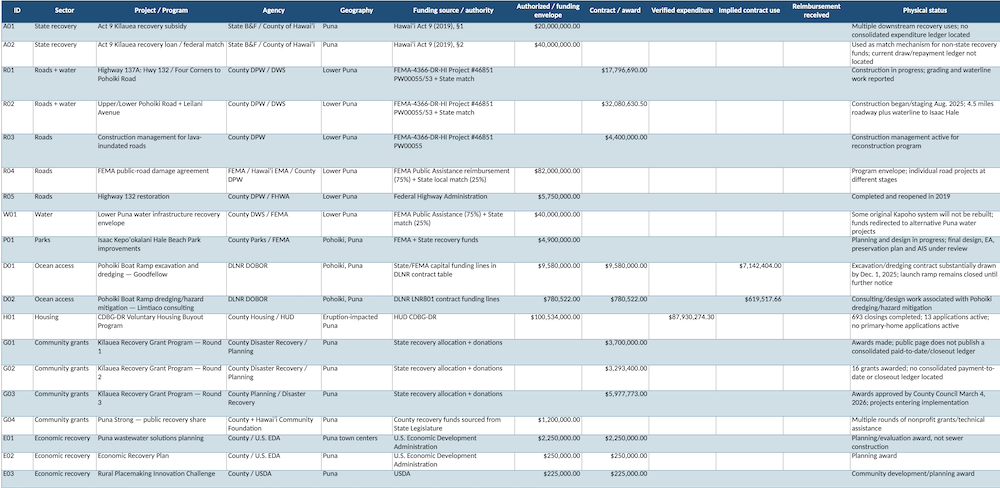
I built the first Puna Recovery Ledger as an audit workbook. It contains six working sheets: Dashboard, Executive Ledger, Road Contracts, DLNR Pohoiki, Round 3 Grants, Records Gaps, and Definitions. Every figure is classified as an appropriation, funding envelope, contract/award, explicit expenditure, or—in one narrowly defined case—an expenditure inferred from a reported outstanding contract balance. Blank means unknown, not zero.
As you can easily see, most of the programs are either not required to disclose their numbers, or havenʻt disclosed them, with no repercussions.
Several findings matter immediately.
1. We can now state the main road contracts exactly.
Isemoto’s Highway 137A base contract is $17,796,690 and Nan’s Pohoiki Road/Leilani Avenue contract is $32,080,630.50. Together that is $49,877,320.50 in construction contracts. The County separately awarded $4.4 million to Weley R. Segawa & Associates for construction management, bringing the identified road-program contracts to $54,277,320.50 before change orders.¹ ² ³
But I have not called that $54.3 million “spent.” I have not yet found a publicly accessible County ledger showing invoices and payments to Isemoto, Nan, or Segawa. Nor have I found the corresponding FEMA reimbursement transactions. That is now explicitly identified as a records gap in the workbook.
2. Act 9 gives us a particularly strong accountability hook.
The Legislature appropriated $20 million as a subsidy and $40 million as a loan, and the statute explicitly says Hawaiʻi County “shall report monthly expenditures” to the State Department of Budget and Finance.⁴ Those monthly reports are therefore not something we are merely asking government to create—they were legally required to exist. I have not located a public archive of them.
3. Housing is presently the cleanest actual-expenditure figure.
As of July 29, 2026, the County reports 693 completed buyout closings and $87,930,274.30 actually expended, with 13 active applications remaining and no primary-home applications still active.⁵
4. Pohoiki gives us something close to a real expenditure trail.
DLNR’s December 1, 2025 active-contract report breaks the Goodfellow dredging project into four funding lines totaling $9.58 million, with $2,437,596 still outstanding. Subtracting the outstanding balance from the contract maximum produces $7,142,404 of implied contract use by that date. I have deliberately labeled that implied use, not “cash paid,” because DLNR’s table does not expressly call the difference expenditures.⁶
There is another useful wrinkle here: the four DLNR funding lines total $9.58 million, whereas the original Goodfellow award was publicly described as roughly $9.28 million. That extra $300,000 needs to be reconciled against amendments or supplemental funding. And despite all of this expenditure, DOBOR’s current facility notice continues to say **“Pohoiki Launch Ramp will be closed until further notice.”**⁷
5. The community-grant story remains largely an award story.
Round 2 awarded $3,293,400. Round 3 was finally approved at $5,977,773 on March 4, 2026, including $500,000 for Vacationland roads, $500,000 for Leilani road restoration, $203,887 for Railroad Avenue, $140,940 for the Kapoho Kai water system, and $81,991 for the second phase of Holo Lio Road.⁸ ⁹ What is missing is a consolidated County table saying how much each recipient has actually received, spent, returned, and physically completed.
6. Physical completion remains a separate—and poorly reported—measure.
Highway 137A is officially targeted for Q3 2026; Pohoiki Road for Q2 2027. The County does not publish a current percentage-complete figure for either, so I did not invent one.¹⁰ Isaac Hale’s permanent improvements were still listed as “Planning and Design in Progress” on July 16, 2026.¹¹
The Records Gaps sheet is probably the most important part of the workbook now. It specifies ten document sets needed to finish the audit, starting with the Act 9 monthly reports, County general-ledger transactions, contractor pay applications and change orders, and FEMA Project 46851 reimbursement history.
Once those are obtained, we can produce the number that government press releases generally avoid:
- amount promised →
- amount contracted →
- amount actually paid →
- federal reimbursement received →
- amount remaining →
- percentage physically complete →
- what the public actually got.
Please subscribe and share.
This is a no-profit enterprise. If you care to support this effort I accept payments at http://www.hawicenter.com/payments, via Zelle, and at CashApp $richardbodien.
¹ County of Hawaiʻi, Department of Public Works, bid recap, “Reconstruction of Lava Inundated Roads, Highway 137A,” Job E-4523, April 11, 2024.
² County of Hawaiʻi, Department of Public Works, bid recap, “Reconstruction of Lava Inundated Roads—Upper Pohoiki Road/Leilani Avenue, Lower Pohoiki Road,” Job E-4523A, December 19, 2024.
³ County of Hawaiʻi, “Professional Services Awarded 2023–2024,” construction-management award C.011809, June 17, 2024.
⁴ Hawaiʻi, Act 9, H.B. 1180, Session Laws of Hawaiʻi 2019, §§1–3.
⁵ County of Hawaiʻi, “CDBG-DR Voluntary Housing Buyout Program,” figures as of July 29, 2026.
⁶ Hawaiʻi Department of Land and Natural Resources, Supplemental Budget Briefing: Active Contracts as of December 1, 2025, table 10, pp. 82–83.
⁷ Hawaiʻi Department of Land and Natural Resources, Division of Boating and Ocean Recreation, “Harbor and Facility Notices,” updated January 14, 2026.
⁸ County of Hawaiʻi, “Kīlauea Recovery Grant Program,” Round 2.
⁹ Hawaiʻi County Council, Resolution 459-26, Draft 2, adopted March 4, 2026.
¹⁰ County of Hawaiʻi, “Restoration of Pohoiki Road Begins,” August 29, 2025.
¹¹ County of Hawaiʻi Department of Parks and Recreation, “Parks Projects,” updated July 16, 2026.

Leave a Reply