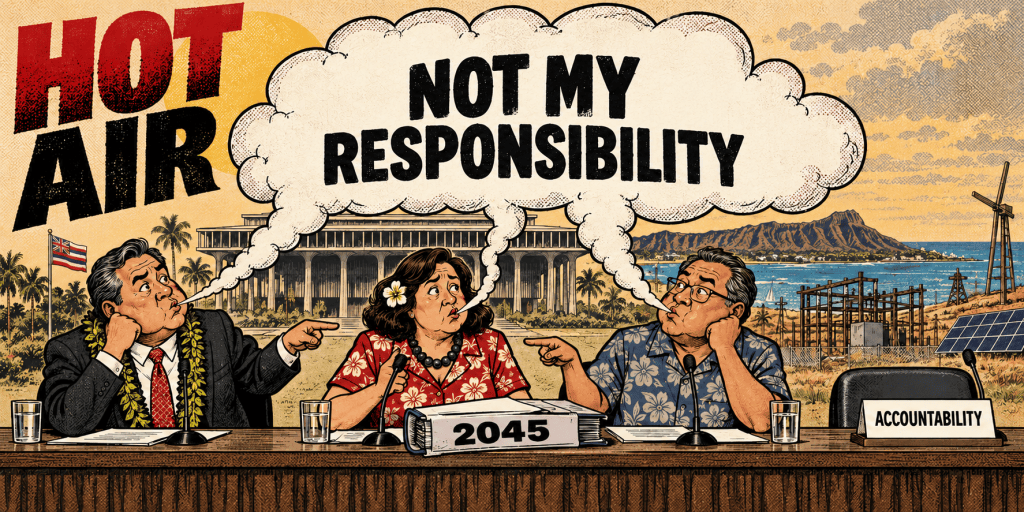
Somebody needs to be responsible for making Hawaiʻi’s energy promises happen.
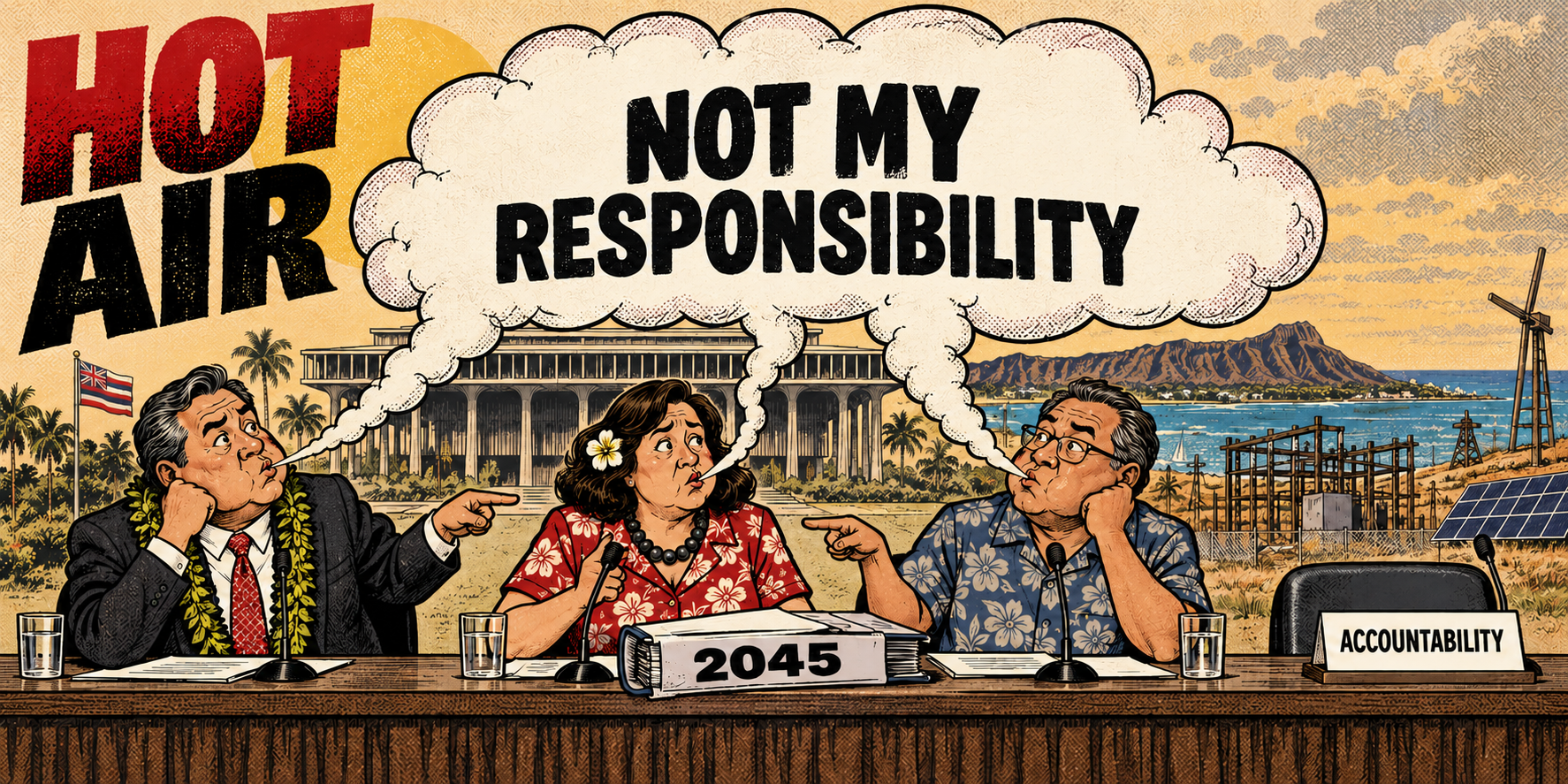
Hawaiʻi has adopted ambitious and well-needed energy goals. This is great on the surface, but once again, similar to our experiences with disaster recovery, these goals are trumpeted without specifying the fuel supplies, infrastructure, accounting rules, costs, and accountability needed to reach them.
We know the year: 2045.
We know the slogan: 100 percent renewable.
Who is responsible for delivering what must happen next year?
Henry Curtis raises the underlying problem in his recent Ililani Media article, “Getting Hawaii to 100% by 2045: The Questions Nobody Has Fully Answered Yet.” He distinguishes the renewable-electricity requirement, enforced against utilities through the Public Utilities Commission, from the broader statewide climate target.
Cleaning up electricity would be a substantial achievement. It would still leave major questions about aviation fuel, transportation, emissions accounting, and how the remaining transition gets financed.¹ Curtis asks what replaces petroleum jet fuel, where the replacement comes from, how much it costs, and how the state will count emissions. Those are essential questions.
An equally essential question belongs above them:
whose job is it to produce the answers—and by when?
A deadline twenty years away gives today’s officials considerable room to describe tomorrow’s accomplishments. By the time the deadline arrives, the governor may be retired, legislators may have moved on, agency directors will have changed, and consultants may be working under another contract.
The goals remains.
So do the bills.
That is why a distant target needs immediate obligations. Every year between the announcement and the deadline must have work attached to it, with a responsible office, a named official, a budget, and a result the public can examine.
Somebody must be able to say: this was my assignment; this is what we completed; this is what we spent; this is where we fell behind; and this is how we will recover.
Large public projects require cooperation. Utilities, regulators, legislators, departments, counties, contractors, and communities have different powers and obligations. A governor cannot manufacture aviation fuel by executive order. An agency director cannot spend money the Legislature has refused to provide.
Accountability must recognize those limits. It must also identify them.
If the Legislature has withheld necessary funding, identify the appropriation requested, the amount provided, and the work that cannot proceed. If an agency has failed to issue a decision, identify the decision and its deadline. If a contractor has missed a deliverable, publish the contract requirement and the remedy being pursued. If the proposed technology cannot do the job, revise the plan and explain the consequences.
The phrase “implementation challenges” tells the public almost nothing.
We need to know who controls the next step.
Curtis describes a broader climate law that directs the Climate Commission to pursue the goals and agencies to consider how their decisions affect them, without the same penalty-backed compliance structure as the utility standard.¹ That distinction matters. An obligation to consider a goal leaves substantial distance between acknowledging it and delivering it.
The Legislature should close that distance with specific duties and enforceable reporting requirements. Each major commitment should identify the lead agency, the responsibilities of cooperating agencies, annual milestones, the cost of meeting them, and what happens when performance falls short.
Progress reports should connect spending to results. Money appropriated is spending authority. Money awarded is a commitment. Money paid is an expenditure. The public needs to see what those expenditures produced.
For energy, that means operating generation, usable storage, completed grid improvements, reliable service, and measured emissions reductions. For agriculture, it means productive land, dependable water, viable farms, and food reaching buyers. For disaster recovery, it means restored services and completed repairs.
A report should make the difference between activity and accomplishment visible.
The measurements also need independent scrutiny. If agencies define success, select the evidence, and grade their own performance, the public has little protection against an increasingly generous definition of progress. Auditors and regulators need access to the underlying records and enough resources to examine them. Residents should be able to trace a reported achievement back to evidence.
Missed milestones should trigger action while there is still time to correct course: a public explanation, a revised completion schedule, a hearing where necessary, and consequences proportionate to the failure. Persistent neglect should affect appointments, contract renewals, and political support.
That does not mean punishing officials for every storm, price increase, or technological setback. It means judging whether they anticipated foreseeable problems, disclosed emerging difficulties, used their authority competently, and acted when the plan stopped working.
Honest uncertainty is useful.
Concealed failure is expensive.
Politicians should welcome this standard if they believe their promises. It gives competent officials evidence of accomplishment. It identifies where they need help. It prevents the next administration from inheriting a stack of commitments whose costs and unfinished work have been obscured.
The same officials who ask the public to believe in 2045 should be willing to publish what they owe us in 2027.
Hawaiʻi can set ambitious goals. But every goal needs an answer to a few ordinary questions:
Who is doing the work?
What must they deliver?
When is it due?
Who checks?
What happens if they fail?
Put names beside the promises.
Otherwise, it is just hot air.
¹ Henry Curtis, “Getting Hawaii to 100% by 2045: The Questions Nobody Has Fully Answered Yet,” Ililani Media, August 31, 2026.
Please subscribe and share.
This is a no-profit enterprise. If you care to support this effort I accept payments at http://www.hawicenter.com/payments, via Zelle, and at CashApp $richardbodien.

Leave a Reply