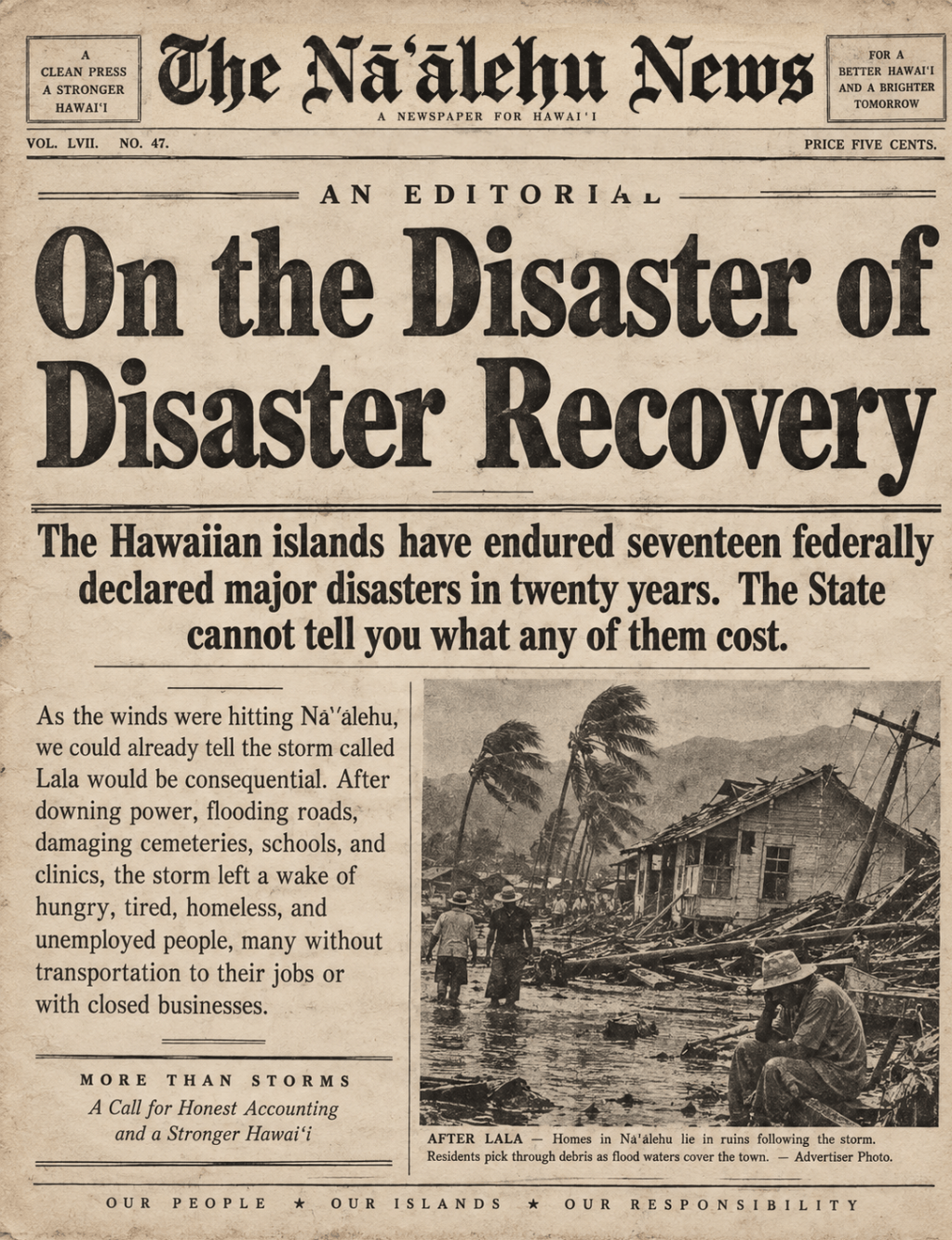
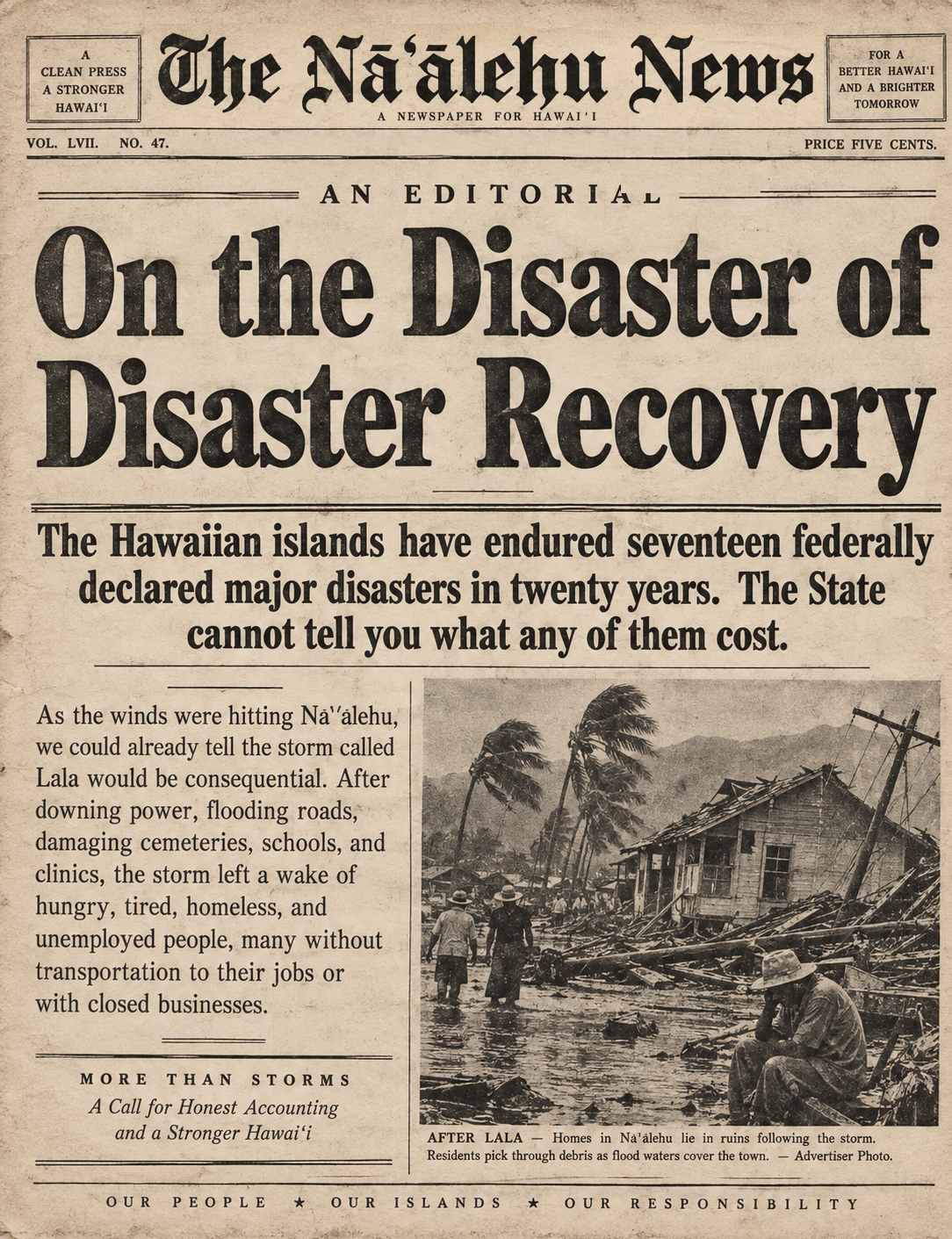
The Hawaiian islands have endured seventeen federally declared major disasters in twenty years. The State cannot tell you what any of them cost.
As the winds were hitting Nāʻālehu, we could already tell the storm called Lala would be consequential. After downing power, flooding roads, damaging or destroying homes, cemeteries, schools, and clinics, the storm left a wake of hungry, tired, homeless, and unemployed people, many without transportation to their jobs or closed businesses.
I knew that the experience of Puna and Lahaina were less than ideal. We can see what has and hasnʻt been done.
Why hasnʻt more been done?
Hundreds of millions of dollars were promised for “recovery,” to help make the affected people whole again.
Where did the money go?
I started to dig. The results of that research are this draft report. It is mostly complete but still needs verification in several places; they are flagged:
The Distance Between a Dollar and a Road:
Disaster Recovery, Private Consultants, Utility Regulation, and the Accountability Gap in Hawaiʻi
The report is too long for a blog post. You can find it here.
Here is a summary:
EXECUTIVE SUMMARY
The question
Hawaiʻi has experienced seventeen presidentially declared major disasters over the last twenty years. Announcements of recovery funding for those events are routine, and the figures announced are often large. This report asks what happens between the announcement and the finished asset, and finds that the State of Hawaiʻi cannot answer the question for any of them.
Not because the records are sealed. The numbers exist — in FEMA’s Public Assistance system, in Federal Highway Administration allocation tables, in HUD quarterly reports, in four county budgets, in state appropriations, and in at least one case in a settlement agreement filed under seal. They have never been assembled, because no office is charged with assembling them. When you try to assemble them yourself, the reasons why become the story.
The finding
The expected finding was corruption. The actual finding is structural: outcomes produced by people acting lawfully, within their authority, following procedures that did not require them to do anything that was not done. No statute obligated the verification. No form captured the arithmetic. No office was assigned the reconciliation.
That distinction has practical consequences. A corrupt official can be indicted and replaced, and the machine resumes working. A structure that produces these outcomes while everyone behaves properly will produce them again after the next storm.
A structure that generates these outcomes while everyone behaves properly will generate them again.
The single strongest piece of evidence assembled here is a February 12, 2026 examination by the Office of the New York State Comptroller of payments the New York State Division of Homeland Security and Emergency Services made to Tidal Basin Government Consulting under a contract totaling $91.7 million. During a twelve-month examination period, the Division paid the firm $24.1 million — $22.5 million for professional services and $1.6 million for travel.
The auditors did not find that the charges were improper. They found that the Division lacked the controls necessary to establish whether they should have been paid. That the examination was performed by a New York official rather than a Hawaiʻi one states the report’s central problem in a single fact: the same category of firm performs the same category of work here, and no equivalent Hawaiʻi examination has been located.
The organizing device
Money moves along a five-rung ladder. Each rung is a separate event, separated from the next by months or years, and each is a place where the process can stop without anyone noticing that it has.
appropriated → awarded → obligated → spent → built
| Rung | What it means | Where the record fails |
| Appropriated | A legislature has set money aside. | Reported publicly as though the work were funded and underway. |
| Awarded | An allocation is made to a grantee. | Contract ceilings quoted as if they were disbursements. |
| Obligated | Funds are committed against a project. | Federal Emergency Relief money can sit obligated in a national queue for years. |
| Spent | Money has actually been paid out. | Quarterly performance reports stop appearing; nobody writes to ask why. |
| Built | A road, a house, a hardened pole exists. | Composite percentages fold occupied homes together with permit applications. |
Nearly every misleading public statement examined in this report is produced by collapsing that ladder — by reporting a contract ceiling as a disbursement, an obligation as a completion, or a request for release of funds as houses rebuilt. A companion taxonomy identifies seventeen named mechanisms by which public legibility degrades at these transitions. None of them requires anyone to make a false statement.
Utility money moves through a longer version of the same ladder, and Part VII follows one program down it: proposed → plan approved → cost recovery authorized → collection permitted → collected → spent → built → return earned.
What the record shows
The state’s own accounting does not reconcile.
Four declarations on the Hawaiʻi Emergency Management Agency’s public history page carry both a stated total and an itemized breakdown. In all four, the items do not sum to the total, with gaps between 4.80 and 8.30 percent. There is probably an innocent explanation involving administrative cost categories omitted from a two-line breakdown. That explanation appears nowhere on the page. This is the most complete public disaster accounting the State produces, and it does not internally reconcile.
Reporting stops, and nobody writes to ask why.
Kauaʻi County posted quarterly performance reports on its 2018 flood CDBG-DR grant through all of 2021, 2022, 2023 and 2024, and then stopped. Eight years after the flood, no member of the public can determine how much of the $9,176,000 has been spent, on what, or whether anything was built.
Composite percentages travel further than measurements.
Maui County’s three-year Lāhainā update reported that 2,248 of 2,746 lost housing units — 81.9 percent — are “on a path toward rebuilding.” An independent analysis of roughly 1,000 disaster-recovery permits obtained by records request found approximately 25 percent of destroyed single-family homes actually rebuilt. The figures are not in conflict, because they do not measure the same thing. Of the 2,248 units on the path, roughly 1,264 are permits.
A percentage combining completed construction with a pending application is not a measure of housing — and it is the number that travels.
A count of declarations is a lagging indicator of disaster burden.
The magnitude 6.0 South Kona earthquake of May 22, 2026 damaged 548 homes in a district where two households carried earthquake insurance. Two houses, not two percent. The governor requested a major disaster declaration on July 20; the declaration issued September 2, at 103 days. For that entire interval there was no insurance layer and no federal individual assistance layer, and the event appeared in no federal dataset, because federal datasets are keyed to declarations.
Not every declaration rebuilds anything.
The federal action following Hurricane Lala was an emergency declaration under Title V of the Stafford Act, authorizing emergency protective measures under Category B at 75 percent federal funding. It authorizes no permanent work and no Individual Assistance. The State’s announcement described assistance for three counties; FEMA’s release, issued the same day, designated one.
Consultants operate inside the machinery, not beside it.
The record does not show that private firms determined how much assistance Hawaiʻi received. Those decisions were made by Congress, HUD, FEMA, the Legislature, and county governments acting under statutes, appropriations, formulas, and grant rules. What the record does show is firms participating in the production of the information on which those decisions depend — damage assessment, eligibility, replacement cost, unmet need, benefit- cost analysis, program design — and, in at least one case, moving from recovery management into the design of the programs governing a $1.639 billion grant. Authority and influence are not the same thing.
Contract ceilings are not payments.
Maui County reported total Office of Recovery professional-services spending of $6,210,688 across all vendors as of April 1, 2026. That single figure does more analytical work than any contract ceiling in the record, and it is the reason no sentence in this report asserts that any firm was paid its contract maximum.
The utility case is the same collapse inside a regulatory body.
A wildfire program publicly described as roughly $480 million was approved on December 31, 2025; approximately $350 million in cost recovery was authorized on June 25, 2026; the securitization application had not been filed as of August 2026; and not one dollar has been collected from a ratepayer. In Lāhainā itself, thirty-three months after the fire, the work amounted to nineteen new poles along a two-mile stretch of highway. In the same order approving the program, the Commission required progress and expenditure metrics for the first time and identified twenty-five areas for continued improvement — the regulator conceding, in writing, that it could not verify what it was approving.
Counter-evidence carried
Facts that cut against the simplest version of this argument belong in the argument, and are retained here rather than confined to a caveat.
- Real work has been delivered: sewer service in Lāhainā fully restored in April 2025, debris disposal completed at the end of 2025, Front Street reopened to vehicles on August 1, 2026, Highway 132 rebuilt in Puna, and thousands of poles replaced or upgraded across the Hawaiian Electric system.
- Securitized wildfire mitigation costs will not enter rate base, a qualification confirmed by the company’s chief financial officer.
- The Public Utilities Commission discharged both of its Act 258 study obligations on time.
- The Puna funding increase followed both a revised technical assessment and documented advocacy by a senior appropriator. A report arguing that upstream information shapes downstream awards should not suppress the evidence that upstream advocacy does too.
- Section 428 of the Stafford Act explains most apparent discrepancies between an announced federal amount and a construction contract. It should be checked before any such gap is treated as an error, because it usually is not one.
- In the Horne matter in Texas, the contracting agency stated that the commissioner played no role in the selection and that three senior officials chose the firm through a federally compliant procurement. That rebuttal is a material fact and is carried in the body.What followsThe report makes no finding of corruption, and none is required. It sets out eighteen findings and eleven ordered remedies. The first remedy is the highest-value action identified and requires no new legislation: an examination by the Hawaiʻi State Auditor, or by county auditors, of payments to disaster-recovery consultants — whether invoices were compared against approved staffing plans, whether official duty stations were designated, and what documentation supports each certification that a charge was just, true, correct, and appropriate to pay.
The remainder concerns disclosure: an invoice-level recovery ledger placing contracts, payments, verifications, work product, political finance, and lobbying on one timeline; publication of Section 428 fixed-cost agreements; a quarterly mitigation scorecard reported as a table rather than a narrative; annotation of the state history page; restoration of Kauaʻi’s missing quarterly reports; and resolution of a Commission investigation currently routed into a container incapable of producing a finding.
None of this requires new legislation. All of it requires someone to ask.
Note on the state of the record. Claims that remain unverified at the time of writing are flagged at the point where they appear in the body and consolidated in the verification register at Appendix A. The absence of verification is treated throughout as a documented finding rather than as a reason to omit a claim. Figures, dates, and case-specific claims summarized in this overview are sourced in the body of the report.
Let me know what you think.
Please subscribe and share.
This is a no-profit enterprise. If you care to support this effort I accept payments at http://www.hawicenter.com/payments, via Zelle, and at CashApp $richardbodien.


Leave a Reply