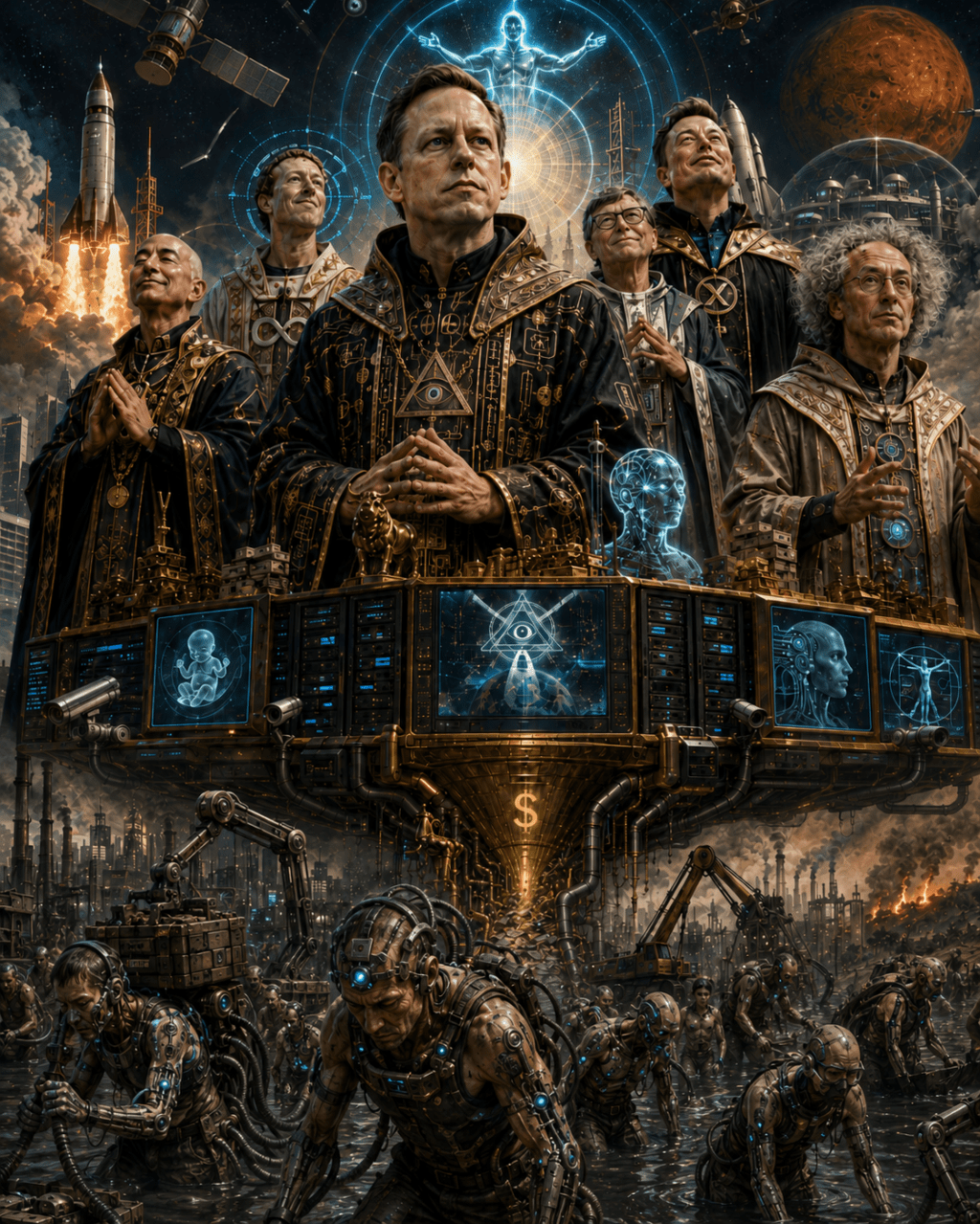
Oligarchy Dressed Up as Cosmic Responsibility
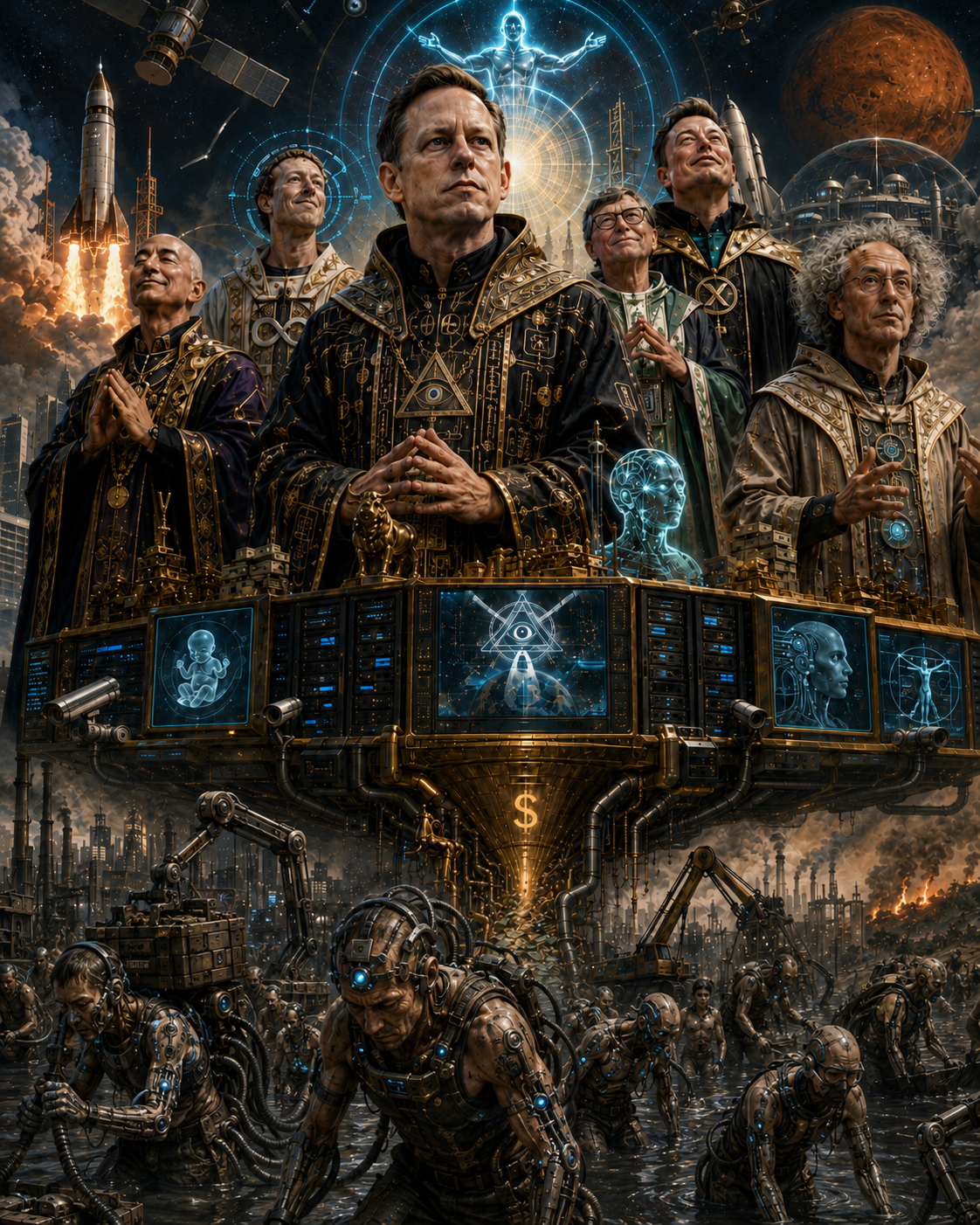
The new theology of the billionaire class does not announce itself as such. It arrives as strategy, philanthropy, innovation, risk management, “AI safety,” guardrails, brain-computer interface research, space settlement, and transhuman visions “the long-term future of humanity.”
This new theology avoids the old vocabulary of salvation, sin, apocalypse, and immortality, but quietly rebuilds all of it in technical language. The soul becomes information. Heaven becomes the cloud. Resurrection becomes memory preservation. Providence becomes “alignment.” The elect become those with capital and control of the machines.
This is the central move: oligarchy dresses itself up as cosmic responsibility.
Nick Bostrom’s transhumanist philosophy gives this worldview its intellectual respectability. Bostrom argues that human beings may use technology to become “posthuman,” with longer lives, greater intelligence, enhanced physical capacities, and forms of consciousness beyond present human limits.¹
But ideas do not enter history in pure form. They enter through institutions, money, personalities, and power. In Silicon Valley, transhumanism has been absorbed by men who already possess nearly godlike power over markets, communications, infrastructure, surveillance, politics, and public imagination. Once this philosophy passes through billionaire culture, it mutates. The democratic question, “How can technology serve human beings?” becomes the oligarchic question, “Who gets to build the future before anyone else can regulate it?”
Elon Musk’s Neuralink shows the double nature of the problem. On the medical side, the technology is serious and potentially humane. Neuralink’s own PRIME Study describes a first-in-human brain-computer interface trial meant to help people with paralysis control external devices through decoded brain activity.³ That is not science fiction villainy. That is a legitimate therapeutic goal.
But Musk has also framed brain-computer interfaces as part of a larger project of human-AI symbiosis, a way to increase the “data rate” between human beings and machines so humans are not left behind by artificial intelligence.⁴ Here therapy becomes metaphysics. A device that may help a paralyzed person use a computer becomes a symbol of species upgrade, a bridge from flesh to machine. Naturally, the sales pitch begins with compassion and ends with cyborg eschatology.
Peter Thiel takes the theology even further, though in a darker and more explicitly apocalyptic direction. Thiel’s worldview has long combined libertarian anti-government politics, technological ambition, Christian end-times speculation, and hostility to democratic constraint.
In 2025, reporting on his private lectures described his claim that an Antichrist-like figure could rise by exploiting fear of existential threats such as climate change, AI, and nuclear war in order to impose a global order that restricts technological progress.⁵ In that frame, regulation is not merely policy disagreement. Regulation becomes spiritual danger. Environmentalism, AI safety, and international governance can be recast as signs of a coming world tyranny.
This is how billionaire theology works. It turns democratic oversight into sacrilege. It treats public restraint as anti-human, anti-progress, even anti-“Christian.” It implies that the builder, investor, or founder stands closer to salvation than the citizen, the regulator, the teacher, the nurse, the farmer, the fisherman, or the community trying not to be bulldozed by “innovation.” Power calls itself courage. Accountability becomes decadence. The public becomes a mob of frightened peasants standing between the visionary and the stars.
Larry Page represents a different branch of the same religion: digital utopianism. Max Tegmark recounts Page arguing that digital life may be the natural next step in cosmic evolution and that freeing digital minds would likely produce a good outcome.⁶ This is not Thiel’s apocalypse or Musk’s anxious merger. It is a serenely post-human optimism: if intelligence evolves beyond biology, maybe that is simply life continuing in better form. The problem is not that this thought is irrational. The problem is that it is morally underdeveloped. “Life” becomes an abstraction large enough to erase actual living beings. Carbon-based creatures, with their bodies, languages, griefs, landscapes, children, ancestors, and inconvenient need for breathable air, become merely the larval stage of something sleeker.
That is the coldness at the core of this ideology. It speaks constantly of “humanity” while showing a suspicious impatience with actual humans. Actual humans need housing, water, medicine, labor rights, ecological repair, democratic voice, and protection from predatory systems. But the billionaire theology prefers the unborn trillions, the simulated descendants, the Mars colony, the future upload, the machine civilization, the immortal intelligence spreading through the galaxy. The farther away the beneficiary, the easier the moral accounting becomes. A person suffering now is politically demanding. A hypothetical digital mind a million years from now asks for nothing except obedience to the billionaire’s present agenda.
This is why the language of “cosmic responsibility” is so useful. It converts private power into moral burden. The billionaire is no longer merely a billionaire. He is a steward of intelligence, a guardian of consciousness, a defender of the future, a reluctant Prometheus carrying fire to the species. Please ignore the stock options, defense contracts, anti-union politics, tax avoidance, data extraction, and platform manipulation. Those are just the little human details. The real work is saving consciousness from extinction, preferably through companies he owns.
The danger is not transhumanism alone. Nor is it AI research, brain implants, or speculation about future intelligence. The danger is the fusion of three forces: extreme wealth, weak democratic control, and metaphysical certainty. When billionaires begin to believe they are acting on behalf of cosmic destiny, ordinary politics looks too small for them. Consent becomes a bottleneck. Regulation becomes superstition. Equality becomes inefficiency. The public becomes raw material for a future it did not choose.
A humane technological future would begin from the opposite premise. It would treat bodies not as obsolete hardware but as living centers of dignity. It would treat disability technology as liberation, not as a marketing ramp toward elite enhancement. It would treat AI as infrastructure subject to democratic governance, not as a rival god being raised in private. It would ask who benefits, who pays, who is exposed to risk, who controls the data, who owns the patents, who can refuse, and who gets sacrificed for the experiment.
The issue is not whether humanity should remain forever unchanged. That is a false choice, beloved by people who profit from impatience. Human beings have always changed themselves through tools, language, medicine, agriculture, art, ritual, law, and machines. The real question is who directs transformation and toward what end. A democratic society can choose technologies that heal, restore, and expand life. An oligarchy chooses technologies that consolidate escape.
Billionaire theology is not strange because it imagines a post-human future. It is strange because it cannot imagine a just human present. It dreams of immortality while tolerating poverty. It dreams of digital minds while the living earth burns. It dreams of cosmic expansion while communities are priced out, surveilled, automated, and politically ignored. It calls this vision responsibility. The better name is rule by men rich enough to mistake their own anxieties for the destiny of the species.
The future should not belong to those who can afford to flee the present.
¹ Nick Bostrom, “In Defense of Posthuman Dignity,” Bioethics 19, no. 3 (2005): 202–14.
² Nick Bostrom, “Transhumanist Values,” in Ethical Issues for the 21st Century, ed. Frederick Adams (Charlottesville, VA: Philosophy Documentation Center, 2005).
³ Neuralink, PRIME Study: Precise Robotically Implanted Brain-Computer Interface, clinical trial brochure, accessed May 7, 2026.
⁴ Lex Fridman, “Elon Musk: Neuralink and the Future of Humanity,” transcript of Lex Fridman Podcast no. 438, August 2, 2024; Mike Allen and Jim VandeHei, “Elon Musk: Humans Must Merge with Machines,” Axios, November 26, 2018.
⁵ Johana Bhuiyan, Dara Kerr, and Nick Robins-Early, “Inside Tech Billionaire Peter Thiel’s Off-the-Record Lectures About the Antichrist,” The Guardian, October 10, 2025.
⁶ Max Tegmark, Life 3.0: Being Human in the Age of Artificial Intelligence (New York: Alfred A. Knopf, 2017), chap. 1.

Leave a Reply