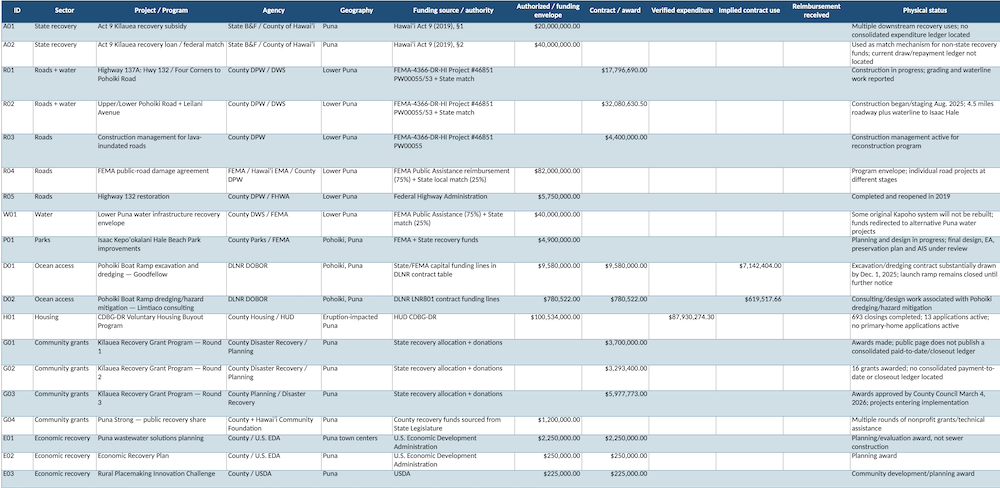
The revised Puna Recovery Ledger (DRAFT, rev. October 13, 2026) can be downloaded at www.bodien.com/downloads.
I built the Puna Recovery Ledger as an audit workbook for the money spent since the 2018 Kīlauea eruption. It has seven working sheets: Dashboard, Executive Ledger, Road Contracts, DLNR Pohoiki, Round 3 Grants, Records Gaps, and Definitions, plus a Change Log that records every correction made since the first draft.
Every figure sits on one rung of a ladder: money appropriated, awarded, obligated, spent, reimbursed, and finally built. Government announcements tend to report the lower rungs as if they were the higher ones. The ledger keeps them apart. In one narrowly defined case it records implied spending, calculated from a contract’s ceiling minus its reported unpaid balance, and labels it as such. A blank cell means unknown, not zero.
Most of these programs are required to account for their money. Very little of that accounting reaches the public in a form anyone can use. Several findings follow.
1. The road contracts can be stated exactly. What has been paid on them cannot.
Isemoto Contracting’s Highway 137A contract is $17,796,690. Nan, Inc.’s contract for Upper and Lower Pohoiki Road and Leilani Avenue is $32,080,630.50. Together that is $49,877,320.50 in construction. The County separately awarded $4.4 million to Weley R. Segawa & Associates for construction management, bringing the identified road contracts to $54,277,320.50 before change orders.¹ ² ³
I have not called that $54.3 million “spent.” I have found no public County ledger of invoices or payments to Isemoto, Nan or Segawa, and no record of the corresponding FEMA reimbursements. The work is to be paid 75 percent by FEMA and 25 percent by State recovery funds.⁴
These two contracts are also not the whole road program. The County put lava damage to public roads at about $82 million.⁵ Two remaining segments, Highway 137 from Pohoiki Road to MacKenzie and the short Lighthouse Road, were still in design at the County’s last public update, and I have found no award for either.
2. The schedule has already slipped, and the slippage is itself a record.
Isemoto received notice to proceed on June 24, 2024, under an 18-month contract. The County’s target was March 2026.⁶ By August 2025 the target had moved to the third quarter of 2026.⁷ In April 2026 crews were laying base course ahead of paving.⁸ That quarter ended on September 30. As of October 13, I have found no public notice that Highway 137A is complete or open.
An 18-month contract running past two years usually means a time extension or a change order. Either one is a document, and either can be requested. Pohoiki Road is now targeted for the middle of 2027.⁸ The permanent improvements at Isaac Hale Beach Park were still listed as “Planning and Design in Progress” on July 16, 2026.⁹
3. Act 9 is the strongest accountability hook in the record.
In 2019 the Legislature appropriated $20 million as a subsidy and $40 million as a loan to Hawaiʻi County, the loan to help match federal recovery funds. The statute is explicit: “The county of Hawaii shall report monthly expenditures to the department of budget and finance.”¹⁰
Those monthly reports are not something we are asking government to create. The law required them to exist. Years of them should be on file at the State Department of Budget and Finance. I have not located a single one in public.
4. Housing is the one program with a clean expenditure figure.
As of July 29, 2026, the County reports 693 completed buyout closings and $87,930,274.30 actually expended, with 13 applications still active and no primary-home applications remaining.¹¹ That squares with the County’s own early-2026 count of 626 properties acquired and 82 in escrow.¹² The average works out to about $127,000 per closing, reflecting the mix of homes and vacant lots.
This is the program that has done what it said it would do, and it deserves to be said plainly. One question remains: the buyout budget is about $100.5 million, so roughly $12.6 million had not yet been spent as of July. Where that balance goes as the program closes should be on the public record.
5. Pohoiki shows what “spent but not built” looks like.
In 2023 the Legislature set aside $35 million for the Pohoiki boat ramp, toward DLNR’s preferred plan of removing most of the volcanic debris from the bay, estimated at $40 million. Budget cuts reduced it to $6.645 million, which paid only for a narrow channel dredge. The 2023 environmental assessment had warned that a channel alone could fill back in.¹³
DLNR’s December 1, 2025 contract report breaks the Goodfellow Bros. contract into four funding lines totaling $9.58 million, with $2,437,596 still outstanding.¹⁴ Subtracting the balance from the ceiling gives $7,142,404 of implied contract use. I call it implied use, not “cash paid,” because DLNR’s table does not label the difference as payments.
The funding codes on those lines explain a discrepancy I flagged in the first draft. In Hawaiʻi’s budget, A means general funds, B special funds, and C general obligation bonds.¹⁵ The general-fund line ($5.4 million) plus the bond line ($1.245 million) equals exactly the $6.645 million left after the cuts. Adding the first special-fund line ($2.635 million) gives $9.28 million, the award as reported.¹⁶ A second special-fund line of $300,000, entirely undrawn as of December 1, brings the total to $9.58 million. No line is coded as federal money: the State paid for the dredge up front. That reading is my inference from the codes. It still needs to be checked against the contract amendments.
Here is what the money bought. On October 10, 2025, after removing about 46,000 cubic yards of sand and rock, the contractor opened a channel to the ramp for the first time since the eruption. Between October 16 and 19, ocean swells filled it back in.¹⁷ DLNR’s contract report, with its $7.1 million in implied use, is dated six weeks after the channel closed. The ramp remains shut.
In February 2026 FEMA approved $4 million that Representative Greggor Ilagan said would reimburse the State’s general fund for the dredge. Councilmember Ashley Kierkiewicz responded that the community needed “10 times that.”¹⁸ Ilagan has requested $1 million to design two jetties, a project he estimates at more than $60 million.¹⁹
The other side belongs on the record too. DLNR knew the risk and said so in writing. Its chair, Dawn Chang, explained that the State chose to try the channel because waiting for full funding might have meant waiting forever.¹⁹ That is a defensible judgment about a bad set of options. But the ledger’s job is to record outcomes, and on the last rung of the ladder Pohoiki reads: spent, about $7 million; built, nothing usable.
6. The community-grant story is still an award story.
The Kīlauea Recovery Grant Program has made three rounds of awards: about $3.7 million in Round 1 (one $104,500 award was later declined), $3,293,400 in Round 2, and $5,977,773 in Round 3, approved by the County Council on March 4, 2026.²⁰ ²¹ Round 3 includes $500,000 for Vacationland roads, $500,000 for Leilani road restoration, $203,887 for Railroad Avenue, $140,940 for the Kapoho Kai water system and $81,991 for the second phase of Holo Lio Road.²² Together the three rounds total about $13 million.
The County publishes the awards. It does not publish how much each recipient has received, spent, returned or finished. The program is funded with State recovery money. If that money came from the Act 9 subsidy, as appears likely, the missing monthly reports would show these grants too.
What the public can check without asking
Before filing a single records request, three public sources can supply part of what the ledger lacks:
- The County’s federal single audits, filed with the Federal Audit Clearinghouse, which report federal money actually spent each year by program, including FEMA Public Assistance and the HUD disaster grant.
- FEMA’s OpenFEMA data, which lists the federal share obligated for each Public Assistance project under the 2018 disaster declaration.
- HUD’s Disaster Recovery Grant Reporting system, whose quarterly reports show what the County has drawn on its HUD grant, activity by activity.²³
These fill the obligated and spent rungs where the County’s own pages stop at awarded.
What still has to be requested
The Records Gaps sheet lists the documents needed to finish the audit, beginning with the Act 9 monthly reports, the County’s general-ledger transactions, the contractors’ pay applications and change orders for both road contracts, and FEMA’s reimbursement history for the road project. The Pohoiki records are now on the list as well: the final Goodfellow ledger, the $300,000 line, and proof that the $4 million from FEMA was actually received.
Once those records are in hand, we can produce the figures that government press releases generally avoid:
- amount promised →
- amount contracted →
- amount obligated by FEMA or HUD →
- amount actually paid →
- federal reimbursement received →
- percentage physically complete →
- what the public actually got.
Pohoiki is the reason the last line matters. Every rung above it can be filled in, and the answer can still be a closed boat ramp.
Please subscribe and share.
This is a no-profit enterprise. If you care to support this effort I accept payments at http://www.hawicenter.com/payments, via Zelle, and at CashApp $richardbodien.
¹ County of Hawaiʻi, Department of Public Works, bid recap, “Reconstruction of Lava Inundated Roads, Highway 137A,” Job E-4523, April 11, 2024.
² County of Hawaiʻi, Department of Public Works, bid recap, “Reconstruction of Lava Inundated Roads—Upper Pohoiki Road/Leilani Avenue, Lower Pohoiki Road,” Job E-4523A, December 19, 2024.
³ County of Hawaiʻi, “Professional Services Awarded 2023–2024,” construction-management award C.011809, June 17, 2024.
⁴ “Work starts to restore 4.5-mile section of Pohoiki Road,” Hawaii Tribune-Herald, August 29, 2025.
⁵ County of Hawaiʻi, Kīlauea Recovery, “Roads” (cost agreement announced March 2020: about $61.5 million federal, $20.5 million County match covered by State loans).
⁶ County of Hawaiʻi, Kīlauea Recovery, “Roads”; “Repair work for lava-covered Big Isle highway on schedule,” The Garden Island, November 21, 2024.
⁷ County of Hawaiʻi, “Restoration of Pohoiki Road Begins,” news release, August 29, 2025.
⁸ “‘We’re ready to go’: After 8 long years, lower Puna residents are eager to drive home,” Hawaii Tribune-Herald, April 19, 2026.
⁹ County of Hawaiʻi, Department of Parks and Recreation, “Parks Projects,” updated July 16, 2026.
¹⁰ Hawaiʻi, Act 9, Session Laws of Hawaiʻi 2019 (H.B. 1180, H.D. 1), §§1–3, approved April 16, 2019.
¹¹ County of Hawaiʻi, “CDBG-DR Voluntary Housing Buyout Program,” figures as of July 29, 2026.
¹² County of Hawaiʻi, 2026 Annual Action Plan (draft, January 2026), Year 2 of the 2025–2029 Consolidated Plan.
¹³ Hawaiʻi Department of Land and Natural Resources, news release NR25-124, October 23, 2025.
¹⁴ Hawaiʻi Department of Land and Natural Resources, Supplemental Budget Briefing: Active Contracts as of December 1, 2025, table 10, pp. 82–83.
¹⁵ Legislative Reference Bureau, Public Access Room, “The Budget Process” (means-of-financing codes).
¹⁶ The Hawaii Tribune-Herald reported the award as $9.2 million and said DOBOR covered the amount above the $5.4 million budget with department funds. “Pohoiki dredging could soon begin,” December 15, 2024.
¹⁷ DLNR, NR25-124; “Long-term solutions being explored after dredging of Pohoiki Boat Ramp failed,” Big Island Now, October 29, 2025.
¹⁸ “FEMA approves $4M for permanent repairs to Pohoiki boat ramp, but more funding needed,” Big Island Now, February 20, 2026.
¹⁹ Big Island Now, October 29, 2025; Big Island Now, February 20, 2026.
²⁰ County of Hawaiʻi, “Kīlauea Recovery Grant Program,” Rounds 1 and 2.
²¹ Hawaiʻi County Council, Resolution 459-26, Draft 2, adopted March 4, 2026.
²² “Council awards Kilauea recovery grants to Puna nonprofits,” Hawaii Tribune-Herald, March 8, 2026.
²³ Federal Audit Clearinghouse; FEMA, “OpenFEMA Dataset: Public Assistance Funded Projects Details”; HUD, Disaster Recovery Grant Reporting System, public reports.

Leave a Reply