
In Hawaiʻi, we have no idea where our money is going. That infrastructure funding is so well hidden cries for attention as we suffer the consequences of our fragile electric, road, bridge, and healthcare systems.
Just Scratching the Surface…and It Stinks
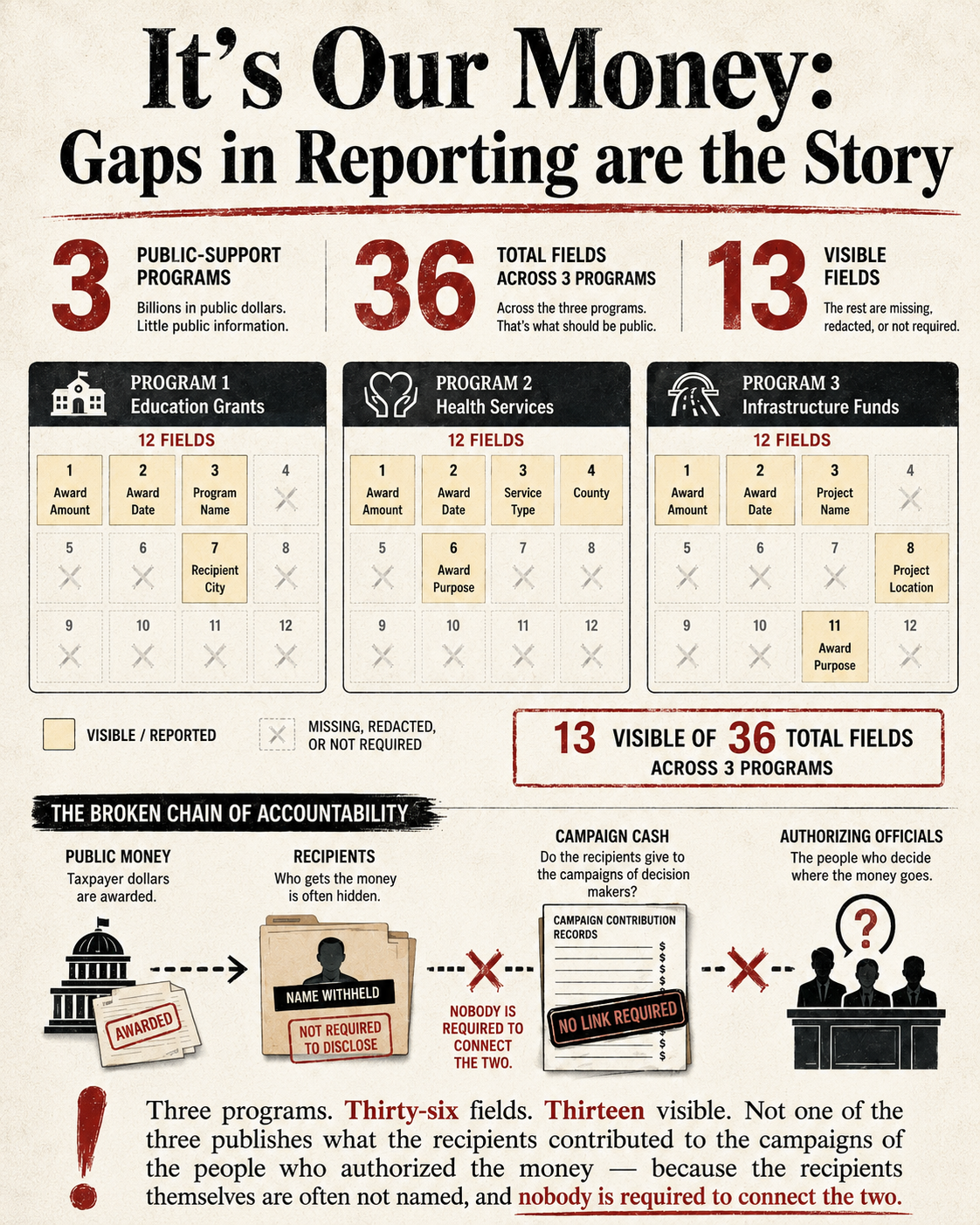
Three programs. Thirty-six fields. Thirteen visible. Not one of the three publishes what the recipients contributed to the campaigns of the people who authorized the money — because the recipients themselves are often not named, and nobody is required to connect the two.
Two of the three carry no clawback at all. Two require nothing about jobs or wages. And the largest single commitment — nearly $400 million in public bonds plus 73 acres of state land — was approved by a public authority that then withheld the contract terms.
This ledger is a prototype built in an afternoon from public sources. A funded organization could build the real one, statewide, and keep it current.
- Require every recipient of a state subsidy, contract, or land concession to be named in a single public register — with the value, the authorizing act, and the responsible official.
- Require annual performance reporting against stated promises, with automatic expiration and clawbacks when promises break.
- Require disclosure of campaign contributions and lobbying expenditures by any entity receiving state benefits, cross-linked to the benefit received.
- Bar campaign contributions from entities holding active state subsidies, contracts, or concessions.
Towards an Hawaiʻi Public Support Ledger
Hawaiʻi Public Support Ledger Pilot — three entries assembled from public records
The state hands out money, land, and privilege. Almost all of the record exists — scattered across procurement files, tax reports, campaign filings, and lobbying disclosures. Nobody assembles it. Here is what happens when someone does. Each entry records what the public gave, who received it, who authorized it, what was promised in return, and whether anyone checked. Sources are listed with every entry.
13/36
The number of fields a member of the public can actually see, across three programs worth $442.5 million.
- Prototype, August 2026. Figures compiled from: DBEDT, Assessing the Impacts of Hawaiʻi’s Film Tax Credit in 2024 (December 2025); Hawaiʻi Film Office incentive documentation, HRS §235-17 and Act 217 (2023); DBEDT Tax Credit for Research Activities program materials, HRS §235-110.91; Aloha Stadium Authority NASED project documentation and FAQ; Act 268 (2019); Hawaiʻi Business Magazine, “Aloha Stadium’s $4 Billion Gamble” (March 2026); Honolulu Civil Beat, “It’s Time To Re-Envision The Aloha Stadium District” (July 2026) and “Public Needs To Know More About State’s Massive Stadium Project” (October 2025); Spectrum News Hawaiʻi (May 2026).
- Dollar figures are not directly comparable: the film and research credits are annual, the stadium commitment is one-time capital plus a land concession. “Not disclosed” means the information is not published in any form an ordinary resident can retrieve — not that it does not exist somewhere in state files.
This is not yet “every transfer.” It establishes the data architecture and seeds it with five major 2023 public-support programs representing $265.018 million in primary reported support, plus 52 Enterprise Zone firms publicly identified by DBEDT as certified as eligible for 2023 tax incentives. I deliberately did not manufacture campaign-finance or lobbying connections where entity-level matching has not yet been verified.
The workbook contains a dashboard, the master ledger, the 52-firm Enterprise Zone recipient crosswalk, a source map, a data dictionary, and—importantly—a Transparency Gaps sheet documenting where Hawaiʻi’s disclosure system itself prevents accountability.
Several findings already demonstrate why this ledger is necessary.
First, the procurement database is not a complete record of public spending. HANDS explicitly excludes awards from SPO price/vendor-list contracts, small purchases under $2,500, and Chapter 42F grants. More seriously, the State Procurement Office checked FY2021 agency contract logs and found that 48 percent of contract awards that should have been posted were not posted to HANDS.¹
Second, tax subsidies are structured so the public can often learn how much a program costs without learning who received the money. DOTAX’s 2023 tax-credit report is compiled directly from tax returns, but the department suppresses small or potentially identifying tabulations to preserve taxpayer confidentiality.² The result is an accountability wall: we can know, for example, that 55 returns claimed $60.9 million in Low-Income Housing Tax Credits, but the tax report does not tell us which projects received how much, what units those projects promised, or what was actually delivered.³
The same problem occurs with the affordable-housing GET exemption. Hawaiʻi estimates that exemption at $55.206 million in 2023, associated with about $1.380 billion in exempt gross receipts. The latter is not the subsidy value; DOTAX explicitly describes the $55.206 million figure as a tax-expenditure estimate. Recipient-level GET return information is confidential.⁴
Third, simple numbers do not reconcile. DBEDT says 25 film productions claimed $37.3 million in film credits in 2023. DOTAX’s tax-return data say 24 returns claimed $43.5 million for tax year 2023. Those figures can differ because the agencies are measuring different reporting and claiming periods. The ledger therefore preserves both instead of quietly choosing whichever number makes the better argument.⁵
The film program also illustrates why the ledger separates money spent, promises made, outcomes reported, and outcomes actually attributable to the subsidy. DBEDT reports 9,168 supported jobs, including 7,770 resident jobs and $56.5 million paid to Hawaiʻi residents. But DBEDT itself warns that the job number can count the same worker several times and that nearly half the resident jobs were extras. Average earnings for local below-the-line jobs were only $6,688. On a state-revenue basis, DBEDT estimated the credit returned about 50 cents in state tax revenue for every dollar of credit, falling to 35 cents under its redundancy assumption.⁶
Enterprise Zones reveal another form of fragmentation. DBEDT publicly names firms certified as eligible for the incentives—the workbook contains 52 of them—while DOTAX reports the benefit in aggregate. For 2023, the ledger identifies about $11.537 million in Enterprise Zone support: $639,000 in income-tax credits, $10.836 million in estimated GET expenditures, and $62,000 in estimated GET expenditures for Enterprise Zone contracting. DBEDT reports 876 jobs created or maintained by 54 reporting companies. But the State Auditor has specifically warned that the available evidence does not establish that the tax credit caused those jobs to exist.⁷
The political-influence side can be built. Hawaiʻi’s Campaign Spending Commission provides searchable contribution and expenditure data for candidate and noncandidate committees, and the Ethics Commission publishes lobbyist registrations and lobbying expenditure reports.⁸ The hard part is entity resolution: ABC Development LLC, its parent corporation, its PAC, its principals, and employees cannot simply be treated as one donor. The workbook is designed to make those relationships explicit rather than generate guilt by loose name association.
That is the principle I would use for the finished ledger: no accusation without a traceable transaction; no subsidy without its public value; no promise without its outcome; no “jobs created” claim without distinguishing reporting from causation; and no blank space that disguises a disclosure failure.
Please subscribe and share.
This is a no-profit enterprise. If you care to support this effort I accept payments at http://www.hawicenter.com/payments, via Zelle, and at CashApp $richardbodien.
¹ Hawaiʻi State Procurement Office, “FAQs,” stating the categories excluded from HANDS; Hawaiʻi State Procurement Office, Procurement Circular No. 2023-01, July 8, 2022, reporting that 48 percent of FY2021 contract awards in its random check had not been posted.
² Hawaiʻi Department of Taxation, Tax Credits Claimed by Hawaiʻi Taxpayers: Tax Year 2023, explaining that the data come from tax returns and that tabulations are suppressed to maintain taxpayer confidentiality.
³ Hawaiʻi Department of Taxation, Tax Credits Claimed by Hawaiʻi Taxpayers: Tax Year 2023, 23–24: 55 returns claimed $60.9 million in Low-Income Housing Tax Credits.
⁴ Hawaiʻi Department of Taxation, Hawaiʻi General Excise & Use Tax Exemptions: Tax Year 2023, 16; Hawaiʻi Revised Statutes §237-34.
⁵ Hawaiʻi Department of Business, Economic Development & Tourism, Hawaiʻi Film Tax Credit Report 2023; Hawaiʻi Department of Taxation, Tax Credits Claimed by Hawaiʻi Taxpayers: Tax Year 2023.
⁶ Hawaiʻi Department of Business, Economic Development & Tourism, Hawaiʻi Film Tax Credit Report 2023, 25.
⁷ Hawaiʻi DBEDT, Enterprise Zones Partnership Program, 2023, reporting 876 jobs; Hawaiʻi Office of the Auditor, Review of Income Tax Provisions Pursuant to Section 23-94, Hawaiʻi Revised Statutes, Report No. 23-15, December 2023, finding insufficient evidence to establish a causal relationship between the Enterprise Zone credit and reported employment.
⁸ Hawaiʻi Campaign Spending Commission, searchable candidate and noncandidate committee databases; Hawaiʻi State Ethics Commission, “Public Data.”

Leave a Reply