
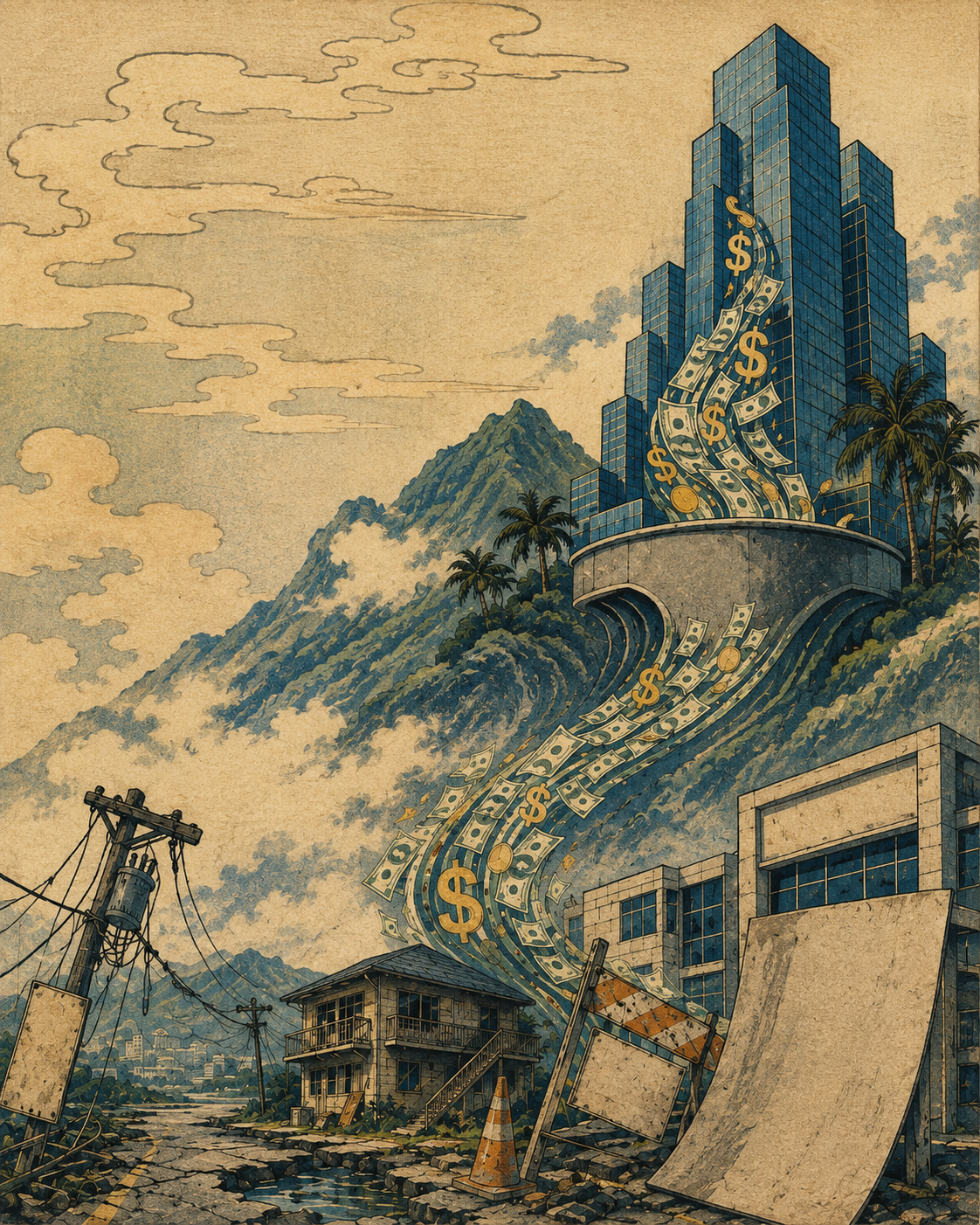
Corporations profit. Fragile infrastructure deteriorates.
Here’s the deal Hawaiʻi government keeps making: the public takes the risk, and private interests take the profit.
We hand out subsidies, tax exemptions, no-bid contracts, loan guarantees, land concessions, and regulatory favors — and we ask for almost nothing back. No enforceable promises. No penalty when the promises break. No accounting anyone can follow.
That’s not free enterprise. That’s corporate socialism, and we’re paying for it twice: once at the Capitol, and again on our electric bills, our rents, and our medical debt.
It doesn’t have to work this way. There are efforts we can make.
Expose every transfer.
Build a Hawaiʻi Public Support Ledger: who got the money or the privilege, what it was worth, who authorized it, what campaign cash and lobbying flowed from that recipient, what jobs and wages and housing were promised — and whether any of it actually happened. Almost all of this data already exists, scattered across procurement records, campaign finance filings, lobbying disclosures, and tax credit reports.¹ It’s just never assembled where ordinary people can see it. That’s not an accident.
Attach conditions.
No public money without measurable public benefit, living wages, local hiring, full ownership disclosure, annual performance reports, automatic expiration dates, clawbacks when promises break, and a public equity stake or revenue share when taxpayers carry serious risk. Want the freedom of private enterprise? Accept private risk. Want public protection? The public gets a cut.
Replace donor-funded elections.
Hawaiʻi’s public financing program is a joke. The election fund held over $2.4 million at the end of fiscal 2025 — and not one candidate received a dollar of it in 2026.² A fund nobody can use isn’t reform, it’s a prop. Revive comprehensive Clean Elections: qualify through small resident contributions, get real money to compete, give up the big private checks.
Close the lobbying door.
Ban lobbyist contributions across the entire election cycle, not just during session. Require prompt disclosure of every lobbying contact and expenditure. Extend the revolving-door restrictions. Disclose who actually wrote each significant amendment — because somebody did, and it usually wasn’t the legislator whose name is on it. Require legislators to log meetings with anyone seeking a contract, subsidy, or regulatory decision.³
Defend the ground we’ve won.
Act 11 — the 2026 law restricting corporate and dark-money election spending — takes effect July 1, 2027, and will almost certainly be sued into oblivion if nobody shows up for it.⁴ Forty-nine states are watching. It needs organized public backing, implementation oversight, and political muscle. A law nobody defends is a law nobody keeps.
Organize nonvoters around results, not slogans.
Open with: your electric bill is too high, your rent is too high, you can’t get healthcare, and public money is making private interests rich. Here’s the rule we’re going to change. Ask people to join a campaign, not back a candidate. Candidates come later. The rule (value) comes first.
Make incumbents choose in public.
Put a short Public Return Pledge in front of every legislator: comprehensive public financing, full subsidy and contract transparency, clawbacks and public-return requirements, real lobbying and revolving-door limits, and no campaign money from corporations receiving state benefits. Publish who signs, who refuses, how each one votes, and who funds them.
And don’t label every politician corrupt — that lets everyone off. Name the transaction. Name the recipient. Name the decision-maker. Name the cost.
Where to start.
Hawaiʻi doesn’t lack organizations willing to fight this. It lacks a single, damning document that makes the fight concrete.
The Clean Elections Hawaiʻi Coalition already represents more than fifty organizations,⁵ and the coordinating leadership alone is a serious bench: Common Cause Hawaiʻi, the League of Women Voters of Hawaiʻi, the Hawaiʻi Alliance for Progressive Action, ACLU Hawaiʻi, Sierra Club Hawaiʻi, Our Hawaiʻi, the Hawaiʻi Public Health Institute, the Chamber of Sustainable Commerce, HULI PAC, and Imua Alliance.
To this add the groups that carried the 2026 session: Indivisible Hawaiʻi, whose Public Policy Action Group helped drive Act 11 from a forwarded essay to the governor’s desk in six months,⁶ along with Lāhainā Strong, the Hawaiʻi Workers Center, Living Wage Hawaii, Our Revolution Hawaiʻi, Young Progressives Demanding Action, Pono Hawaiʻi Initiative, 350 Hawaiʻi, the Democratic Party of Hawaiʻi Education Caucus, and here on this island, the League of Women Voters of Hawaiʻi County.
That is not a movement waiting to be built. That is a movement waiting for ammunition.
So give it some. HAPA already tracked 135 good-government bills through the 2026 session and published exactly which ones lived and which ones died quietly without a hearing.⁷ That is the template — now aim it at the money.
Pick one industry, or one development. Trace every public benefit it received: the tax credits, the exemptions, the contracts, the land, the regulatory waivers. Trace every dollar of political spending it produced: the campaign contributions, the lobbyists, the amendments nobody will admit writing. Put both columns on the same page. Publish it.
One industry. One report. One bill in the 2027 session. Then do it again.
The coalition that just overrode Citizens United in a single session can absolutely carry a one-page document about who is getting our money. What it needs is someone to write it.
Corporate socialism is the diagnosis. Public Money, Public Return is the message. Clean Elections, enforceable conditions, transparency, and organized nonvoters are how we win.
Looks like Iʻve got some work to do.
Please subscribe and share.
This is a no-profit enterprise. If you care to support this effort I accept payments at http://www.hawicenter.com/payments, via Zelle, and at CashApp $richardbodien.
1 Hawaiʻi State Procurement Office, “Awards”; Hawaiʻi State Ethics Commission, “What We Do”; Hawaiʻi Department of Taxation, “Tax Credits Claimed by Hawaiʻi Taxpayers.”
² Hawaiʻi Campaign Spending Commission, “Hawaii Election Campaign Fund” and “Public Funds Disbursed in 2026.”
³ Hawaiʻi State Ethics Commission, “Lobbying Law Restrictions” and “Post-Employment Restrictions,” 2026.
⁴ Jennifer Sinco Kelleher, “New Hawaii Law Targets Corporate Influence in Politics after Citizens United Ruling,” Associated Press, May 15, 2026.
⁵ Clean Elections Hawaiʻi Coalition, cleanelectionshawaii.org.
⁶ Indivisible Hawaiʻi, “Sunshine Over Dark Money: How Hawaiʻi Overrode Citizens United,” May 22, 2026.
⁷ HAPA, “Good Government Bills Crossover Update,” March 12, 2026.


Leave a Reply