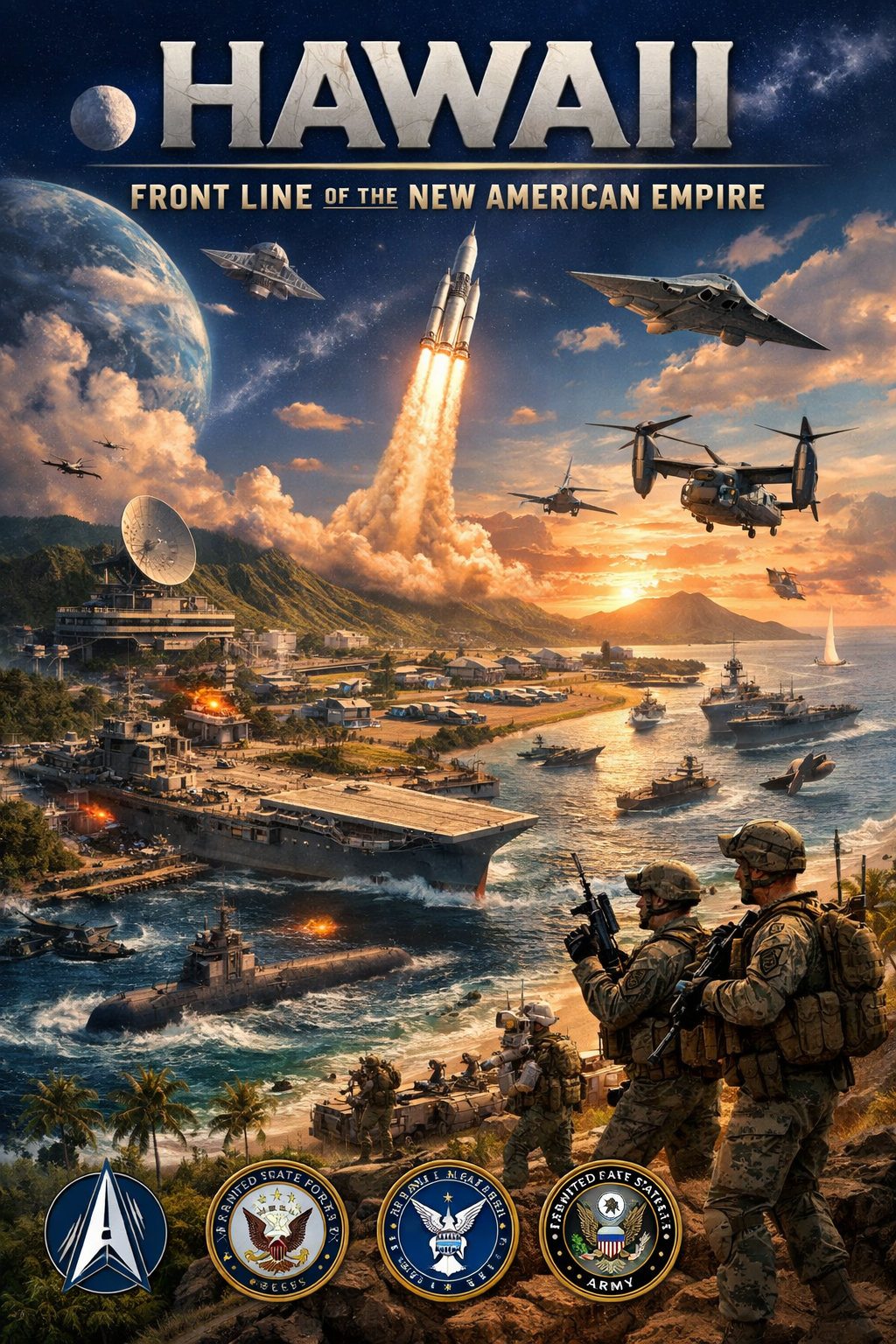
The new American empire does not even bother to pretend it has a civilizing mission. It has branding. It has camera angles. It has a permanent trailer voice promising strength, order, greatness, and one more shocking episode after the break.
What it does not have is a coherent plot beyond accumulation: more energy, more leverage, more access, more obedience. Its worldview is to dominate its own hemisphere, lock down strategic routes and resources, and treat outside influence as a hostile intrusion. It is a form of reality television for a political culture that increasingly mistakes spectacle for strategy.¹
The language coming out of Washington is stripped of euphemism. The 2025 National Security Strategy states that the United States “must be preeminent in the Western Hemisphere” and describes the region in terms of strategic resources, ports, infrastructure, migration control, cartel suppression, and the rollback of outside influence. It frames hemispheric policy as “Enlist and Expand,” which sounds less like diplomacy than franchising.² That is the real plot, if one insists on finding one: consolidate the neighborhood, subordinate the periphery, and make the empire pay for itself through energy, logistics, and security dependence.
Energy sits at the center of this imperial mood. The United States is not imagining power from a position of scarcity. It is acting from abundance. U.S. crude production hit record monthly levels in 2025, while the country also consolidated its position as the world’s largest LNG exporter.³
Energy surplus alters the political imagination. A state that can drill, liquefy, export, sanction, insure, and reroute supply begins to treat hydrocarbons not merely as commodities but as instruments of command. Oil and gas become less an industry than a language of hierarchy.
That is why the new empire looks half like a PowerPoint presentation and half like a military operation. It speaks in the language of private enterprise, investment, and commercial diplomacy, but the enforcement mechanism is always nearby: bases, naval presence, military cooperation, sanctions, coercive bargaining, threats against transit routes, and the casual suggestion that force may be used to secure what matters.
Reuters’ reporting on the administration’s “Shield of the Americas” summit captured the style exactly: a cartel coalition sold as regional salvation, paired with warnings about hostile foreign influence in the hemisphere, including around the Panama Canal.⁴ The costume is counter-crime security. The structure underneath is restored hegemony.
Latin America, in this script, is not treated as a zone of equal republics. It is treated as a management problem. Cartels justify militarization. Migration justifies pressure on neighboring governments. Chinese investment justifies an anti-foreign campaign dressed up as hemispheric self-defense. Even when the language is cooperative, the grammar is command. The region is welcome as a partner, but only on terms set in Washington. This is old imperial behavior with newer branding and worse dialogue.
China sharpens the obsession because it offers alternatives. Beijing’s trade with the CELAC bloc reached $515 billion in 2024, up dramatically from 2000, while Xi Jinping pledged billions more in credit and investment.⁵ For Washington, this is intolerable not simply because China is present, but because China is useful. It offers ports, markets, infrastructure, and bargaining room. Empires hate alternatives. A neighbor with options is harder to discipline. So Chinese activity is framed not as competition to be met with better policy, but as intrusion to be rolled back.
The broader geopolitical logic is uglier still: America dominates the Western Hemisphere; Russia gets its revanchist sphere in its near abroad; China keeps pressing its claims in East Asia. Reuters described this as a return to spheres of influence, a world in which major powers carve out zones where force, intimidation, and hierarchy displace law.⁶ That is the deepest corruption of the new imperial mentality. It is not only aggressive. It is anti-universal. It no longer even bothers to perform belief in a shared order of rules. It treats the world as divisible turf.
Hawaiʻi fits squarely into this structure. If the Western Hemisphere is the yard Washington wants fenced off, Hawaiʻi is the forward deck from which it projects beyond that yard. It was absorbed not because the United States admired Hawaiian self-government, but because annexation solved a strategic problem. In 1898, after an annexation treaty had stalled, Congress used a joint resolution to take Hawaiʻi anyway. The islands were valuable as a mid-Pacific fueling station and naval installation. It was an acquisition for imperial projection.
That older seizure still structures the present. The headquarters of U.S. Indo-Pacific Command sits at Camp H. M. Smith outside Honolulu, while Joint Base Pearl Harbor-Hickam houses hundreds of tenant commands, including U.S. Pacific Fleet and Pacific Air Forces. Pearl Harbor remains one of the principal command nodes connecting U.S. military power to Asia and the Pacific.⁸ So Hawaiʻi is not peripheral to empire. It is one of its operating centers.
Economically, Hawaiʻi also shows how empire embeds itself locally. Defense is the state’s second-largest industry segment after tourism, and Hawaiʻi ranks near the top nationally in defense spending as a share of state GDP. State figures for 2025 list more than $10 billion in military-related spending and over 73,000 Department of Defense personnel statewide.⁹ The islands are not simply defended territory. They are organized, in part, around servicing the defense state.
They also bear the costs. The Red Hill Bulk Fuel Storage Facility, built to support military operations in the Pacific, stored massive quantities of fuel connected by pipeline to Pearl Harbor. After the 2021-2022 drinking water crisis, the Pentagon ordered it defueled and permanently closed.¹⁰ The pattern is familiar: strategic infrastructure first, local risk after, apology later.
On Hawaiʻi Island, Pōhakuloa makes the same point in land form. The Army argues it must retain thousands of acres there because it is the only training area in the state where larger units can conduct live-fire and maneuver exercises, even as its own environmental review acknowledges significant adverse impacts to land use, biological resources, cultural practices, and environmental justice.¹¹ That is how empire talks when it is trying to sound reasonable while keeping control.
So Hawaiʻi is military infrastructure: command centers, harbors, air hubs, fuel nodes, and training grounds. It was a nation state taken for strategy, converted into military geography, and normalized as though that outcome were simply history rather than policy backed by force.
There is great irony in this. While Washington talks of energy dominance and hemispheric command, Hawaiʻi is still dependent on imported fossil-fuel.¹² Even the empire’s island outpost remains vulnerable to the fuel chains it serves.
That is the real character of the new American empire. It is not a confident civilization extending itself. It is a powerful state narrating its appetite as destiny. It wants oil, energy routes, compliant neighbors, command platforms, and strategic depth. Hawaiʻi is part of that machinery, both as a historical example and as a living military platform. No plot, then. Only the season arc of blind ambition: own the fuel, patrol the sea lanes, discipline the hemisphere, and call it order.
Notes
¹ The White House, National Security Strategy (Washington, DC, December 2025).
² Ibid.
³ U.S. Energy Information Administration, “U.S. Field Production of Crude Oil,” released February 27, 2026; U.S. Energy Information Administration, “Ten Years after First Sabine Pass Cargo, U.S. LNG Exports Are Still on the Rise,” February 24, 2026.
⁴ Nandita Bose, Sarah Morland, and David Brunnstrom, “Aggressive Trump Launches Latin America Cartel Coalition,” Reuters, March 7, 2026; Phil Stewart and Ryan Patrick Jones, “US Tells Latin America: Military Force Is the Only Way to Defeat Cartels,” Reuters, March 5, 2026.
⁵ Eduardo Baptista, Joe Cash, and Liz Lee, “China Offers Latin America and the Caribbean Billions in Bid to Rival US Influence,” Reuters, May 13, 2025.
⁶ Matt Spetalnick, John Geddie, and Antoni Slodkowski, “Trump’s Exercise of Raw Power Upends World Order, Sending Friends and Foes Reeling,” Reuters, January 13, 2026.
⁷ National Archives, “The 1897 Petition Against the Annexation of Hawaii,” last modified November 24, 2021; National Archives, “Joint Resolution to Provide for Annexing the Hawaiian Islands to the United States (1898),” last modified September 30, 2024.
⁸ U.S. Indo-Pacific Command, “About United States Indo-Pacific Command,” accessed March 7, 2026; Commander, Navy Region Hawaii, “JB Pearl Harbor-Hickam: About,” accessed March 7, 2026; National Park Service, “Pearl Harbor,” last modified September 13, 2024.
⁹ Hawaiʻi Defense Economy, “Economic Impact,” accessed March 7, 2026; State of Hawaiʻi Military and Community Relations Office, Military in Hawaiʻi Economic Impact Factbook 2025 (Honolulu, January 14, 2026).
¹⁰ U.S. Environmental Protection Agency, “About the Red Hill Bulk Fuel Storage Facility,” last modified October 28, 2025; U.S. Environmental Protection Agency, “Red Hill Bulk Fuel Storage Facility in Hawaiʻi,” last modified December 30, 2025.
¹¹ U.S. Army Garrison Hawaii, “Project Overview,” last updated August 7, 2025; U.S. Army Garrison Hawaii, “Army Publishes the Final Environmental Impact Statement for Proposed Land Retention at Pōhakuloa Training Area,” April 18, 2025.
¹² Hawaiʻi State Energy Office, “Hawaiʻi Clean Energy Initiative.”


Leave a reply to Susan Alexy Cancel reply