Surveillance society: the new normal
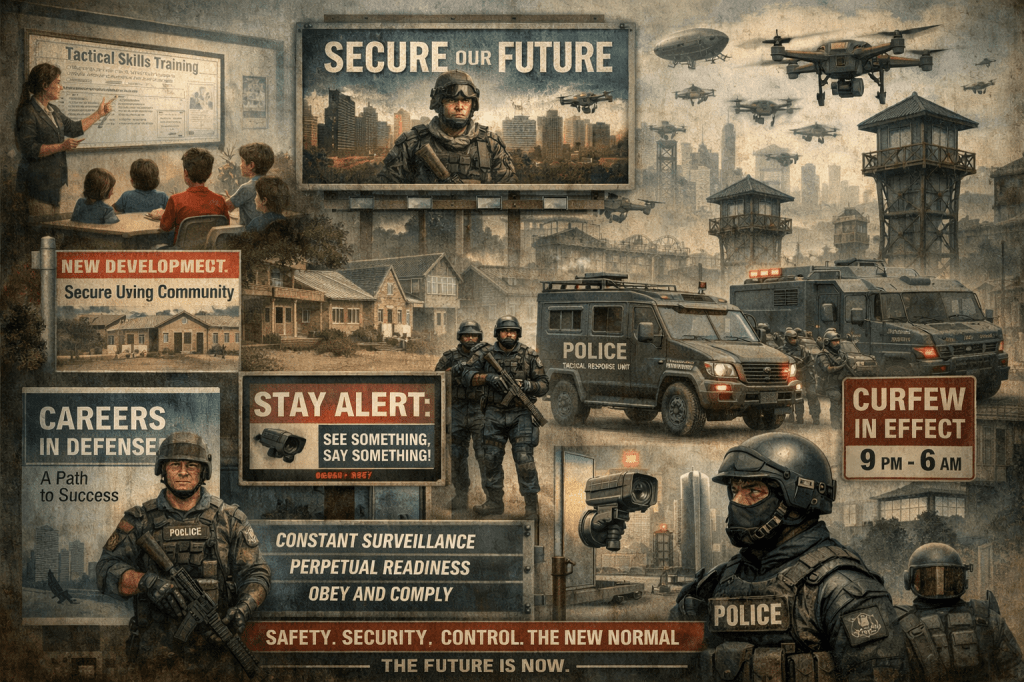
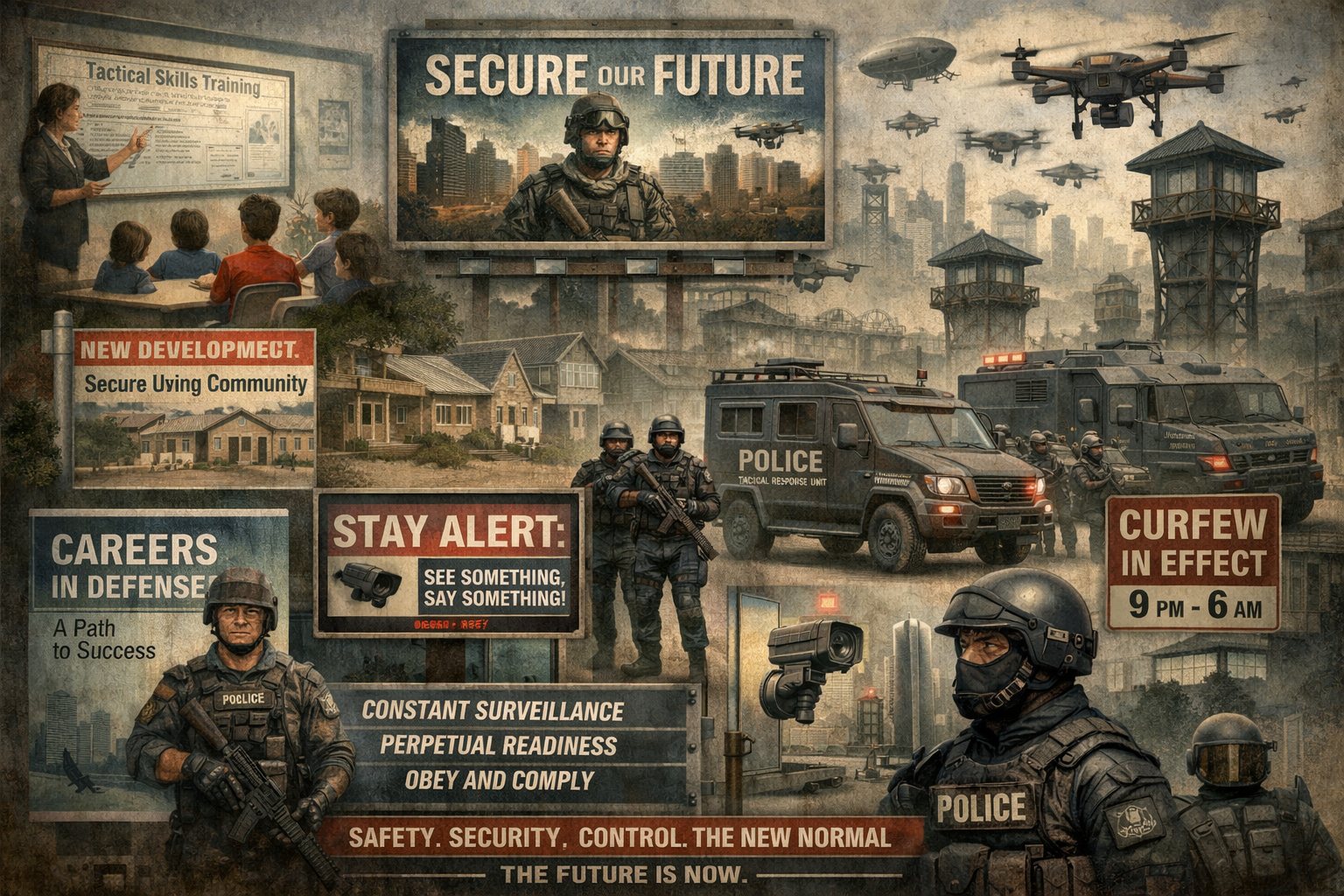
Our militarized future did not arrive as a parade. It arrived as curriculum, budget line, land use plan, and normalized emergency. It arrived in the language of opportunity and the architecture of routine. Before the drones were visible and the tactical hardware was familiar, the cultural groundwork was already laid: permanent mobilization repackaged as atmosphere, as safety, as the reasonable shape of modern life. The dystopian imagination was not warning us. It was preparing us. The preparation is largely complete. Militarized dystopia for controlling the masses is now government policy.1
- In occupied parts of Ukraine, the Russian state has imposed patriotic and military education aimed at preparing children for future service and punishing families who resist the new curriculum.2
- In Myanmar, since the military coup of 2021, schools have been occupied as barracks and interrogation sites, curricula rewritten to enforce loyalty, students recruited for combat roles, and more than two hundred educational facilities destroyed in airstrikes — while over half of the country’s school-age children, some seven million, are now out of school entirely.3
- In Sudan, the war between the Sudanese Armed Forces and the Rapid Support Forces has put 16.5 million children out of school; in December 2025, RSF drone strikes killed more than forty children inside a kindergarten in South Kordofan.4
- In the Democratic Republic of the Congo, UN officials and rights experts continue to warn of child recruitment, mass displacement, and systematic abuse amid escalating violence.5
- In Colombia, armed groups sharply increased child recruitment, while dozens of schools were attacked, militarized, or forced to close in 2025 alone.6
Across the Sahel, insecurity had already forced the closure of nearly 14,364 schools as of mid-2024, depriving 2.8 million children of education and exposing them to recruitment, forced labor, and further violence.7
What these places share is not identical politics. It is a pattern. War does not stay at the front. It colonizes the social body. It reorganizes schooling, public space, labor markets, transportation, memory, and language. It turns children into targets for enlistment or ideological conditioning. It makes dependency feel like realism. It teaches civilians to accept militarized authority as the only form of order left standing. The question is no longer whether society is militarized. The question is how completely militarization has been made to seem ordinary.8
The United States likes to pretend it is exempt from this process because the homeland still markets itself as consumer paradise. But militarization in America has always worked by dispersal rather than spectacle. It is embedded in procurement, policing, entertainment, border enforcement, research universities, and school-to-service pipelines. It does not always arrive with tanks in the street. Sometimes it arrives as a guidance counselor steering a teenager toward the Armed Services Vocational Aptitude Battery. Sometimes it arrives as a career pathway folded into public education. Sometimes it arrives as a grant, a contract, a base payroll, a patriotic assembly, a museum field trip, or a local economy made too dependent to say no. Humans do love building cages and then calling them opportunity.
In Hawaiʻi, this pattern is especially stark because the military is not incidental to the political economy. According to Hawaiʻi’s own Military and Community Relations Office, total defense spending in the state reached $10.2 billion in 2023, supporting more than 73,000 total personnel; local reporting on the same factbook said defense spending accounts for about 9.2 percent of Hawaiʻi’s GDP and roughly 17 percent of all jobs are tied directly or indirectly to defense spending.9
That is not just presence. It is structural leverage. When so much employment, contracting, and public revenue are tethered to the military, dissent is made to feel irresponsible, even when dissent is morally obvious.
The entanglement begins early. Hawaiʻi’s Department of Education describes JROTC as a four-year career and technical education elective that is cost-shared by branches of the U.S. military, and two consecutive JROTC courses can satisfy the CTE credit requirement for a high school diploma.10 Other official and quasi-official Hawaiʻi sources list JROTC units across public high schools and market them in the language of citizenship, leadership, discipline, and career development.^11 This is how militarization works in a democracy that prefers euphemism. It does not need to command every child to become a soldier. It only needs to make military culture familiar, respectable, and institutionally rewarded.
In Hawaiʻi, that normalization lands on occupied ground. The islands are not merely another state with a large federal footprint. They are a seized archipelago whose lands, waters, and political future have long been subordinated to U.S. strategic doctrine.
The burden is not only ecological, though the record there is ugly. It is also psychic and civic. Recruitment in schools, patriotic framing in public institutions, and economic dependence on defense dollars all help produce a colonized common sense in which the apparatus of occupation is reintroduced as benefactor, employer, mentor, and guardian. That is how domination matures. First it takes the land. Then it reorganizes survival around itself. Then it asks for gratitude.
This is why militarization should not be discussed only as a matter of war abroad. It is also a domestic reordering of values. A militarized society learns to privilege hierarchy over reciprocity, surveillance over trust, discipline over freedom, procurement over care, and strategic utility over human dignity. It teaches young people to read danger everywhere and power only in armed form. It drains public imagination. Schools become feeder systems. Harbors become targets. Infrastructure becomes dual-use. Citizens become spectators of permanent readiness. The homefront becomes a barracks.
The danger for Hawaiʻi is not merely that it will be dragged into future conflict between larger powers. That danger is real enough. The deeper danger is that militarization will continue to define what counts as development, what counts as employment, what counts as education, and what counts as security. Once that frame hardens, every alternative begins to look naïve. Food sovereignty looks sentimental. Demilitarization looks unrealistic. Cultural survival looks secondary. Public goods must then compete against the endless moral blackmail of “jobs” and “readiness.” A people can be conquered that way without a single new invasion, simply by having the terms of necessity written for them.
So the task is not merely to oppose the next war. It is to oppose the social order that prepares us to accept war as organizer of everyday life. That means resisting recruitment pipelines in schools, challenging the economic blackmail that makes communities dependent on military spending, defending public space from surveillance and tactical creep, and insisting that safety be measured by housing, water, health, education, food, and land security rather than by the density of uniforms and contracts. It also means telling the truth about Hawaiʻi: that an occupied nation cannot build a just future by deepening its dependence on the machinery that occupies it.
Dystopia was never just entertainment. It was a user manual. The only question left is whether people will continue reading from it.
1. Roger Chickering, “The History of War and Military Affairs,” *History and Theory* 57, no. 3 (2018), accessed March 29, 2026, via JSTOR, ([JSTOR][1]); Ronald R. Krebs, “The Age of Militarism,” University of Notre Dame working paper, March 10, 2026, ([O’Brien Security Center][2]).
2. Office of the United Nations High Commissioner for Human Rights, *Report on Children’s Rights in Ukraine*, March 21, 2025, ([OHCHR][3]); Center of Civic Education “Almenda,” reporting summarized in Mezha, “Russification and Militarization of Education in Occupied Ukrainian Territories, 2025–2026,” February 23, 2026, ([Межа. Новини України.][4]).
3. War on the Rocks, “A Worrying Military Build-up in the Western Balkans?” February 19, 2026, ([War on the Rocks][5]); SIPRI, “SIPRI Military Expenditure Database,” accessed March 29, 2026, ([SIPRI][6]).
4. Office of the Special Representative of the Secretary-General for Children and Armed Conflict, “Sudan: All Parties Must Act Now to Save Children,” November 21, 2025, ([Children and Armed Conflict][7]); Office of the Special Representative of the Secretary-General for Children and Armed Conflict, “Statement on Sudan,” February 17, 2026, ([ReliefWeb][8]).
5. UN human rights experts, “UN Experts Urge Immediate Action to Protect Children against Trafficking and Grave Violations in the Democratic Republic of the Congo,” March 26, 2025, ([OHCHR][9]); Office of the Special Representative of the Secretary-General for Children and Armed Conflict, “Intensifying Fighting in Eastern DRC Triggers Major Protection Risks for Children,” January 31, 2025, ([Children and Armed Conflict][10]).
6. UNICEF, “Child Recruitment and Use by Armed Groups in Colombia Quadruples over Five Years,” February 11, 2026, ([UNICEF][11]); Watchlist on Children and Armed Conflict, “Children and Armed Conflict Monthly Update: December 2025,” ([Watchlist][12]); Norwegian Refugee Council, “Colombia: An Attack on Education Every Three Days,” July 31, 2025, ([ReliefWeb][13]).
7. UNICEF West and Central Africa, *Resilient Education in the Sahel: Executive Summary*, 2025, ([UNICEF][14]).
8. Chickering, “The History of War and Military Affairs,” ([JSTOR][1]); Krebs, “The Age of Militarism,” ([O’Brien Security Center][2]).
9. Hawaiʻi Department of Business, Economic Development and Tourism, Military and Community Relations Office, “New Factbook Detailing the Military’s Economic Impact in Hawaiʻi,” January 14, 2026, ([MACRO][15]); HNN Staff, “New Factbook Details U.S. Military’s Economic Impact on Hawaiʻi,” *Hawaii News Now*, January 15, 2026, ([https://www.hawaiinewsnow.com][16]).
10. Hawaiʻi State Department of Education, “JROTC,” accessed March 29, 2026, ([Hawaii Public Schools][17]).
11. Joint Base Pearl Harbor-Hickam, “Education Programs & Resources,” accessed March 29, 2026, ([MilitaryINSTALLATIONS][18]); Kalani High School Coast Guard JROTC announcement, U.S. Coast Guard, November 21, 2024, ([US Coast Guard News][19]); Waipahu High School, “Welcome to JROTC,” accessed March 29, 2026, ([waipahuhigh.org][20]).
[1]: https://www.jstor.org/stable/26567869?utm_source=chatgpt.com “The History of War and Military Affairs Roger Chickering ( …”
[2]: https://ondisc.nd.edu/assets/652170/krebs_age_of_militarism.pdf?utm_source=chatgpt.com “01. Mystery of Modern Militarism_20260310”
[3]: https://www.ohchr.org/sites/default/files/2025-03/2025-03-21-ohchr-report-children-s-rights-in-ukraine.pdf?utm_source=chatgpt.com “2025-03-21-ohchr-report-children-s-rights-in-ukraine.pdf”
[4]: https://mezha.net/eng/bukvy/russification-and-militarization-of-education-in-occupied-ukrainian-territories-2025-2026/?utm_source=chatgpt.com “Russification and Militarization of Education in Occupied …”
[5]: https://warontherocks.com/2026/02/a-worrying-military-build-up-in-the-western-balkans/?utm_source=chatgpt.com “A Worrying Military Build-up in the Western Balkans?”
[6]: https://www.sipri.org/databases/milex?utm_source=chatgpt.com “SIPRI Military Expenditure Database”
[7]: https://childrenandarmedconflict.un.org/2025/11/sudan-all-parties-must-act-now-to-save-children/?utm_source=chatgpt.com “Sudan: All Parties Must Act Now to Save Children”
[8]: https://reliefweb.int/report/sudan/statement-sudan-under-secretary-general-vanessa-frazier-special-representative-secretary-general-children-and-armed-conflict-16-february-2026?utm_source=chatgpt.com “Statement on Sudan by Under-Secretary-General Vanessa …”
[9]: https://www.ohchr.org/en/press-releases/2025/03/un-experts-urge-immediate-action-protect-children-against-trafficking?utm_source=chatgpt.com “UN experts urge immediate action to protect children …”
[10]: https://childrenandarmedconflict.un.org/2025/01/intensifying-fighting-in-eastern-drc-triggers-major-protection-risks-for-children/?utm_source=chatgpt.com “Intensifying Fighting in Eastern DRC Triggers Major Protection …”
[11]: https://www.unicef.org/press-releases/child-recruitment-and-use-armed-groups-in-colombia-quadruples-over-five-years?utm_source=chatgpt.com “Child recruitment and use by armed groups in Colombia …”
[12]: https://watchlist.org/publications/children-and-armed-conflict-monthly-update-december-2025/?utm_source=chatgpt.com “Children and Armed Conflict Monthly Update – December …”
[13]: https://reliefweb.int/report/colombia/colombia-attack-education-every-three-days?utm_source=chatgpt.com “Colombia: An attack on education every three days”
[14]: https://www.unicef.org/wca/media/12156/file/ENG_Executive%20Summary_Resilient%20Education%20Sahel_UNICEF%202025.pdf.pdf?utm_source=chatgpt.com “Executive Summary Resilience Sahel UNICEF 2025”
[15]: https://www.macro.hawaii.gov/military-and-community-relations-office-releases-new-factbook-detailing-the-militarys-economic-impact-in-hawaii/?utm_source=chatgpt.com “MACRO – Military and Community Relations Office – Hawaii.gov”
[16]: https://www.hawaiinewsnow.com/2026/01/15/new-factbook-details-us-militarys-economic-impact-hawaii/?utm_source=chatgpt.com “New factbook details US military’s economic impact on …”
[17]: https://hawaiipublicschools.org/academics/jrotc/?utm_source=chatgpt.com “JROTC – Hawaiʻi State Department of Education”
[18]: https://installations.militaryonesource.mil/military-installation/joint-base-pearl-harbor-hickam/education/education?utm_source=chatgpt.com “Joint Base Pearl Harbor | Education Programs & Resources”
[19]: https://www.news.uscg.mil/Press-Releases/Article/3973580/coast-guard-establishes-first-hawaii-based-jrotc-program/?utm_source=chatgpt.com “Coast Guard establishes first Hawaii-based JROTC program”
[20]: https://www.waipahuhigh.org/apps/pages/index.jsp?pREC_ID=1101036&termREC_ID=&type=d&uREC_ID=571786&utm_source=chatgpt.com “JROTC”

Leave a comment