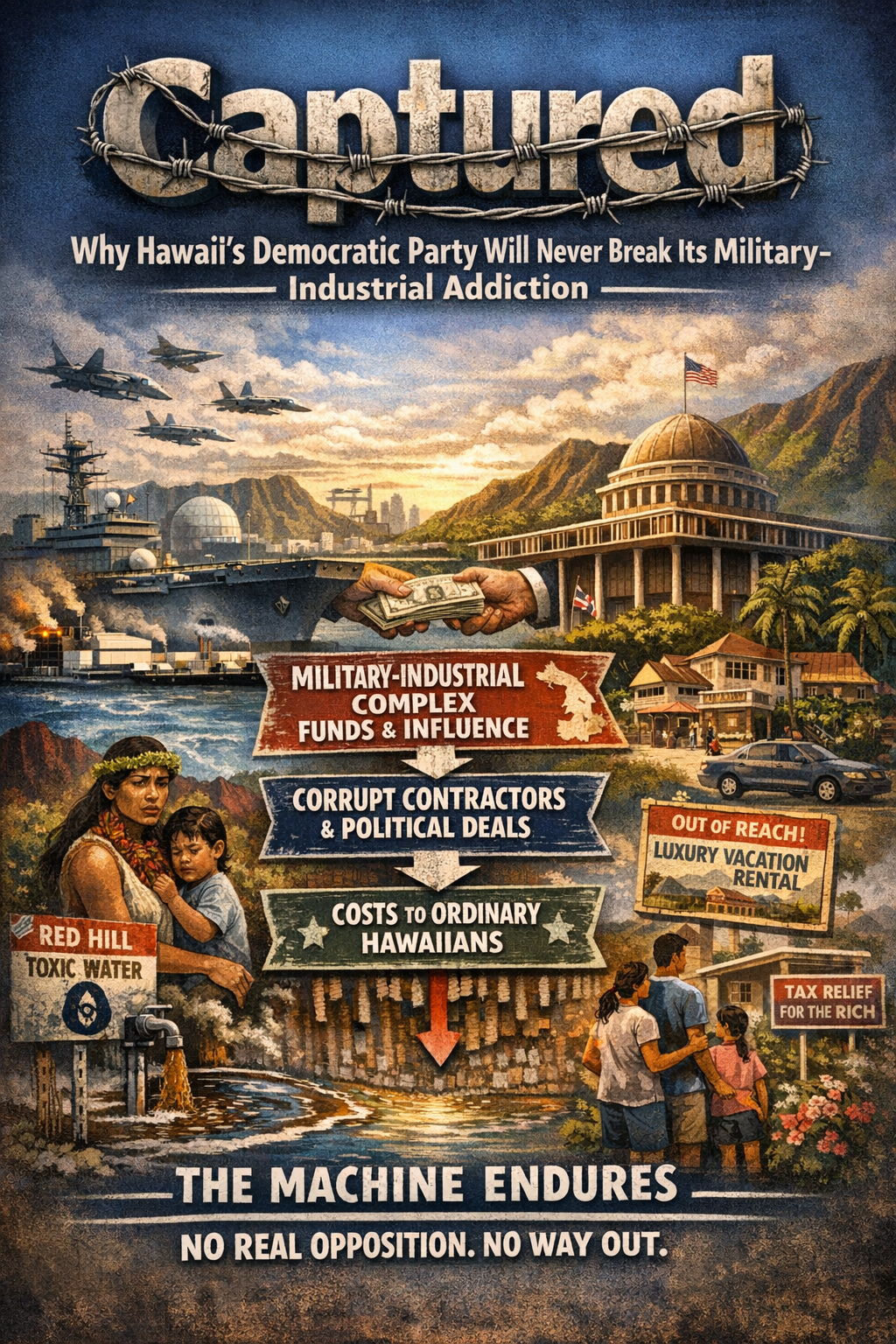
Captured
Hawaii is often called a progressive paradise — a deep-blue state with universal healthcare ambitions, strong labor protections, and a tradition of Native Hawaiian advocacy. Yet beneath this image lies a political machine that has operated without meaningful opposition for over six decades, one that has grown deeply entangled with the U.S. military establishment, defense contractors, and a donor class that shapes policy as surely as any vote cast at the State Capitol.
The Hawaii Democratic Party, for all its progressive rhetoric, has become a reliable steward of the military-industrial complex and a willing participant in the flow of federal dollars that enriches well-connected insiders at the expense of ordinary residents. This is not accidental. It is structural. And it will not change.
A One-Party State Built on Pentagon Dollars
Hawaii is home to one of the most significant concentrations of U.S. military infrastructure on the planet. Pearl Harbor, Hickam Air Force Base, Schofield Barracks, Camp H.M. Smith — the islands host tens of thousands of active-duty personnel, civilians, and dependents.
According to the state’s own Military and Community Relations Office, defense spending accounted for approximately 9.2 percent of Hawaii’s gross domestic product in 2023, with $10.2 billion in total defense spending flowing into the state that year. When indirect and induced economic effects are counted, defense activity accounts for an estimated $16.6 to $17.4 billion in statewide economic contributions and roughly 17 percent of all jobs in Hawaii. Earlier RAND Corporation modeling put that figure even higher: up to 18 percent of Hawaii’s economy during fiscal years 2007–2009.
For decades, Hawaii’s U.S. senators and representatives — almost exclusively Democrats — have sat on Armed Services and Appropriations committees, positions that allow them to channel federal defense dollars back to the islands. The late Senator Daniel Inouye, who chaired the Senate Appropriations Committee from 2009 to 2012, was legendary for his capacity to secure military construction funds. He once boasted to a Big Island audience, “I’m the No. 1 earmarks guy in the U.S. Congress.”
His earmark total between 2008 and 2010 exceeded $1.25 billion — the highest among Democratic appropriations chairs — and his solo earmarks in fiscal year 2009 alone reached $220.7 million. Defense companies that received Inouye-backed earmarks, including Boeing and Northrop Grumman, were also among his largest campaign contributors.
The Contractor Class and the Currency of Influence
Where the military goes, contractors follow. Hawaii’s defense contracting sector is a sprawling network of construction firms, technology companies, logistics providers, and engineering consultants — many of them deeply connected to the state’s political establishment.
The line between campaign donor and policy beneficiary is thin in Hawaii. A 2009 investigation found that Hawaii defense firms whose employees donated to Inouye’s campaigns routinely received millions in earmarks: Honolulu-based Oceanit received $9 million in two earmarks after its employees contributed $22,900 to his campaigns; Referentia Systems received a $3.9 million earmark after its officers donated $17,200.
The conduct of contractors operating within Hawaii’s defense ecosystem has also raised serious concerns about fraud and self-dealing. In one high-profile case unsealed in 2025, federal prosecutors accused Christopher Dawson — founder of the Hawaiian Native Corp. and a prominent defense contractor — of embezzling millions of dollars from his companies through a fraud scheme that victimized Native Hawaiians whose interests the nonprofit was created to serve.
Between 2015 and 2021, prosecutors alleged, approximately $17 million was diverted into shell accounts to fund Dawson’s personal expenses, including international travel and polo horses. Notably, even as the criminal investigation unfolded, the DAWSON companies continued to win lucrative government contracts — including one for maintenance at the Navy’s Red Hill fuel storage facility on Oahu.
Tax Relief for the Rich, Austerity for Everyone Else
Hawaii consistently ranks among the most expensive states in the nation for working residents. Its tax structure is riddled with arrangements that fall hardest on those least able to pay. The General Excise Tax, Hawaii’s equivalent of a sales tax, is applied at every level of a transaction and is widely recognized as regressive — falling with disproportionate weight on working-class families who spend the bulk of their income on goods and services. Hawaii is one of only seven states that taxes groceries at the full rate. A Hawaii family on a thrifty food budget pays over $800 per year in state taxes on groceries alone.
For years, advocates have proposed exempting food and medicine from the GET. For years, the legislature — controlled entirely by Democrats — has declined to act. In 2023, a GET exemption for food and medicine was killed without receiving a hearing in either House or Senate money committees, despite having been a campaign promise of Governor Josh Green.
Hawaii Appleseed and other research organizations have documented that nearly 158,000 eligible individuals failed to take advantage of the existing food/excise tax credit in 2021, meaning the legislature’s preferred partial remedy reaches only a fraction of those who need it.
The state’s approach to short-term vacation rentals offers another illustration. For years, vacation rental platforms including Airbnb wielded significant lobbying power at the legislature, successfully blocking or diluting regulations that could have provided relief to residents priced out of their neighborhoods. Airbnb retained former Hawaii State Attorney General David Louie as its Hawaii lobbyist to fight legislative efforts to phase out short-term rentals.
The Office of Hawaiian Affairs has noted that more than half of all short-term rentals in Hawaii are owned by people living out-of-state, and that in Lahaina, fully 25 percent of the region’s housing units are listed as short-term rentals — a dynamic widely cited as having exacerbated the housing crisis for local families. The Democratic-controlled legislature took years of advocacy, natural disaster, and community protest before passing SB 2919 in 2024, empowering counties to phase out short-term rentals.
Why Reform Is Structurally Impossible
The Hawaii Democratic Party will not change: the structural conditions that would force change do not exist. The absence of a viable Republican Party removes one of the primary mechanisms for accountability. Hawaii Democrats do not need to fear losing general elections — they need only survive primaries, which are characterized by historically low turnout.
In the 2024 primary, just 32.1 percent of registered voters cast a ballot — the lowest turnout in the state’s history as a state. Political scientists attribute low turnout primarily to the dominance of a single party. In that same primary cycle, seven House incumbents and four Senate incumbents faced no opposition whatsoever.
Progressive challengers in Hawaii primaries face opponents backed by the full weight of a consolidated donor network and the implicit endorsement of the party establishment. The result is a system where well-funded incumbents with strong contractor and union support routinely survive low-turnout contests that most residents ignore.
Hawaii’s labor unions, which might elsewhere serve as a counterweight to corporate influence, are deeply integrated into the Democratic apparatus. Their members build military housing, perform base maintenance, and staff the logistics networks that keep the defense economy running. A union whose members hold defense contracts has no structural incentive to oppose the military-industrial complex.
There is also the ideological framing that insulates the machine from critique. Military spending in Hawaii is packaged not as imperialism or contractor welfare, but as economic necessity — as jobs, as federal transfers, as the indispensable price of stability in a volatile Pacific region. Politicians who challenge this framing risk being characterized as naive about geopolitics or indifferent to working families who depend on defense employment. The party has proven adept at co-opting the language of economic justice to defend arrangements that primarily benefit the wealthy and well-connected.
The Costs Borne by Those Without Influence
The consequences of this arrangement fall disproportionately on the people least able to absorb them. Native Hawaiians — whose land was taken through the illegal overthrow of the Hawaiian Kingdom with U.S. military complicity — find their sovereignty claims perpetually deferred.
The Red Hill fuel crisis is the starkest recent illustration of what military impunity costs ordinary people. On November 20, 2021, jet fuel leaked from the Navy’s Red Hill Bulk Fuel Storage Facility into the Pearl Harbor aquifer — the primary source of drinking water for Oahu.
Approximately 93,000 people were potentially exposed to contaminated water. Surveys conducted afterward found that 86 percent of respondents reported new or worsening symptoms following the spill. A federal Inspector General investigation released in 2024 documented numerous systemic failures in the Navy’s handling of fuel, water, and toxic PFAS “forever chemicals” at the site — finding mismanagement going back years, with spills inadequately reported and remediated.
The Navy initially fought to keep Red Hill in operation following the contamination event, only agreeing to closure after sustained public pressure. Even then, the sole discipline announced by the Navy for the officials responsible was a letter of censure for three retired officers — involving no loss of pay or rank. As one impacted military family member told Civil Beat: “If this report doesn’t produce accountability, I don’t know what the hell else will.” The Hawaii Democratic Party, in control of every lever of state government, expressed outrage — and moved on.
The Machine Endures
The Hawaii Democratic Party will not change because change would require dismantling the very relationships that sustain it. The military dollars, the contractor contributions, the tax arrangements that favor landowners and resort operators — these are not aberrations. They are the load-bearing walls of a political structure that has been sixty years in the making.
The party’s progressive identity is a brand, carefully maintained through gestures toward social issues that do not threaten the economic order, while the real business of governance — who gets contracts, who pays taxes, whose land is protected — is conducted in the comfortable spaces between donor dinners and appropriations earmarks.
Until Hawaii develops a genuine opposition — whether from within the Democratic Party through sustained insurgency, or from without through the unlikely rise of an independent political movement with real organizational capacity — the machine will endure. It will continue to wave the flag of aloha while ensuring that the islands remain, as they have been since 1898, a profitable outpost of American military power and a reliable engine for those who know how to work the system. The people of Hawaii deserve better. History suggests they will continue to wait.

Leave a comment