
America After Project 2025
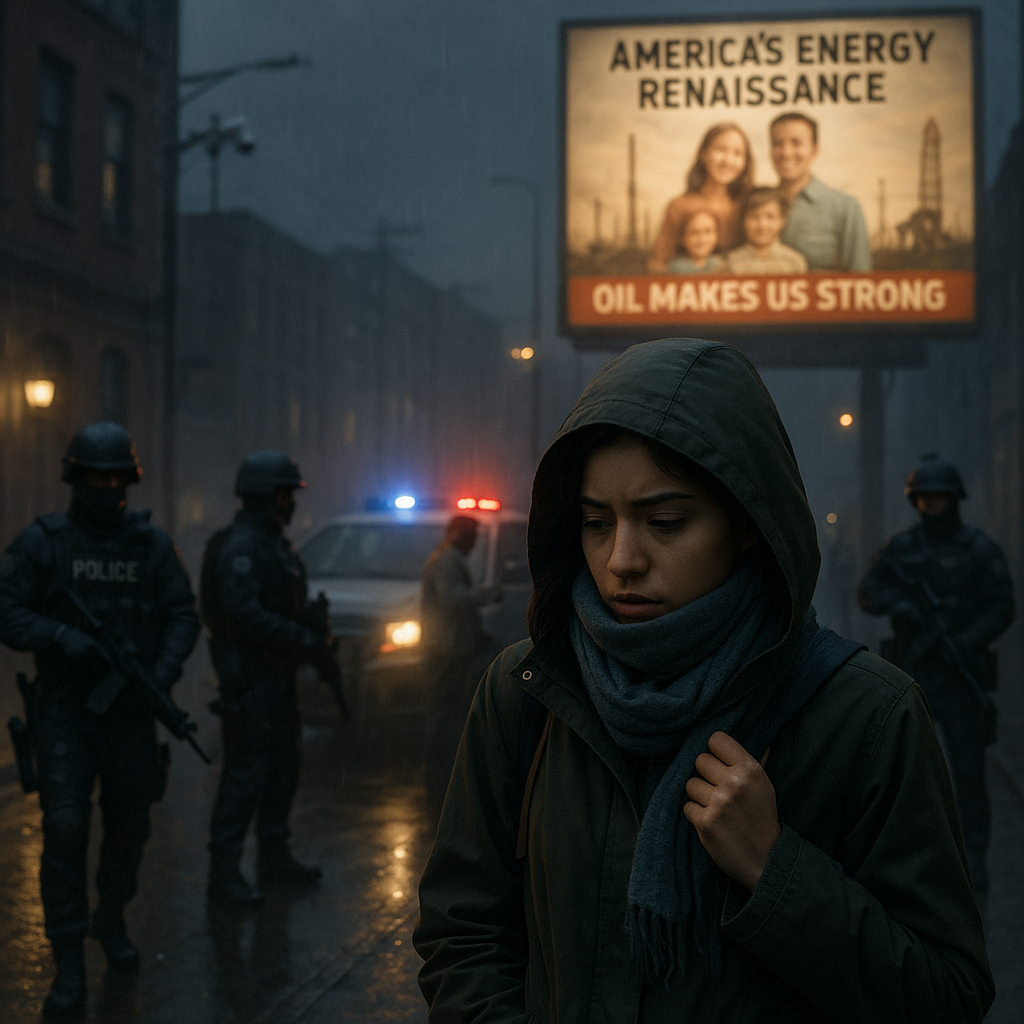
It is spring in 2030. Elena Martinez, a 24-year-old nursing student in Ohio, begins her day as millions of other Americans do—by scanning the news. But the media landscape is not what it was a decade ago. Independent outlets like NPR, The New York Times, and local newspapers have long since folded after federal attacks and years of being branded “fake news.” In their place are government-friendly broadcasters and Trump-aligned media platforms, owned by large Christian-centric corporations, which now dominate the information space.¹
Elena reads that another round of public university closures has been announced. Since the Department of Education was dismantled in 2026,² federal funding for public higher education has been eliminated, and those resources have been diverted to private, corporation-owned, faith-based schools.³
Her own nursing program now survives on corporate sponsorships, but tuition rises every semester. She wonders whether she will be able to finish her degree before debt overwhelms her.
But tuition isn’t the only thing that stalks her. Elena is a citizen, born in the U.S., yet she moves through the world as if she were undocumented—always scanning for uniforms, avoiding eye contact, never lingering in public spaces.
Militarized police roam the streets with open license to detain anyone who “looks foreign” or “acts radical.” A week ago, she watched from the clinic window as officers shoved a neighbor into a van for “documentation checks.” He had lived in the neighborhood for twenty years. Nobody has seen him since.
Elena carries her passport card, birth certificate, and state ID everywhere, though she knows papers are no guarantee. The wrong glance, the wrong word, and she could vanish into the same black hole of detention.
At the clinic where she interns, Elena faces other kinds of silencing. Under Executive Order 14168, gender-related healthcare and abortion are prohibited.⁴ Federal law threatens providers with loss of licenses and incarceration. Colleagues whisper about patients who disappeared after being denied care, either traveling abroad, withdrawing into silence, dying, or killing themselves. She files charts, pretending not to notice how the waiting room becomes emptier each passing week.
That evening, Elena risks everything to attend a protest in the town square against abortion restrictions.⁵ The crowd is small, a knot of desperate voices drowned by floodlights and surveillance drones buzzing overhead. Police film every angle, feeding AI systems that cross-check faces with driver’s license databases and social media feeds.⁶ Elena pulls her hair over her eyes and tightens her scarf, heart hammering, praying the software won’t recognize her. Two classmates were already dropped from their programs after appearing on “watch lists.” For Elena, the danger is doubled—Latina, female, outspoken. A “dangerous radical” by government definition.
On her way home, she turns a corner and freezes. A temporary checkpoint blocks the street. Officers in body armor sweep the sidewalks, demanding IDs. One woman, trembling, fumbles for papers. A baton cracks across her shoulder. She is shoved into the back of an armored van. Elena ducks into an alley, forcing herself to keep walking as though she belongs, as though her very skin were not a target.
Further down, a massive billboard glows against the night: “America’s Energy Renaissance—Oil Makes Us Strong.”⁷ The smiling family in the image stands against a backdrop of pipelines and drill rigs. Elena thinks of the Ohio River swelling each spring, edging closer to the streets where she lives. Floods batter Asia, Africa, South America, but the news calls them “opportunities for American leadership.” Relief is privatized now, meted out through insurance firms that deny more claims than they approve. With the U.S. long gone from the Paris Agreement,⁸ the future looks as fragile as the papers tucked in her bag.
Back in her apartment, Elena scrolls through a social media feed curated into sterility. Dissent is rare, drowned by government-funded ads proclaiming “Strong Families, Strong Nation.” Her younger brother’s high school curriculum now includes mandatory courses on “American Values,” saturated with Christian nationalist doctrine.⁹
She shuts off the phone, locks her door, and sits in the dark. For Elena, freedom and democracy feel like ghosts—something whispered about in the cracks of history.
This story of Elena Martinez is fictional, but the policies shaping her life are drawn directly from Project 2025 and its early implementation: dismantling of federal agencies, rollback of civil rights, entrenchment of religious nationalism, and abandonment of climate commitments. Together, they illustrate how a completed Project 2025 would not simply alter laws and regulations but reshape the lived reality of ordinary Americans.
- Time, “What Is Project 2025?” 2024; AP News, “Conservative Groups Draw Up Plan to Dismantle the US Government,” 2023.
- AP News, “Conservative Groups Draw Up Plan to Dismantle the US Government.”
- Grist, “Project 2025 Tracker,” 2025; Executive Order 14191, “Redirecting Education Funds to Private Vouchers,” 2025.
- Executive Order 14168, “Revoking Federal Recognition of Transgender Identities,” January 2025.
- The Guardian, “Project 2025 and Abortion Restrictions,” 2024.
- American Civil Liberties Union (ACLU), “Project 2025 Explained,” 2024.
- Time, “Trump Is Bringing Project 2025’s Anti-Climate Action Goals to Life,” August 2025.
- Executive Order 14162, “Withdrawal from the Paris Climate Agreement,” January 2025.
- The New Yorker, “The Right’s Blueprint for Power,” 2023; Heritage Foundation, Mandate for Leadership: The Conservative Promise (Washington, D.C.: Heritage Foundation, 2023).


Leave a comment