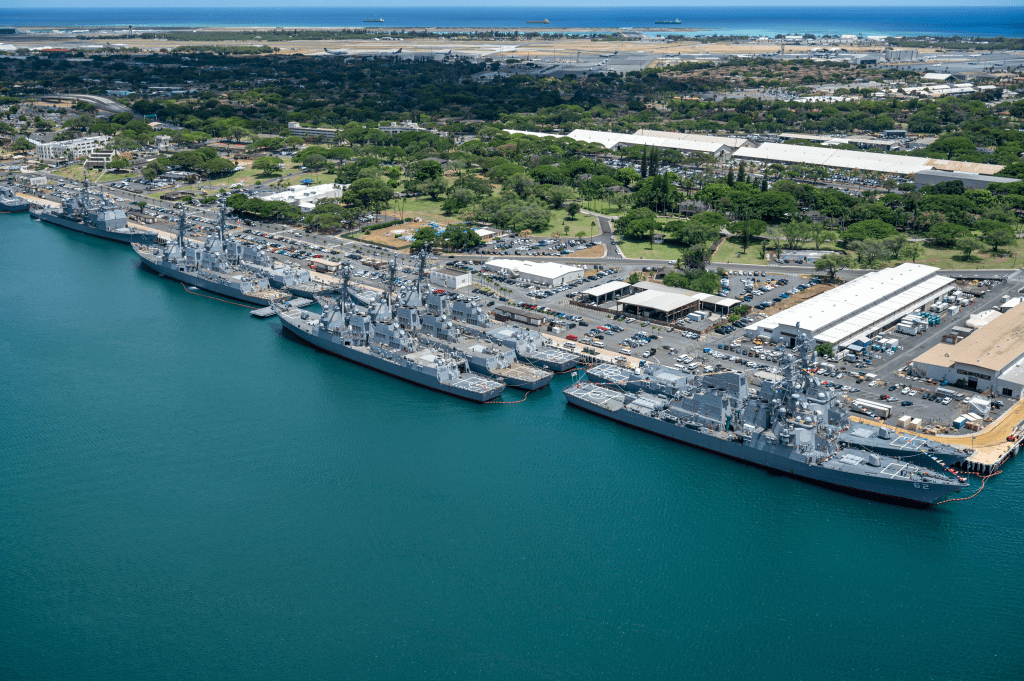

The United States military presence in Hawaiʻi is one of the most concentrated in the world. What is often celebrated as a source of jobs, infrastructure, and “defense” comes at the cost of land, sovereignty, and community well-being.
Scale of Presence
Hawaiʻi is home to more than 55,000 active duty personnel, 65,000 family members, 10,000 National Guard and reservists, and an additional 13,000 retirees and 101,000 veterans drawing over $5.5 billion annually in pensions and disability payments. Altogether, over 250,000 people connected to the military live in the islands—roughly one in six residents of Hawaiʻi when families and dependents are included.¹
The active-duty breakdown is stark: 15,346 Army, 6,453 Marines, 13,558 Navy, 5,403 Air Force, 5,325 National Guard, 4,312 Reserve, and 1,260 Coast Guard members.² Eleven formal bases and dozens of annexes, reservations, and stations make Hawaiʻi one of the most militarized landscapes in the Pacific.³
Economic Role
The military is touted as Hawaiʻi’s second-largest economic driver after tourism, generating nearly $15 billion annuallyand providing around 102,000 civilian jobs.⁴ Yet this dependency masks a structural imbalance: jobs are concentrated in low-wage service sectors surrounding bases, while federal land leases remove tens of thousands of acres from Hawaiian control, much of it sacred or environmentally fragile.⁵
Land Control
Military installations occupy over 200,000 acres of Hawaiian land, much of it seized during the overthrow of the Hawaiian Kingdom or leased under conditions highly favorable to the federal government.⁶ The leases for Pōhakuloa Training Area (PTA), 133,000 acres on Hawaiʻi Island, expire in 2029. The Army is pressuring the state to extend these leases despite lawsuits and community opposition citing cultural desecration and environmental harm.⁷
Bases like Bellows Air Force Station sit on ancient Hawaiian burial grounds, while Aliamanu Military Reservationoccupies a volcanic crater once home to sacred sites.⁸ Such uses constitute ongoing cultural erasure.
Militarization of Daily Life
Joint Base Pearl Harbor–Hickam alone houses more than 66,300 people—a population larger than many Hawaiian towns.⁹ Other facilities, such as the Pacific Missile Range Facility (Kauaʻi) and Kaʻena Point Space Force Station (Oʻahu), extend militarization into space surveillance and weapons testing. The Maui Space Surveillance Complex on Haleakalā houses the DoD’s largest optical telescope for satellite and missile tracking.¹⁰
This infrastructure makes Hawaiʻi not only a staging ground for wars abroad but also a testing site for emerging weapons, exposing local ecosystems and communities to toxic legacies. The U.S. Navy’s 2021 jet fuel leak at Red Hill—contaminating Oʻahu’s water supply—illustrates the profound risks of militarization.¹¹
Disproportionate Burden
According to state data, only 3.6% of Hawaiʻi’s population is in the armed forces, but the landscape is dominated by military infrastructure.¹² The burden falls disproportionately on Native Hawaiians, who experience displacement, cultural desecration, and heightened health risks due to live-fire training, chemical dumping, and base pollution.¹³
Far from being merely “hosts” to the U.S. military, the people of Hawaiʻi live under its weight. What is celebrated as economic contribution is simultaneously a system of occupation, dependency, and cultural loss. As leases like Pōhakuloa come up for renewal, Hawaiʻi faces a choice: continue to carry the costs of America’s wars, or reassert control over land and future.
- Kyle Kajihiro, “Resisting Militarization in Hawai‘i,” in The Bases of Empire: The Global Struggle against U.S. Military Posts, ed. Catherine Lutz (New York: NYU Press, 2009).
2. U.S. Department of Defense, “Military Personnel by State – 2022 Report.”
3. Defense Manpower Data Center, Military Personnel Statistics, 2022.
4. Hawaiʻi Chamber of Commerce, “Military Affairs Council Briefing,” 2021.
5. Ibid.
6. Noelani Goodyear-Kaʻōpua, The Seeds We Planted: Portraits of a Native Hawaiian Charter School (Minneapolis: University of Minnesota Press, 2013).
7. Koohan Paik-Mander, “Hawai‘i: America’s Military Bridge to Asia,” Asia-Pacific Journal 12, no. 48 (2014).
8. Kevin Knodell, “Army Pushes for 65-Year Extension at Pōhakuloa,” Honolulu Civil Beat, August 2022.
9. Kathy Ferguson and Phyllis Turnbull, Oh, Say, Can You See? The Semiotics of the Military in Hawai‘i(Minneapolis: University of Minnesota Press, 1999).
10. U.S. Navy, “Joint Base Pearl Harbor–Hickam Fact Sheet,” 2021.
11. Air Force Research Laboratory, “Maui Space Surveillance Complex,” 2020.
12. Christina Jedra, “Navy’s Red Hill Fuel Leak Contaminates Oahu Drinking Water,” Honolulu Civil Beat, December 2021.
13. Hawaiʻi Department of Business, Economic Development & Tourism, “Population and Economic Data,” 2016.

Leave a comment