
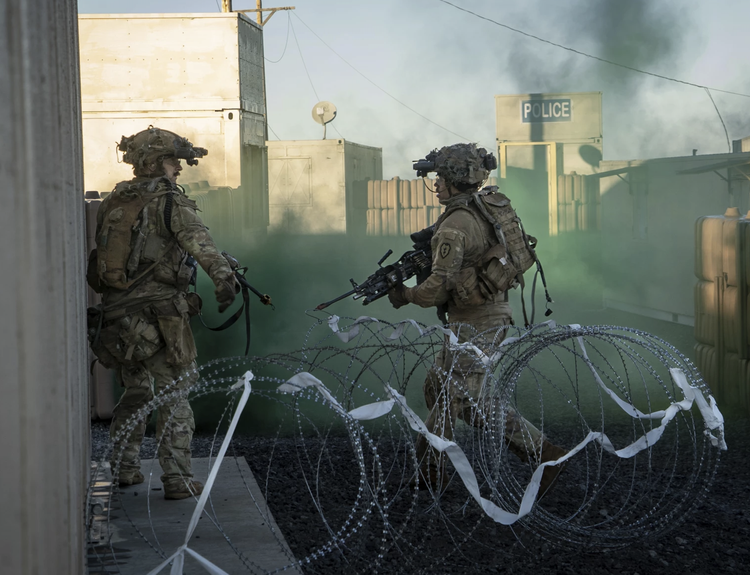
On the high-altitude plateau between Maunakea and Maunaloa lies Pōhakuloa — the so-called “crown jewel” of U.S. Army live-fire training in Hawai‘i, and the spiritual heart of the island for many Kānaka Maoli. For decades, the military has treated this sacred ʻāina as a disposable weapons lab, justifying its destruction in the name of “readiness” and “deterrence” in a geopolitical chess game against China.
But this is not just a training range. It is storied land — once crossed by our ancestors on their way to quarry stone, shelter ki‘i in lava tubes, and travel between coastal settlements. It holds endangered species found nowhere else on Earth, ancient burial sites, and irreplaceable cultural heritage.
A History Written in Scars
The U.S. military’s record in Hawai‘i is an unbroken chain of desecration. Kaho‘olawe, once a living island, was bombed into a wasteland under the guise of “national security.” Returned in 1994 after relentless protest, it remains littered with live explosives, its soil and reef poisoned. In 2021, the Navy’s Red Hill fuel tanks leaked jet fuel into O‘ahu’s drinking water, poisoning thousands and contaminating a key aquifer — a disaster preceded by years of denial and negligence.
Makua Valley, a sacred site and native forest, was burned and scarred by Army live-fire exercises until a legal settlement forced a halt in 2004. Everywhere the military has touched, the land has been left damaged, the people left to fight for cleanup that never truly comes.
Pōhakuloa is no exception. Live munitions, unexploded ordnance, and contamination are the inevitable byproducts of the Army’s “readiness.” The Army’s environmental impact statements and “good stewardship” claims collapse under the weight of its own history: the promises to protect are made in the same breath as the orders to bomb.
The Logic of Occupation
The military argues that Pōhakuloa is indispensable — the only place in Hawai‘i big enough to train battalions with live ammunition. They say that without it, troops would have to travel to the continental U.S., losing precious time in the event of war with China.
But this logic rests on a foundational injustice: that Hawai‘i’s land and people are a permanent forward operating base for U.S. imperial ambitions in Asia and the Pacific. It presumes that the primary purpose of this place is to serve as a staging ground for distant wars, rather than a homeland to be protected, restored, and lived upon by its own people.
The Expiring Lease — and the Fight Ahead
The Army’s lease for state-owned land at the heart of Pōhakuloa expires in 2029. Native Hawaiian leaders, cultural practitioners, and environmental advocates see this as a chance to end the bombing, remove the munitions, and restore the land. The State Land Board has already rejected the Army’s environmental impact statement, citing insufficient accounting of unexploded ordnance and ancient burials.
The military is now exploring ways to keep control — appealing the decision, negotiating a land swap, even hinting at purchase. Governor Josh Green floated the possibility of eminent domain, a chilling reminder that in the colonial imagination, Hawaiian land is always for the taking.
What Must Be Done
Returning Pōhakuloa to the people is not just about ending live-fire training. It is about dismantling the military logic that sees Hawai‘i as a weapons depot rather than a living nation. It means:
- Cancel the lease renewal and reject all attempts at purchase or land swaps that preserve military control.
- Full cleanup and remediation — not token gestures, but the removal of unexploded ordnance, toxins, and military waste to the highest possible standard.
- Cultural restoration led by Native Hawaiian practitioners, archaeologists, and community organizations, not military contractors.
- Binding legal protections to prevent the land from ever again being used for live-fire training.
ʻĀina Before Empire
Healani Sonoda-Pale of Ka Lāhui Hawai‘i says it plainly: “They have bombed and contaminated not just our land but our waters. When does this end?”
The answer should be now. Not in 2029. Not after another decade of damage and broken promises. Every day the military occupies Pōhakuloa is another day that sacred land is sacrificed to the machinery of war.
Hawai‘i is not America’s unsinkable aircraft carrier. It is a homeland, a living ʻāina, and its future must be decided by its people — not by generals drawing battle lines across sacred ground.
Take Action Now: Support Res 234-25
- Written Testimony Deadline: Mon, Aug 18 @ Noon counciltestimony@hawaiicounty.gov
- Request for Zoom Testimony Deadline: Mon, Aug 18th @ Noon councilremotestimony@hawaiicounty.gov
- SHOW UP FOR IN-PERSON TO TESTIFY
Tue, Aug 19, at 11 AM
Kona Civic Center, Building A - Action: Demand an end to live fire and bombing at Pōhakuloa; protect air, water, and sacred lands.
Read The Army Is Not Our Neighbor by Ethan McKown here

Leave a comment