[For a discussion of cesspools, I recommend this 2023 article from Hawaii Business Journal at https://www.hawaiibusiness.com/cesspools-damage-killing-hawaii-coral-solutions-irrigation-landscape/]
The slow death of Hawaiʻi’s coral reefs is no mystery. Cesspools leaking raw sewage into coastal waters are a major and well-documented threat, but they are only one component of a larger assault on one of the state’s most sacred, valuable, culturally vital, and life-sustaining ecosystems.
Climate change, land and ocean based pollution, overfishing, invasive species, sewage, disease, and irresponsible development have now converged to push Hawaiʻiʻs reef system to the brink. These threats are all interconnected and creating a feedback loop of decline.
To protect what remains, the state must stop treating these issues as technical nuisances and start addressing them as urgent symptoms of political and economic mismanagement.
Ocean Warming and Coral Bleaching
Climate change is the most powerful driver of reef decline in the Pacific. As greenhouse gas emissions trap more heat in the atmosphere, the ocean absorbs over 90% of the excess warmth. When water temperatures rise by just 1–2°C above the norm for a sustained period, corals experience thermal stress and expel the symbiotic algae (zooxanthellae) that feed them. This phenomenon, known as coral bleaching, can lead to widespread mortality.
Hawaiʻi has already endured multiple mass bleaching events, particularly in 2014, 2015, and again in 2019. In Kāneʻohe Bay and the west coast of Hawaiʻi Island, reefs experienced up to 90% bleaching during these episodes.¹ Reefs can recover, but repeated bleaching events in short succession leave no time for regeneration.
Ocean Acidification
Less visible but equally deadly is ocean acidification. As atmospheric CO₂ dissolves into seawater, it forms carbonic acid, reducing the water’s pH. This acidified water impairs coral calcification, making it harder for reef-building organisms to maintain their skeletons. As coral structures weaken, they become more susceptible to erosion and breakage during storms, undermining the very foundation of the reef. Ocean acidification also affects shellfish, plankton, and other foundational species in the marine food web.²
Land-Based Pollution and Sedimentation
The connection between mauka and makai—mountain to sea—is critical in Hawaiian ecological thinking. But modern land use breaks that sacred relationship. Beyond cesspools, fertilizer runoff from agriculture introduces nitrogen and phosphorus into nearshore ecosystems. This nutrient overload fuels the explosive growth of algae that competes with and suffocates coral colonies.

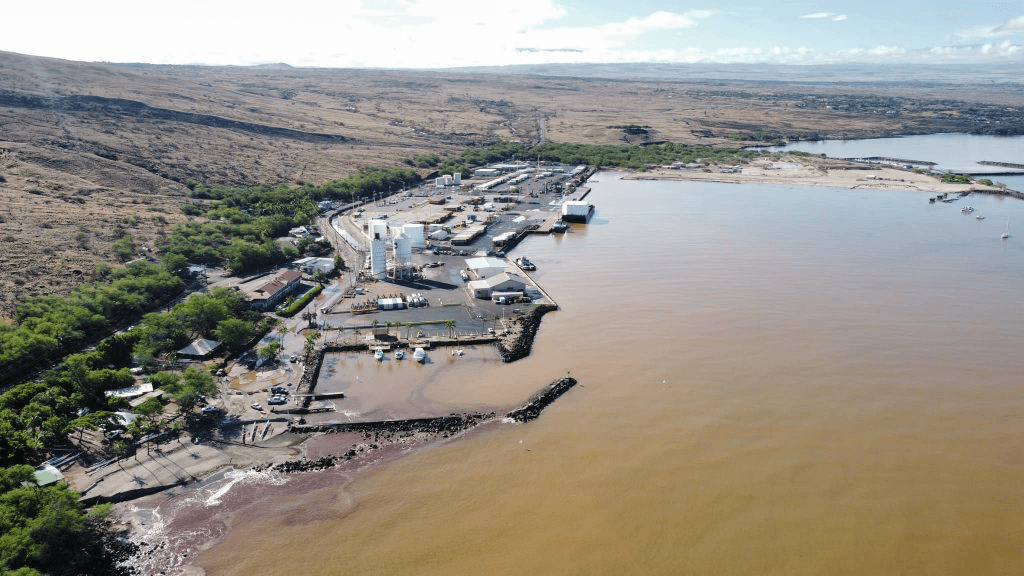
At the same time, sedimentation from poorly regulated construction, deforestation, and grazing washes into streams and coastlines. Sediment clouds the water column, blocks sunlight essential to coral photosynthesis, and physically smothers coral polyps. Studies by the University of Hawaiʻi in South Kona and East Maui have clearly documented significant coral loss correlated with heavy sediment outflows.³ We can see this happening vividly at Kawaihae after a rain.
Overfishing and Trophic Imbalance
Coral health also depends on a balanced food web. In particular, herbivorous fish—such as parrotfish and surgeonfish—play a vital role in grazing algae and allowing coral to grow. Overfishing, unrestrained spearfishing, and subsequent reef depletion have significantly reduced these populations, leading to unchecked algal growth that can quickly overtake coral habitats.
Whereas Hawaiian fishermen previously fed and managed their fisheries, these fisheries are no longer stewarded for regeneration. A landmark study comparing reef fish populations in the remote Northwestern Hawaiian Islands with those in the more developed Main Hawaiian Islands found dramatic differences in fish biomass and species diversity, confirming the impact of unlimited human extraction.⁴
Invasive Species
Invasive species—plant and animal—have altered the ecological dynamics of Hawaiian reefs. Non-native algae introduced through aquaculture and shipping and now proliferate rapidly in nutrient-rich coastal areas.⁵ Gracilaria salicornia (gorilla ogo) and Kappaphycus alvarezii have outcompeted native species and formed dense mats that suffocate coral.
The peacock grouper (roi) was introduced in the 1950s to enhance fishing. It now decimates native reef fish populations. And beecause they accumulate ciguatera toxin, roi are inedible—creating a population boom unchecked by predators or fishing.
The Threat of SCTLD
Perhaps the most alarming recent development is the global spread of Stony Coral Tissue Loss Disease (SCTLD). First identified off the coast of Florida in 2014, this virulent disease spreads quickly, infecting over 20 coral species and causing full colony mortality within weeks. SCTLD has not yet reached Hawaiʻi, but experts warn it will arrive via contaminated ballast water or vessel hulls.
SCTLD could decimate Hawaiʻi’s coral systems. In the Florida Keys it has reduced reef accretion potential by more than 70%.⁶ Prevention efforts by the Hawaiʻi Division of Aquatic Resources and NOAA include public education, monitoring, and inspection protocols for incoming vessels, but just a single outbreak could be catastrophic.⁷
Sunscreen Chemicals and Physical Damage
Finally, widespread use of conventional sunscreen contributes to coral decline. Chemicals like oxybenzone and octinoxate are toxic to coral larvae, disrupt endocrine systems, and damage DNA, impairing reproductive success and resilience. Studies have found these chemicals in high concentrations in popular swimming areas, especially in heavily touristed sites like Hanauma Bay and Waikīkī.⁸ Anchor drops, trampling by snorkelers and divers, and shoreline construction also inflict direct physical damage to fragile reefs, compounding their biological stress.
A Systemic Assault
Hawaiʻi’s coral reef crisis is not natural. It is not inevitable.
It is the consequence of decades of poor stewardship, deregulation, underfunded enforcement, and profit-driven decision-making. Cesspools are a major driver, yes—but focusing solely on them obscures the larger picture: a systemic assault on the ecological integrity of island life.
If the State–as represented by the Governor, Senators, and Representatives—continues to treat coral reefs as passive victims of distant climate forces instead of actively protecting them through bold governance—stopping runoff, regulating chemicals, preventing invasive disease, enforcing fishing limits, and accelerating wastewater reform—the coral will die.
The time for delay is over.
Footnotes
- National Oceanic and Atmospheric Administration (NOAA), 2015 Hawaiʻi Coral Bleaching Rapid Response, Coral Reef Ecosystem Division, 2016.
- Intergovernmental Panel on Climate Change, Special Report on the Ocean and Cryosphere in a Changing Climate, 2019.
- Hawaiʻi Coral Reef Initiative Research Program, Land-Based Pollution Impacts on Coral Reefs, University of Hawaiʻi, 2004.
- Alan M. Friedlander and Eric E. DeMartini, “Contrasts in Density, Size, and Biomass of Reef Fishes Between the Northwestern and Main Hawaiian Islands,” Marine Ecology Progress Series 230 (2002): 253–264.
- Sabine O. Stanley, “Ecological and Economic Impacts of Invasive Algae in Hawaiʻi,” Pacific Science 62, no. 4 (2008): 517–531.
- Lauren T. Toth et al., “Stony Coral Tissue Loss Disease Accelerated Shifts in Coral Composition and Declines in Reef-Accretion Potential in the Florida Keys,” Frontiers in Marine Science 10 (2023).
- Sarah Yamanaka, “Officials Discuss Ways to Prevent Coral Disease from Entering Hawaii Waters,” Honolulu Civil Beat, March 13, 2023.
- Craig A. Downs et al., “Toxicopathological Effects of the Sunscreen UV Filter, Oxybenzone, on Coral Planulae and Cultured Primary Cells,” Archives of Environmental Contamination and Toxicology 70, no. 2 (2016): 265–288.

Leave a comment