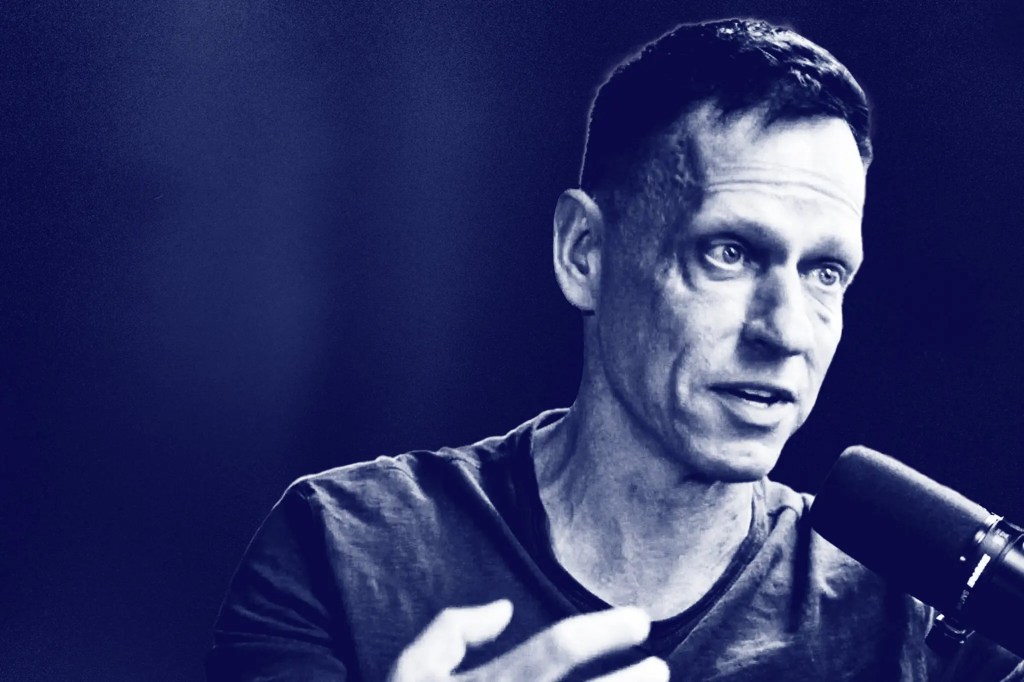
[This guy just might be insane.]
Peter Thiel argues modern society has stagnated. He looks back to the period between 1750 and 1970 – a time of accelerating technological change – and claims that since then, progress has slowed drastically. For Thiel, today’s breakthroughs are mostly confined to the digital world: AI, crypto, and software. Outside these domains, we remain stuck, unable to cure diseases like Alzheimer’s, advance energy systems, or meaningfully raise living standards for new generations.
In his conversation with Ross Douthat, Thiel frames stagnation as an existential threat. Without progress, he argues, society unravels. The middle class loses hope when their children’s prospects no longer surpass their own. Institutions ossify, becoming risk-averse and self-serving. In this view, only technological and economic dynamism can prevent decay.
He believes AI may improve productivity, like the internet did, but doubts it will singlehandedly reverse stagnation. He views radical life extension and Mars colonization as unrealized dreams, noting even Elon Musk now fears that woke governance and AI control will follow humanity off-world, undermining Mars as a true escape hatch.
Yet for all his intellectual heft, Thiel’s vision is strikingly narrow. His critique of stagnation focuses on the lack of monumental breakthroughs that benefit the powerful – AI superintelligence, anti-aging treatments, interplanetary colonies. What he never addresses is how technological and economic systems have failed in their most basic moral purpose: feeding, clothing, sheltering, and caring for people.
The stagnation that should worry us most is not the end of Apollo missions or supersonic flight. It is that billions remain in poverty, migrant refugees die in camps, and children go hungry while a handful of billionaires ponder immortality. Thiel speaks at length about curing dementia for the aging elite, but not about universal healthcare, food security, or safe housing for working people who labor to build these empires.
His framework elevates “risk-taking” and “progress” as ends in themselves, disconnected from human rights, dignity, and solidarity. Missing is any concern for exploited tourism and service sector workers, displaced populations, or those stripped of agency by war and climate change. For Thiel, mass suffering is merely background noise to civilization’s grand narrative of innovation. He worries about an authoritarian “Antichrist” suppressing technological progress, yet shows no equivalent alarm at real-world state violence against refugees or the poor.
Progress is not an abstract upward curve of invention and capital accumulation. True progress feeds the hungry, heals the sick, shelters the unhoused, and liberates workers from exploitation. Without these foundations, no society can sustain technological advancement without collapsing under its own moral rot.
Thiel’s vision is brilliant but morally myopic. Until leaders like him care as deeply about universal dignity and material security as they do about Mars colonies and AI moonshots, the stagnation he fears will persist – not because we lack powerful technologies, but because we refuse to build a world where their benefits reach every human being.

Leave a comment