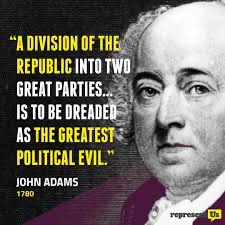
The Republican and Democratic parties no longer represent a functioning democracy. What remains is a hollowed-out shell—two aging machines whose primary functions are maintaining power, preserving elite control, and siphoning billions from donors. Both parties are not just inadequate; they are fundamentally illegitimate. They must be relegated to history’s dustbin to make space for a renewed democratic order rooted in equity, accountability, and genuine people power.
Authoritarianism and Minority Rule
The Republican Party has embraced a platform of open authoritarianism. Its leaders have undermined election integrity, encouraged political violence, and pursued policies of minority rule through voter suppression, gerrymandering, and judicial entrenchment. The party now serves as a vehicle for plutocrats, Christian nationalists, and corporations seeking deregulation, tax cuts, and control over women’s and queer people’s bodies. It has openly supported coups, glorified insurrectionists, and stacked the Supreme Court through procedural manipulation and theft (as in the blocked Merrick Garland nomination in 2016 and the rushed confirmation of Amy Coney Barrett in 2020).
This is not a legitimate political party—it is a machine for holding power by any means necessary, including through violence, disinformation, and the erosion of constitutional checks.
Complicity, Capture, and Corporate Rule
The Democratic Party, while upholding more inclusive rhetoric, has long been captured by the same financial interests. Its leadership spends more time courting Wall Street, Silicon Valley, and defense contractors than organizing with workers, protecting the environment, or defending basic rights. Democratic governance has often meant managing decline: enforcing austerity-lite, expanding fossil fuel production, militarizing police, bailing out banks, and expanding the surveillance state.
Democratic leaders rely on fear of Republican extremism to suppress meaningful dissent within their own ranks, all while resisting reforms like Medicare for All, a Green New Deal, public campaign financing, or student debt cancellation—policies with broad public support. This is not “realistic governance.” It is a performance of resistance that enables the ongoing capture of public policy by private capital.
Money Over Mandate
In both parties, elected officials spend the majority of their time not legislating, but fundraising. Members of Congress are routinely expected to spend 30 to 70 percent of their workweek calling donors. Policy positions follow the money—not public need. Whether it’s fossil fuels, Big Pharma, military contractors, or private equity, corporate interests are embedded in the policy priorities of both major parties.
No meaningful democracy can exist under a campaign finance system where billions of dollars dictate who gets on the ballot, who makes the rules, and who is allowed to speak.
Anti-Democratic Structures and Electoral Theater
The U.S. electoral system is designed to entrench the two-party duopoly. From ballot access laws to gerrymandered districts to winner-take-all voting systems, every lever of electoral procedure is tilted toward ensuring no serious third alternative can emerge. Even debate stages are gated by rules written by the Democratic and Republican parties themselves.
As a result, every election becomes an exercise in “lesser evilism,” forcing voters to choose between an increasingly fascistic Republican agenda and a corporatist Democratic status quo. This is not democracy. It is a rigged system, rebranded every four years with new slogans and fears, but fundamentally unchanged in function.
Erasure of Vision, Co-optation of Movements
Both parties have perfected the art of absorbing and neutering movements. From civil rights to climate justice to labor, grassroots energy is either ignored or pacified through token appointments, half-measures, or symbolic gestures. The structures of governance remain untouched. Ideals are commodified. Organizers are elevated to celebrity only to be silenced, defunded, or redirected once they threaten real change.
Politics in this system is no longer about collective vision. It is crisis management in service of elite preservation.
Democracy Must Be Reborn, Not Rescued
The crises of our time—climate collapse, mass inequality, the erosion of civil liberties—cannot be addressed by the same institutions that caused them. The Democratic and Republican parties, beholden to capital and power, offer no escape. Their continued legitimacy rests on a myth: that this is the best we can do.
But democracy is not a binary. It is a living process, constantly renewed or lost. It can be rebuilt—through proportional representation, ranked-choice voting, public campaign finance, labor-led coalitions, and movements rooted in solidarity, not corporate obedience.
A system that silences alternatives is not a system worth preserving. It is time to stop choosing between corporate-sponsored decline and autocratic collapse. It is time to build anew.

Leave a comment